Comparing Rotary and Static Phase Converters: Which Is Better?

When industrial or commercial facilities need to power three-phase machinery but only have access to single-phase power, phase converters become essential. Two of the most commonly used types are rotary phase converters and static phase converters. While both serve the purpose of converting single-phase to three phase power, they operate differently and come with their own sets of advantages and limitations.
In this blog, we break down the core differences, pros and cons, and application scenarios for each helping you decide which phase converter is right for your needs.
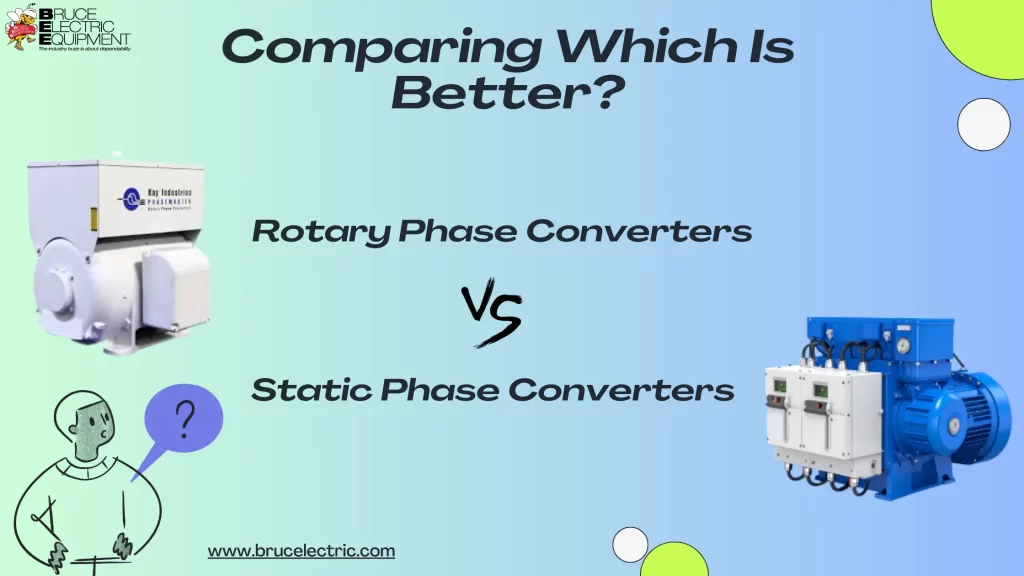
What Are Phase Converters?
Phase converters allow equipment requiring three-phase electricity to run on a single-phase power supply. They are especially useful in areas where three-phase power is unavailable or cost prohibitive to install. For a reliable solution, consider using a Rotary Phase Converter from Bruce Electric Equipment & Trey line Supply to efficiently power your equipment.
There are two primary types:
- – Rotary Phase Converters
- – Static Phase Converters
1. Rotary Phase Converters
How They Work:
Rotary phase converters use an idler motor to generate a third leg of voltage, resulting in a balanced three-phase output. The converter produces continuous three-phase power, making it suitable for running multiple machines simultaneously.
Advantages:
- – Can power multiple machines at once
- – Delivers full horsepower to motors
- – More consistent voltage across all phases
- – Long-term reliability
Best For:
- – High-horsepower applications
- – CNC machines
- – Shops running multiple machines
- – Continuous-duty equipment
Limitations:
- – Higher upfront cost
- – Slightly more complex installation
- – Requires more space due to the idler motor
2. Static Phase Converters
How They Work:
Static phase converters use capacitors to start a three-phase motor, but only provide two legs of single-phase power after startup. The third leg drops out, meaning the motor runs on two legs for continued operation.
Advantages:
- – Lower cost
- – Easy installation
- – Compact and lightweight
- – Good for light-duty, single-motor use
Best For:
- – Occasional-use machines
- – Light-duty motors
- – Simple applications like fans or pumps
Limitations:
- – Cannot power multiple machines
- – Motor runs at 60-70% of rated horsepower
- – Not suitable for CNCs or precision equipment
Side-by-Side Comparison of Rotary Phase Converter and Static Phase Converter
| Feature | Rotary Phase Converter | Static Phase Converter |
| Power Output | Continuous 3-phase | Partial (2-phase after startup) |
| Horsepower Delivery | Full | 60-70% |
| Application Scope | Multi-machine, industrial | Single-machine, light duty |
| Installation Complexity | Moderate | Easy |
| Cost | Higher | Lower |
| Long-Term Reliability | High | Moderate |
Which Is Better?
The right converter depends on your specific needs:
– Choose Rotary if you require full power, consistent performance, and need to run multiple or heavy-duty machines.
– Choose Static if you have a limited budget and plan to run one simple motor occasionally.
At Bruce Electric Equipment Corp., we offer a wide range of rotary phase converters suitable for industrial applications. Our inventory includes trusted brands like Kay Industries known for quality and durability.
(FAQ) Frequently Asked Questions for Rotary and Static Phase Converters
Q1: Can I run CNC machines with a static phase converter?
A: No, CNC machines require consistent voltage and full power, which only rotary converters can provide.
Q2: Is it possible to upgrade from a static to a rotary converter later?
A: Yes, though it requires replacing the static unit with a rotary converter setup.
Q3: Are rotary phase converters noisy?
A: They produce some operational noise, but modern models are designed for quiet performance.
Q4: How long do rotary converters last?
A: With proper maintenance, rotary converters can last for decades.
Q5: Can I install these converters myself?
A: Static converters can be DIY-installed, but rotary converters may require professional installation to ensure safety and compliance.
Need Help Choosing the Right Phase Converter?
Contact us today. Our team will help you select the best solution tailored to your industrial needs.