Aluminum vs. Copper Transformer Windings: Key Differences Explained

Choosing between aluminum and copper windings in distribution transformers is a critical decision that affects cost, efficiency, and reliability. At Bruce Electric Equipment Corp., we’ve helped thousands of industrial and commercial clients make the right transformer selection based on real-world performance needs not just price.
This article breaks down the key differences between copper and aluminum transformer windings, helping you understand when to choose each based on your project goals and budget.
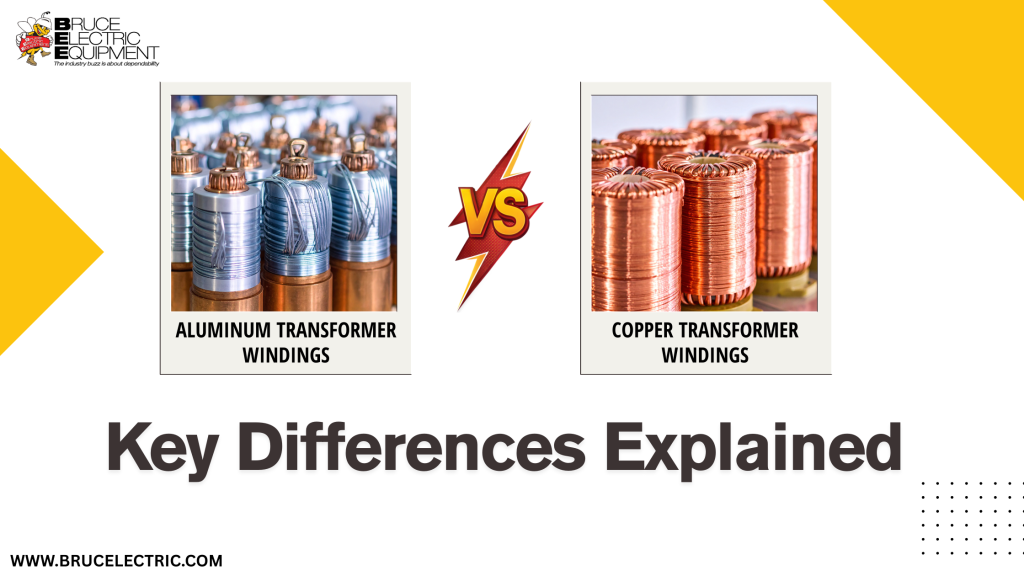
Understanding Transformer Windings
Transformer windings are coils of conductive metal typically copper or aluminum that allow voltage to be increased or decreased through electromagnetic induction. The material you choose for these windings has a major impact on how your transformer performs in the field.
Copper Windings: Pros and Cons
Advantages of Copper Windings:
• Higher Electrical Conductivity: Delivers better efficiency and lower energy loss.
• Compact Design: Requires less material to carry current, allowing for smaller transformer sizes.
• Durability: More resistant to heat, stress, and mechanical wear.
• Better Connection Reliability: Lower risk of failure at joints or terminations.
• Higher Scrap Value: Copper holds better resale value over time.
Disadvantages of Copper Windings:
• Higher Initial Cost: More expensive than aluminum per pound.
• Heavier: Increases transportation and installation effort.
Aluminum Windings: Pros and Cons
Advantages of Aluminum Windings:
• Cost-Effective: Typically, 30–50% cheaper than copper.
• Lightweight: Easier to handle and install.
• Readily Available: Common in utility and pole-mounted applications.
Disadvantages of Aluminum Windings:
• Lower Conductivity: Needs more material to carry the same load as copper.
• Larger Size: Aluminum transformers are bulkier to compensate for conductivity.
• More Prone to Oxidation: Can lead to poor connections if not properly treated.
• Thermal Expansion: More movement under heat, which can weaken connections over time.
Efficiency and Performance: Side-by-Side
| Feature | Copper Windings | Aluminum Windings |
| Conductivity | Higher | Lower |
| Size & Weight | More compact, heavier | Bulkier, lighter |
| Initial Cost | Higher | Lower |
| Connection Durability | Excellent | Needs more attention |
| Thermal Performance | Superior | Adequate |
| Scrap Value | High | Moderate |
When Should You Choose Copper?
• Heavy-duty industrial loads
• Mission-critical systems (data centers, hospitals)
• Limited space or high ambient temperatures
When Should You Choose Aluminum?
• Budget-sensitive commercial installs
• Pole-mounted or outdoor transformers
• Projects where weight matters more than compact size
Get Expert Help from Bruce Electric
Bruce Electric Equipment Corp. offers a full selection of dry-type transformers, buck boost units, and isolation transformers with both aluminum and copper windings. Our experts can help you choose the right product based on your load, space, environment, and compliance needs
Contact us for a quote or expert consultation
FAQs: Aluminum vs. Copper Transformer Windings
Q1. What are the disadvantages of aluminum transformers?
They have lower conductivity, require larger windings, and can oxidize at connection points if not installed properly.
Q2. Which is better: copper coil or aluminum coil?
Copper coils offer better efficiency, reliability, and durability, especially in high-performance or critical-load applications.
Q3. What has better conductivity, aluminum or copper?
Copper has better conductivity about 60% higher than aluminum.
Q4. What is the aluminum transformer scrap price?
Scrap prices vary, but aluminum generally has a lower resale value than copper. Check local rates for the most accurate estimate.
Q5. Why do we use copper winding in transformers?
Copper provides superior conductivity, better heat resistance, and long-term reliability, making it ideal for demanding electrical applications.
Q1. What are the disadvantages of aluminum transformers?
They have lower conductivity, require larger windings, and can oxidize at connection points if not installed properly.
Q2. Which is better: copper coil or aluminum coil?
Copper coils offer better efficiency, reliability, and durability, especially in high-performance or critical-load applications.
Q3. What has better conductivity, aluminum or copper?
Copper has better conductivity about 60% higher than aluminum.
Q4. What is the aluminum transformer scrap price?
Scrap prices vary, but aluminum generally has a lower resale value than copper. Check local rates for the most accurate estimate.
Q5. Why do we use copper winding in transformers?
Copper provides superior conductivity, better heat resistance, and long-term reliability, making it ideal for demanding electrical applications.