How Primary Voltage Affects kVA Ratings in Transformers

How Primary Voltage Affects kVA Ratings in Transformers, Transformers play a crucial role in electrical power systems by enabling the safe and efficient transfer of electrical energy across varying voltage levels. One of the fundamental specifications of any transformer is its kilovolt-ampere (kVA) rating, which indicates the maximum power it can handle. The kVA rating of a transformer is directly influenced by several factors, with primary voltage being a key determinant. Understanding how primary voltage impacts the kVA rating is essential for selecting the right transformer for residential, commercial, or industrial applications.
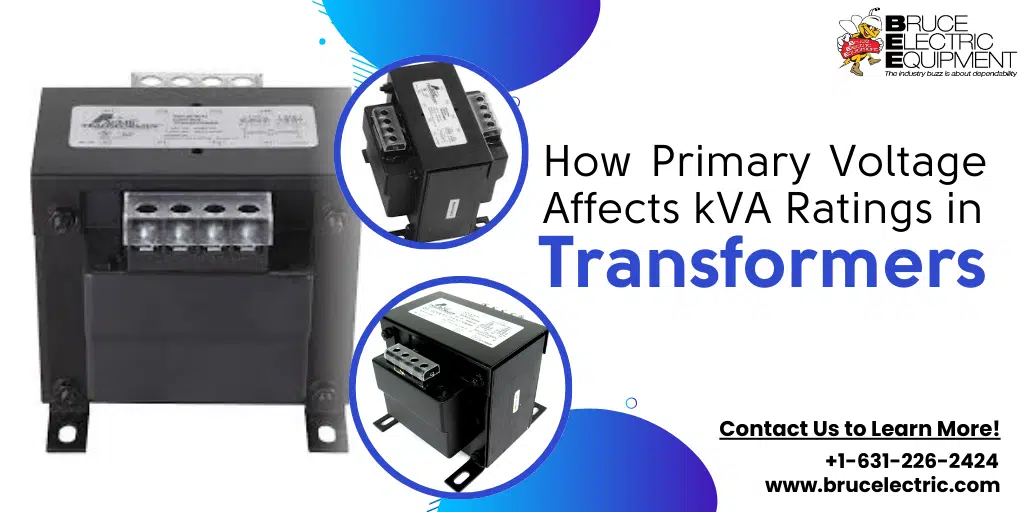
Understanding Transformer Rating and kVA
The transformer rating is typically expressed in kVA (kilovolt-amperes), representing the apparent power the transformer can deliver. Unlike kilowatts (kW), which measure real power, kVA accounts for both real and reactive power, making it a more comprehensive metric in alternating current (AC) systems.
Standard kVA ratings of transformers vary widely, from small units like a 5kVA transformer (480V to 120V) used in small-scale applications, to large industrial units such as a 500kVA transformer. The kVA rating reflects the maximum load the transformer can handle without overheating or suffering damage.
What is Primary Voltage?
Primary voltage refers to the input voltage supplied to the transformer. This voltage is received from the main power supply and is transformed into a different voltage level (secondary voltage) to meet specific load requirements. The primary and secondary voltage levels determine the transformer’s design, core material, and insulation type.
In step-down transformers, a higher primary voltage is reduced to a lower secondary voltage, such as in a 5kVA transformer 480V to 120V. In contrast, step-up transformers increase the voltage from primary to secondary levels.
Relationship Between Primary Voltage and kVA Rating
The kVA rating of a transformer is calculated using the formula:
kVA = (Volts × Amps) / 1000
This formula illustrates that the kVA rating is dependent on both the voltage and the current the transformer can handle. Therefore, the primary voltage has a direct impact on the kVA rating. Higher primary voltages typically allow for the transmission of more power with less current.
Practical Applications and Examples
To better understand the relationship between primary voltage and kVA rating, let’s examine a few real-world examples:
1. 5 kVA Transformer 480V to 120V: This is a step-down transformer used in commercial settings to convert 480V three-phase input to 120V for office or lighting applications. Its kVA rating of 5 ensures it can handle small to medium loads safely.
2. 75 kVA Transformer Cost and Application: A 75kVA transformer is commonly used in larger facilities. Its cost depends on whether it’s a dry-type or oil-filled unit, as well as brand and features. Operating at higher primary voltages, such as 480V or 600V, makes it ideal for moderate industrial loads.
3. 500 kVA Transformer Price Considerations: Large transformers like the 500kVA models are used in manufacturing plants and require robust insulation and cooling mechanisms. The higher the primary voltage, the lower the current, which enables compact yet powerful transformer designs.
Factors Influencing Transformer kVA Ratings
Apart from primary voltage, other factors that influence the kVA rating include:
– Load Type: Resistive vs. inductive loads affect how the transformer is rated and used.
– Duty Cycle: Continuous or intermittent operation alters the thermal management requirements.
– Cooling Mechanism: Air-cooled vs. oil-cooled transformers differ in how much heat they can dissipate.
– Altitude and Temperature: Environmental factors influence the transformer’s performance and safety margins.
By choosing the correct kVA rating and primary voltage, electrical engineers can optimize performance, safety, and cost.
Selecting the Right Transformer
When selecting a transformer, consider the following steps:
– Identify your primary and secondary voltage requirements.
– Calculate the load in amps and convert it to kVA using the voltage.
– Choose a standard kVA rating that exceeds your calculated value for safety.
– Consider future expansion and operational efficiency.
Consulting with transformer experts or authorized distributors is essential when choosing large capacity units such as a 500kVA transformer, both in terms of performance and cost.
Why Trust Bruce Electric for Transformer Solutions
With decades of experience, Bruce Electric Equipment Corp. is a trusted name in the distribution of new, used, and reconditioned electrical equipment. Our expertise spans a wide array of transformer types including autotransformers, dry-type, buck-boost, and industrial-grade solutions. We work with top manufacturers and ensure every unit meets industry and safety standards. You Can Also Sell Us Your Stuff.
Conclusion
The primary voltage is a foundational factor in determining the kVA rating of a transformer. From small 5kVA units to massive 500kVA transformers, the right combination of voltage and power capacity ensures safe, efficient, and reliable operation. Understanding this relationship is key to choosing the ideal transformer for your electrical infrastructure.
FAQ on Primary Voltage Affects kVA Ratings in Transformers
Q1. How to increase kVA rating of transformer?
A. You can’t increase it physically only by replacing it with a higher-rated unit or connecting in parallel, if designed for it.
Q2. What is the primary factor determining the rating of a transformer?
A. The kVA rating depends mainly on the voltage and current it can safely handle.
Q3. What does kVA depend on?
A. kVA depends on voltage × current, without considering power factor.
Q4. Why is the transformer rated in kVA but not kW?
A. Because it doesn’t account for load power factor kVA reflects the total apparent power capacity.
Q5. How many amps can a 25 kVA transformer handle?
A. At 240V, roughly 104 amps; actual amps depend on voltage and phase.
Q6. What does 1500VA/1000W mean?
A. It means 1500 volt-amps apparent power, 1000 watts real power, indicating a power factor of 0.66.