Live-Front vs Dead-Front Bushings in Dry-Type Distribution Transformers

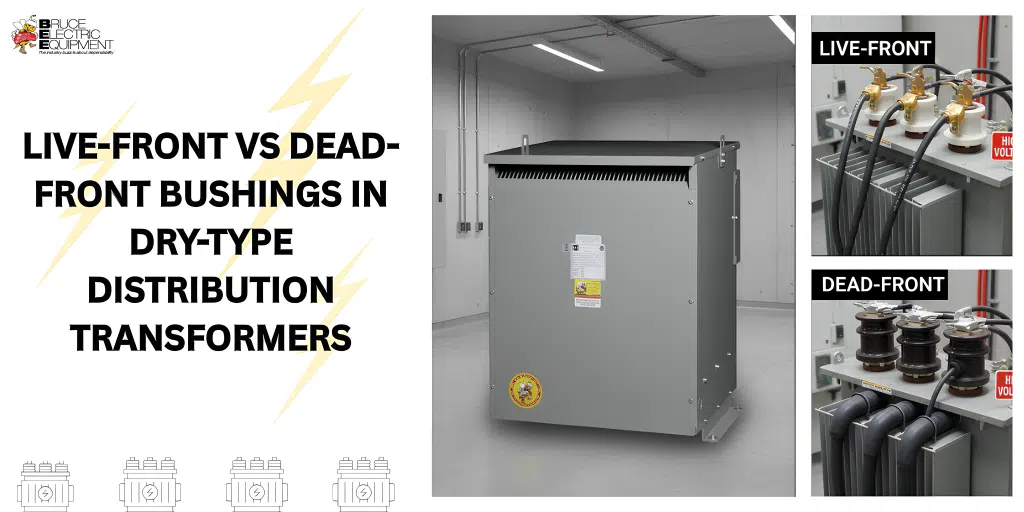
Understanding transformer bushings is critical for electrical safety and system reliability. When selecting dry type distribution transformers, one of the most important decisions involves choosing between live-front and dead-front bushing configurations. This choice impacts not only the safety of your electrical installation but also maintenance requirements, space considerations, and overall operational costs.
What Are Transformer Bushings?
A transformer bushing serves as the insulated conductor that allows electrical current to pass through the transformer’s grounded enclosure safely. These critical components provide the electrical connection point between the transformer windings and external circuits while maintaining proper insulation from the grounded tank or enclosure.
Bushes in transformer systems act as the interface between high-voltage internal components and external connections. They must withstand electrical stress, environmental conditions, and mechanical forces while maintaining reliable insulation properties throughout their service life.
Understanding Live-Front Bushings
Live front bushings feature exposed energized terminals on the outside of the transformer enclosure. In this configuration, the electrical connections are accessible and visible, which means live electrical parts are present when the transformer is energized.
Characteristics of Live Front Systems
• Exposed Terminals: The connection points remain visible and accessible from the exterior
• Compact Design: Generally requires less physical space than dead-front configurations
• Lower Initial Cost: Typically more economical for initial installation
• Simple Connection: Direct access to terminals simplifies certain connection procedures
• Safety Barriers Required: Must incorporate protective barriers, fencing, or restricted access areas
Live front transformer installations require qualified personnel for all maintenance and operational procedures. Only trained electricians with proper safety equipment should work on or near these systems when energized.
Understanding Dead-Front Bushings
Dead-front bushings incorporate insulated bushings that completely enclose the energized parts within the transformer cabinet or enclosure. All electrical connections occur inside a protective housing, eliminating exposed live parts under normal operating conditions.
Characteristics of Dead Front Systems
• Enclosed Connections: All energized parts are fully insulated and contained within the enclosure
• Enhanced Safety: Significantly reduces the risk of accidental contact with live electrical components
• Touch-Safe Design: Allows safer operation in accessible locations without extensive barriers
• Weather Protection: Better protection from environmental factors and contamination
• Code Compliance: Often required by modern electrical codes for certain installations
Detailed Comparison: Live-Front vs Dead-Front
| Feature | Live Front Bushings | Dead Front Bushings |
|---|---|---|
| Safety Level | Requires safety barriers and restricted access | Touch-safe design with enclosed connections |
| Initial Cost | Lower equipment cost | Higher equipment cost |
| Installation Space | Compact but requires clearance zones | Slightly larger footprint, minimal clearance needed |
| Maintenance Access | Requires de-energization for safe access | Safer maintenance procedures possible |
| Code Compliance | Restrictions in accessible areas | Acceptable in most locations |
| Environmental Protection | Exposed to elements | Better sealed against contaminants |
| Installation Flexibility | Limited by safety requirements | Greater installation flexibility |
Grounding Bushing and Current Transformers
Regardless of the bushing type selected, proper grounding remains essential for transformer safety. A grounding bushing provides a secure connection point for the system ground, ensuring that any fault currents have a safe path to earth ground.
Many modern transformer installations also incorporate a bushing current transformer (BCT) for monitoring and protection purposes. These devices clamp around the bushing conductor and measure current flow without interrupting the circuit. Bushing current transformers enable sophisticated protective relaying and metering functions essential for modern electrical distribution systems.
When to Choose Live Front Bushings
Live front configurations may be appropriate in the following scenarios:
• Industrial settings with controlled access and trained personnel only
• Existing installations being replaced with similar configurations
• Budget-constrained projects where safety can be maintained through proper barriers
• Outdoor pad-mounted installations with secure fencing
• Temporary power distribution where mobility is prioritized
When to Choose Dead Front Bushings
Dead front configurations are increasingly preferred for:
• Commercial buildings with public or semi-public access
• Indoor installations in occupied spaces
• Facilities requiring enhanced safety standards
• New construction projects meeting current NEC requirements
• Locations where space for safety barriers is limited
• Environments with harsh weather or contamination concerns
Industry Trends and Modern Standards
The electrical industry has shown a clear trend toward dead-front technology in recent decades. The National Electrical Code (NEC) and various state and local codes increasingly mandate dead-front configurations for new installations in accessible locations. This shift reflects the industry’s commitment to enhanced electrical safety and reduced accident risk.
Insurance companies often look favourably upon dead-front installations, potentially offering better rates due to reduced risk exposure. Additionally, OSHA regulations regarding qualified personnel and working spaces around electrical equipment make dead-front systems more practical from a compliance standpoint.
Practical Considerations for Your Selection
When deciding between live front and dead front bushings for your dry type distribution transformer, consider these practical factors:
Budget Analysis
While live-front equipment typically costs less initially, calculate the total cost of ownership including safety barriers, training requirements, insurance premiums, and potential liability exposure. Dead-front systems often prove more economical over their full service life despite higher upfront costs.
Personnel Training
Evaluate your organization’s ability to maintain properly trained personnel for live-front equipment. Dead-front systems reduce training requirements and allow broader access for maintenance personnel.
Future Expansion
Consider how your electrical system may grow. Dead-front systems offer greater flexibility for modifications and additions without complex safety accommodations.
Regulatory Environment
Review local electrical codes, insurance requirements, and industry standards applicable to your location and facility type. Some jurisdictions effectively mandate dead-front construction for new installations.
FAQs
Q1. What are the signs of a bad transformer bushing?
A. Oil leaks, cracks, overheating, partial discharge noise, abnormal IR readings, swelling, or carbon tracking.
Q2. What are the different types of transformer bushings?
A. Air-to-air, air-to-oil, oil-to-oil, RIP/RIS solid bushings, condenser (capacitive-graded), and live-front/dead-front bushings.
Q3. Why do transformer bushings fail?
A. Insulation aging, moisture, thermal stress, contamination, overvoltage, installation errors, vibration, or poor maintenance causing partial discharge.
4. What is C1 and C2 in transformer bushing?
A. C1 tests insulation between the conductor and capacitive layers; C2 tests between capacitive layers and grounded flange. High values mean insulation deterioration.
5. What is the life expectancy of a transformer bushing?
A. Typically, 25 – 40 years with proper maintenance; RIP/RIS bushings usually last longer than older oil-impregnated types.
Conclusion
Selecting between live-front and dead-front bushings requires balancing safety, code compliance, and installation conditions. For most commercial and industrial projects, dead-front bushings deliver safer operation and greater flexibility, while live-front options may still be suitable in controlled facilities with trained personnel. To ensure the right solution, Bruce Electric can help evaluate your requirements and recommend the most reliable, compliant bushing configuration for your transformer installation.