Transformer Sound – A Guide to Transformer Humming, Safety and IEEE Standards

If you’ve ever walked past an electrical room or stood near a transformer, you’ve probably heard it that distinctive low frequency humming or buzzing sound. For facility managers, electrical engineers, and building operators, understanding why transformers hum is essential for distinguishing between normal operation and potential problems that require immediate attention.
Dry type transformers are essential to industrial, commercial, and utility power systems due to their durability, safety, and low maintenance requirements. Yet, one characteristic often captures the attention of facility managers and engineers: the distinct humming or buzzing noise these transformers produce. This guide explains why dry-type transformers hum, what the sound means, how to interpret it safely, and what the IEEE Standards for Transformers say about acceptable noise levels.
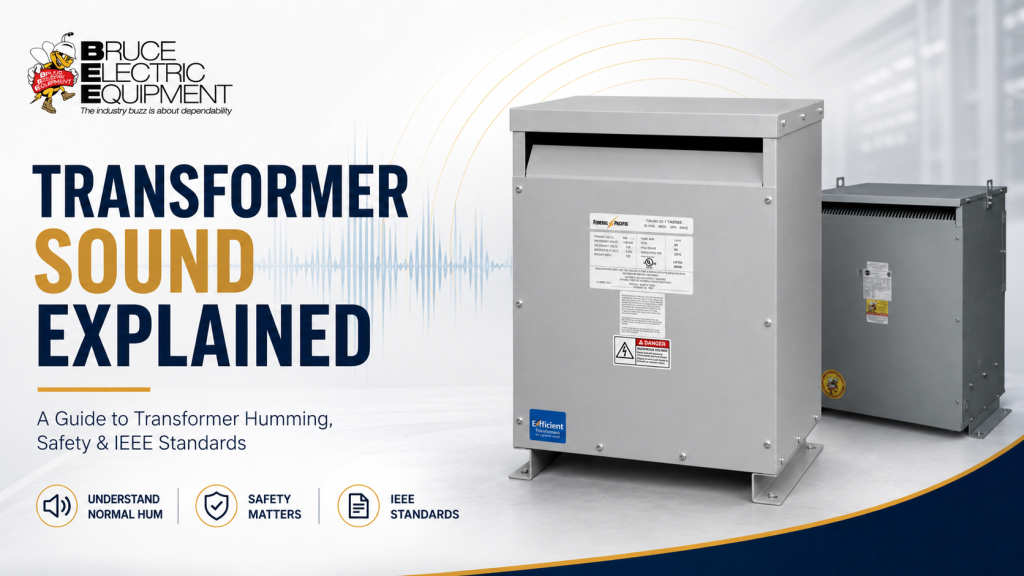
What Causes Transformer Humming?
Transformer buzzing and humming are primarily caused by a physical phenomenon called Magnetostriction. This is the process by which ferromagnetic materials specifically the laminated steel core of a transformer physically expand and contract when exposed to alternating magnetic fields.
What is Magnetostriction?
The core of a transformer is made of laminated steel sheets. When alternating current flows through the windings, the steel core expands and contracts slightly at twice the frequency of the power source. This physical change is called Magnetostriction.
How Magnetostriction Creates Transformer Noise
Inside every dry type transformer, the core consists of stacked laminations made from grain-oriented electrical steel. When alternating current flows through the transformer windings, it generates a magnetic field that passes through these steel laminations. This magnetic field causes the steel to expand and contract microscopically.
In a 60 Hz electrical system, the magnetic field reverses direction twice during each cycle, meaning the core expands and contracts 120 times per second. This creates vibrations at 120 Hz—the fundamental frequency of transformer humming. While these dimensional changes are too small to see with the naked eye, they’re significant enough to produce audible sound waves.
IEEE C57.12.91 Tested
Need a Low-Noise Dry-Type Transformer? We Stock IEEE-Compliant Units.
Sound levels from 40 dB to 65 dB, depending on kVA rating. NEMA ST-20 compliant ventilated and non-ventilated models for offices, hospitals, and occupied facilities.
✔ Nameplate sound levels verified per IEEE C57.12.91 ✔ NEMA TP-1 energy efficiency compliant ✔ 2-year warranty on reconditioned transformers
Additional Contributors to Transformer Buzzing
While magnetostriction is the dominant source of transformer sound, several other factors contribute to or amplify the noise:
• Core Lamination Movement: If laminations aren’t tightly clamped or if joints loosen over time, individual sheets can vibrate independently, producing sharper or louder sounds.
• Winding Vibration: Electromagnetic forces acting on current-carrying coils cause microscopic movement, especially under high load conditions.
• Cooling System Noise: In ventilated dry-type transformers, fans and airflow add higher-frequency sound components.
• Structural Resonance: Mounting structures, enclosures, and nearby surfaces can amplify vibrations, particularly if they resonate at similar frequencies.
IEEE Standards for Dry-Type Transformers
The electrical industry has established rigorous standards to ensure transformers operate safely and within acceptable noise levels. Understanding these IEEE Standards for Transformers helps facility managers make informed decisions about equipment selection and installation.
Key IEEE Standards Governing Transformer Performance
IEEE C57.12.01:
This is the primary standard for general requirements of dry-type distribution and power transformers. It covers electrical, mechanical, and safety requirements for ventilated, non-ventilated, and sealed dry-type transformers with voltages of 601V or higher.
Covers:
• Construction
• Insulation systems
• Sound levels
• Thermal performance
• Testing requirements
IEEE C57.12.91:
This standard describes test methods for dry-type transformers, including procedures for measuring sound levels. It provides the foundation for verifying that transformers meet their specified performance criteria.
Covers:
• Sound measurement procedures
• Decibel testing environment
• Safety & operational tests
IEEE C57.12.00:
These standards define the maximum permissible sound levels based on kVA rating and transformer type.
| kVA Rating | Typical Max Sound Level (dB) |
|---|---|
| 0–50 kVA | 40–45 dB |
| 51–300 kVA | 45–50 dB |
| 301–500 kVA | 50–55 dB |
| 501–1000 kVA | 55–60 dB |
NEMA and IEEE Noise Level Standards
Both NEMA (National Electrical Manufacturers Association) and IEEE have established maximum permissible noise levels for transformers. These standards specify sound pressure levels in decibels (dB) measured at one meter from the transformer surface.
| Transformer kVA Rating | Maximum Sound Level (dB) | Comparable Environment |
|---|---|---|
| 0–9 kVA | 40 dB | Quiet library |
| 10–50 kVA | 45 dB | Quiet office |
| 51–150 kVA | 50 dB | Typical office background |
| 151–300 kVA | 55 dB | Normal conversation |
| 301–500 kVA | 60 dB | Business office |
| 501–700 kVA | 62 dB | Air conditioner |
| 701–1000 kVA | 64 dB | Restaurant conversation |
These standards ensure that transformer noise remains at manageable levels for typical installation environments. A dry-type distribution transformer in the 500-1000 kVA range typically operates between 55 and 65 dB, comparable to normal office background noise.
When Transformer Humming Is Normal
A healthy transformer produces a low, steady, consistent hum that doesn’t vary significantly during operation. This sound should be relatively uniform and predictable, without sudden changes in pitch, volume, or character.
It’s important for facility managers to understand that some level of transformer humming is completely normal and expected. The sound results from fundamental physics that cannot be eliminated entirely. Here’s what indicates normal operation –
Normal Transformer Sound Characteristics:
• Consistent Tone: The hum maintains a steady pitch and volume during normal loading conditions
• Low Frequency: The sound primarily occurs at 120 Hz (for 60 Hz systems) and its harmonics
• Within Standards: Sound levels fall within the IEEE and NEMA specified limits for the transformer’s kVA rating
• Predictable Changes: The hum may increase slightly during periods of heavy load, which is expected behavior
Causes of Abnormal Transformer Sound
Transformer Overload: When a transformer carries more current than its design rating, the core and windings can overheat. This thermal stress alters the unit’s vibration patterns, disrupting the normal consistent hum. The increased electromagnetic forces during overload conditions also intensify winding vibrations, creating louder and potentially irregular sounds.
Loose Components: Over time, bolts, mounting hardware, and internal connections can loosen due to continuous vibration and thermal cycling. Loose core laminations are particularly problematic when individual steel sheets aren’t tightly clamped together, they vibrate independently, creating rattling noises and potentially accelerating wear.
Mechanical Deterioration: Regular wear and tear gradually affects transformer integrity. Aging insulation may become brittle, structural supports can weaken, and component connections may degrade. These changes progressively alter the transformer’s acoustic signature, making the hum louder or less consistent.
Cooling System Issues: In ventilated transformers, fan motor problems, bearing wear, or blocked airflow can create abnormal noise patterns. These cooling-related sounds are typically higher in frequency than magnetostriction hum and may be intermittent.
Ships in 24–48 Hours
Hearing Abnormal Buzzing or Rattling? Replace Your Transformer Before It Fails.
Unusual humming often signals loose core laminations, winding vibration, or chronic overload. Don’t wait for catastrophic insulation breakdown.
✔ Emergency replacement units available nationwide ✔ New, used & reconditioned options for fast retrofit ✔ Every unit tested for winding integrity before shipment
Strategies for Managing Transformer Noise
Even when transformers operate within IEEE standards, the noise can still be problematic in certain environments. Bruce Electric recommends these proven strategies for managing transformer sound:
1. Strategic Installation Location
Proper placement significantly impacts perceived noise levels. Install transformers in dedicated electrical rooms with thick, insulated walls whenever possible. Avoid corners, stairwells, and corridors where sound waves reflect and amplify. Maintain at least 10 feet of clearance from other equipment and structural elements that could resonate.
2. Foundation and Mounting Considerations
Install transformers on reinforced concrete pads that are at least 10 times heavier than the transformer itself. This massive, stable foundation prevents vibration transmission to surrounding structures. Anti-vibration pads or isolation mounts create an air gap between the transformer and ground, absorbing vibrations before they propagate through the building structure.
3. Regular Transformer Maintenance
Implementing a comprehensive transformer maintenance program is essential for managing noise and ensuring long-term reliability. Your maintenance schedule should include:
• Quarterly Inspections: Check all mounting bolts, connections, and hardware for tightness. Loose components are a leading cause of increased noise.
• Annual Acoustic Testing: Document sound levels and compare them to baseline measurements and IEEE standards. Gradual increases may indicate developing problems.
• Thermal Imaging: Regular thermographic inspections identify hot spots that could indicate overload conditions or deteriorating insulation.
• Load Monitoring: Track actual loading versus rated capacity to ensure the transformer isn’t experiencing chronic overload conditions.
• Cleaning and Ventilation: Keep cooling passages clear and fans operating properly to prevent thermal stress.
4. Acoustic Treatment Options
When noise reduction is critical, consider acoustic enclosures or barriers. These solutions use sound-absorbing materials to contain transformer noise while maintaining adequate ventilation for cooling. Professional acoustic engineering can achieve significant noise reductions without compromising transformer performance.
The Relationship between Load and Transformer Sound
Understanding how loading affects transformer noise helps operators distinguish normal variations from problem indicators. The relationship between load and sound is predictable in healthy transformers.
Under light load conditions, transformers produce minimal noise primarily from core magnetostriction with relatively weak winding vibrations. As load increases, electromagnetic forces on the windings intensify, adding to the overall sound level. This load-dependent noise increase is normal and expected.
While some increase in transformer humming with load is normal, sudden or dramatic changes in sound character warrant investigation. A transformer that becomes noticeably louder may be approaching or exceeding its rated capacity, potentially leading to premature aging or failure.
Safety Considerations and IEEE Compliance
Compliance with IEEE Standards isn’t just about noise management it’s fundamental to electrical safety. These standards address critical safety factors including:
• Temperature Limits: IEEE C57.12.01 specifies maximum temperature rises to prevent insulation degradation and fire hazards
• Dielectric Strength: Standards ensure adequate insulation to prevent electrical breakdown and shock hazards
• Mechanical Integrity: Requirements for structural strength prevent physical failures that could result in injuries or equipment damage
• Accessibility and Clearances: Standards mandate proper spacing for safe operation and maintenance
Bruce Electric emphasizes that transformers meeting IEEE standards provide inherent safety margins. However, proper installation, maintenance, and monitoring remain essential for long-term safe operation.
Modern Approaches to Reducing Transformer Noise
Advances in materials science and engineering have enabled significant improvements in transformer acoustic performance. Modern low-noise transformers incorporate several innovations:
1. Advanced Core Materials: High-grade grain-oriented electrical steel with superior magnetostrictive properties produces less vibration for a given flux density. Some premium materials can reduce core noise by 3-5 dB compared to standard grades.
2. Optimised Core Design: Step-lap core construction techniques minimise air gaps between laminations, reducing magnetic flux leakage and vibration. Improved clamping systems maintain consistent pressure on core laminations throughout the transformer’s operational life.
3. Winding Design Enhancements: Strategic winding arrangements minimise electromagnetic forces and vibration. Proper bracing and support structures reduce winding movement under load.
4. Acoustic Optimisation: Advanced simulation software allows engineers to model and predict transformer acoustic behaviour during the design phase, enabling optimisation before manufacturing.
Key Takeaways
• Transformer humming from magnetostriction is normal and unavoidable
• IEEE Standards establish clear acoustic and safety requirements
• Normal transformer sound is low, steady, and consistent
• Rattling, excessive buzzing, or sudden changes indicate problems requiring investigation
• Strategic installation and regular maintenance effectively manage transformer noise
• Transformer overload and loose components are common causes of abnormal sound
• Modern materials and design techniques can significantly reduce transformer noise levels
Conclusion
Dry-type transformers hum due to magnetostriction, a natural part of transformer physics.
However, understanding the difference between normal humming and abnormal buzzing is essential for safety and system reliability. By following IEEE Standards for Transformers, performing regular transformer maintenance, and monitoring for transformer overload, facility managers can ensure safe and efficient operation. Bruce Electric supports this process by supplying thoroughly tested, high-quality new, used, and refurbished transformers that meet required IEEE standards.
FAQs
1. How to reduce humming noise?
A. Reduce humming by tightening core clamps, ensuring proper coil insulation, eliminating loose parts, and improving mounting or vibration damping. Regular maintenance also helps minimize noise.
2. How to reduce magnetostriction in transformer?
A. Use high-grade silicon steel, improve core lamination, and maintain proper clamping pressure. These steps reduce core deformation and lower noise.
3. What is the frequency of the hum in a transformer?
A. The typical hum is 100 Hz in 50 Hz systems and 120 Hz in 60 Hz systems, caused by magnetostriction of the core.
4. What are common hum troubleshooting steps?
A. Check for loose bolts, core clamps, or panels; inspect for overload; verify proper grounding; and ensure no external vibrations are transferred through mounting.
5. What is the 80% rule for transformers?
A. The 80% rule suggests loading a transformer to no more than 80% of its rated capacity to reduce heat, improve efficiency, and extend lifespan.