Electrical Power Solutions for Book Binding & Bindery Equipment
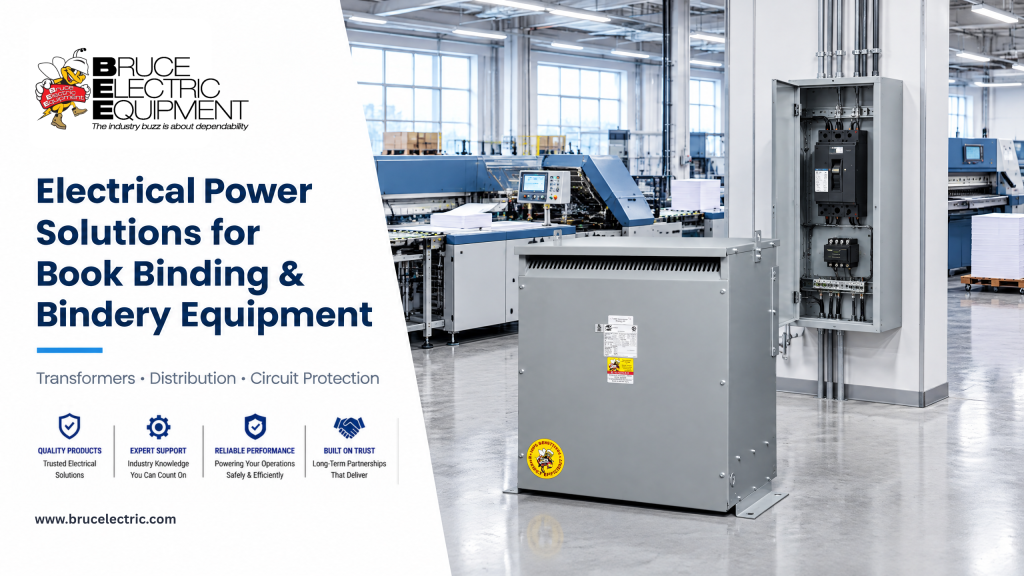
Book bindery operations place varied electrical demands on the facility’s power infrastructure. Production equipment such as cutting, folding, gathering, stitching, binding, and finishing machinery can incorporate motors, drives, control circuits, heating elements, and electronic components with different voltage, phase, and load requirements. As production lines become increasingly automated and equipment loads grow, properly specified transformers, power distribution equipment, and circuit protection are important for maintaining stable electrical service and reliable machine operation.
Bruce Electric Equipment Corp. provides dry type transformers, control transformers, and electrical distribution equipment for industrial, commercial, and institutional facilities. We offer new, surplus, Used and professionally reconditioned equipment from leading manufacturers to meet varied electrical requirements. Whether a project requires a transformer for a book binding machine, or other distribution equipment, we help customers source the equipment specified for their bindery operations.
Electrical Power Challenges in Book Binding & Bindery Operations
Bookbinding and bindery machinery can present varying electrical demands depending on machine configuration, motor loads, controls, and production requirements. Properly evaluating these characteristics is important when establishing the facility’s power distribution infrastructure.
• Voltage and Phase Requirements: Bindery equipment is manufactured for specific voltage (380V, 400V, 480V or other voltage configurations) and phase configurations. The facility’s electrical supply must correspond with the machine’s nameplate requirements, including primary voltage, frequency, and single- or three-phase operation.
• Motor Starting and Inrush Current: Motor-driven equipment can draw substantially higher current during startup than during normal operation. Transformer capacity and circuit protection should account for these starting characteristics to support reliable equipment operation without unnecessary interruptions.
• Power Quality: Drives, electronic controls, and other nonlinear loads can introduce or be affected by voltage fluctuations, harmonics, transients, and electrical noise. Appropriate power infrastructure can help maintain the electrical conditions required by sensitive equipment.
• Multiple Equipment Loads: Bindery facilities may operate several machines simultaneously, creating significant aggregate electrical demand. Distribution equipment must be appropriately rated for the connected and anticipated operating loads while accounting for load diversity and facility capacity.
• Imported machinery: European and other international equipment may have electrical specifications that differ from the facility’s available supply.
Electrical Distribution and Transformers for book binding machine & Bindery Operations
Electrical equipment and Transformers for book binding machine and bindery operations must be selected according to the required voltage, phase, load characteristics, control requirements, and power-quality considerations. We supply transformers and electrical distribution equipment that can be specified as part of these power systems.
• Dry Type Transformers: These transformers provide voltage transformation for electrical distribution systems, stepping voltage up or down to meet connected equipment requirements. Bruce Electric offers dry-type transformers in a wide range of voltage, phase, kVA, and configuration options, including specialty and international voltage configurations for book binding and bindery operations. Our transformer inventory can support various equipment voltage requirements, including 380V, 400V, and 480V, as well as lower control voltages such as 20V, depending on the machinery manufacturer’s specifications and system design.
• Control Transformers: These transformers provide the required voltage for dedicated control circuits while maintaining electrical separation from the primary power circuit where specified.
• Drive Isolation Transformers: These transformers provide electrical isolation for circuits supplying drive equipment and can address specific electrical noise and power-quality considerations associated with drive systems.
• K-Factor & Harmonic-Mitigating Transformers: Designed for electrical systems with nonlinear loads that generate harmonic currents, our K-factor-rated and harmonic-mitigating designs can be considered where harmonic content is a factor in transformer selection.
• Panelboards, Circuit Breakers & Disconnects: Panelboards distribute electrical power to branch circuits, while circuit breakers provide overcurrent protection and disconnects provide a means of isolating electrical equipment. Together, these components support reliable power distribution in book binding facilities.
• UPS & Power Conditioning Equipment: UPS systems provide temporary backup power for selected electrical and electronic loads during utility interruptions. Power conditioning equipment can address specified voltage fluctuations, transients, and other power-quality disturbances where required.
• Rotary Phase Converters: Rotary phase converters can generate three-phase power from a single-phase electrical supply where compatible equipment requires three-phase operation. Selection depends on the equipment’s voltage, phase, motor characteristics, and electrical specifications.
Applications Across Book Binding & Bindery Operations
Different bindery machines create different electrical requirements. The focus should be on the machine’s actual electrical characteristics, rather than assigning one solution to an entire equipment category.
| Equipment | Primary Electrical Consideration | Potential Equipment |
|---|---|---|
| Perfect Binding | Motors, controls, voltage and load | Dry-type/control transformer, distribution equipment |
| Saddle Stitching | Multiple motors and control circuits | Transformer, panelboard, circuit protection |
| Paper Cutting / Guillotine | Motor starting and control requirements | Transformer, control transformer, circuit protection |
| Folding Machines | Motors, drives and electronic controls | Transformer, distribution and power-quality equipment |
| Automated Bindery Lines | Combined motor, drive and control loads | Transformer, distribution, UPS/power-quality equipment where required |
Powering Imported Book Binding Machinery
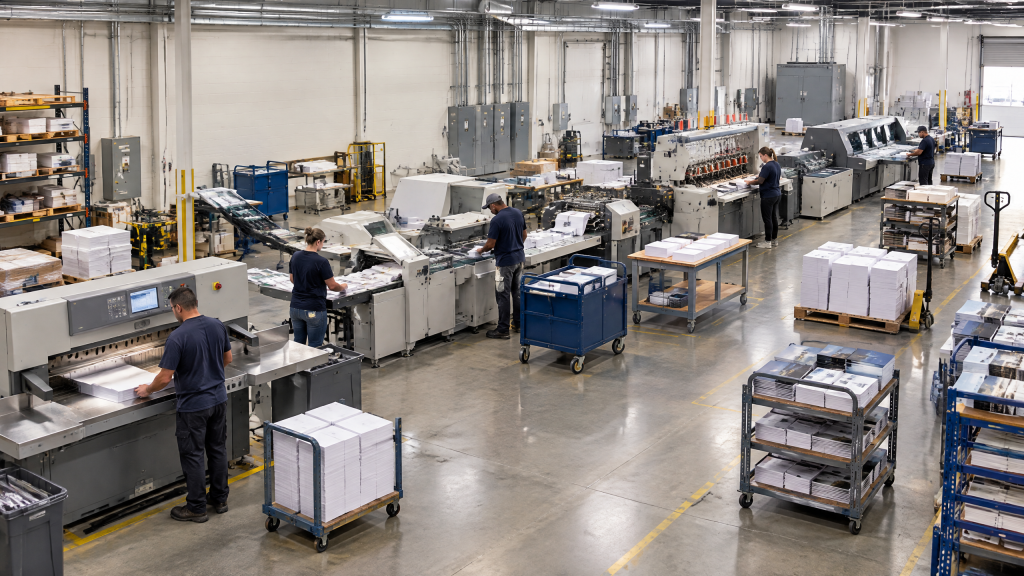
Imported bindery machinery can create a voltage or frequency mismatch when its electrical specifications differ from the facility supply. Equipment may be specified for 380V or 400V, while a U.S. facility may have 480V, 208V/240V, or another available distribution voltage.
Before selecting a transformer or other power equipment, verify:
• Machine input voltage
• Facility supply voltage
• Primary and secondary voltage
• Single- or three-phase configuration
• 50 Hz or 60 Hz frequency
• kVA or input current
• Motor starting/inrush requirements
• Control voltage requirements
• Manufacturer-approved electrical configuration
For example, 400V, 50 Hz machinery connected to a 480V, 60 Hz facility supply cannot be evaluated on voltage alone. A transformer can address a voltage mismatch, but it does not convert frequency. Bruce Electric’s current transformer inventory includes specialty and international configurations, including examples involving 380V, 400V and 480V systems.
How to Select Electrical Equipment for Bindery Machinery
Start with the machine’s nameplate and manufacturer documentation, then evaluate:
• Voltage & phase: Match the machine requirements with available facility power.
• Frequency: Verify 50 Hz/60 Hz compatibility.
• kVA/current: Account for connected and anticipated loads.
• Motor starting: Consider inrush and startup characteristics.
• Power quality: Evaluate harmonics, transients, and voltage variation where relevant.
• Distribution capacity: Confirm transformer, panelboard, breaker, and disconnect requirements.
• Future expansion: Consider additional machines and available facility capacity.
• Installation: Check enclosure, dimensions, environment, and available space.
For imported machinery or replacement equipment, the nameplate photo is often the most useful starting point for an RFQ.
Why Choose Bruce Electric for Bindery Power Equipment Power Distribution
With decades of experience supplying electrical distribution equipment, we provide access to transformer and power equipment for industrial applications where equipment availability and specification are important considerations. Our inventory and sourcing capabilities allow contractors, facility engineers, and procurement teams to obtain equipment for replacement, expansion, and new installation requirements.
• Extensive Inventory: We maintain one of the largest inventories of dry type transformers, including standard and non-standard configurations, to help reduce equipment lead times.
• Manufacturer Selection: We offer equipment from leading manufacturers, including Rex Power Magnetics, Federal Pacific, HPS, G.E., Acme, Sola HD, ABB, and others.
• BEE Warranty: Our reconditioned transformers and circuit breakers are inspected and tested and backed by the applicable BEE warranty.
• Rapid Equipment Availability: Most orders ship within 24–48 hours, with expedited shipping options available for time-sensitive requirements.
Frequently Asked Questions
Q1. What type of transformer is used for a book binding machine?
There is no single transformer type for all book binding machines. Dry-type distribution transformers or control transformers may be appropriate depending on the machine’s voltage, phase, kVA, and control requirements.
Q2. How do I determine the right transformer size for bookbinding equipment?
Transformer sizing depends on voltage, phase, connected load, motor characteristics, starting current, and operating conditions. The machine manufacturer’s specifications should be used to establish the required kVA.
Q3. Do bookbinding machines require single-phase or three-phase power?
It depends on the machine. Bindery equipment may use single- or three-phase power depending on its motors, drives, controls, and manufacturer specifications.
Q4. How do I power 400V bookbinding equipment in the U.S.?
First compare the machine’s 400V requirement with the facility’s available supply. A properly specified transformer may address a voltage mismatch, but frequency compatibility must also be verified because a transformer does not convert 50 Hz to 60 Hz.
Q5. When is a control transformer used in bindery equipment?
A control transformer is used when machine control circuits require a different voltage from the primary equipment supply. Its rating should be selected according to the control circuit’s voltage and VA/kVA requirements.