Electrical Distribution Solutions for Hospital Equipment
Healthcare facilities depend on reliable electrical infrastructure to support critical patient care, diagnostic accuracy, and continuous operations. From operating rooms and intensive care units to imaging suites, laboratories, and patient care areas, every department requires a stable medical power supply to ensure the safe and uninterrupted operation of essential equipment. As healthcare facilities continue to adopt advanced technologies and expand their electrical loads, the demand for dependable transformers, UPS systems, and power distribution equipment becomes increasingly important for maintaining system reliability and operational continuity.
Bruce Electric has supplied dry-type transformers, isolation transformers, UPS systems, and power distribution equipment to industrial, commercial, and institutional facilities since 1973. Hospitals, clinics, and healthcare campuses rely on us for fast access to new, surplus, used, and professionally reconditioned electrical equipment from leading manufacturers. Whether the requirement is a replacement transformer, an uninterruptible power supply for medical equipment, or other critical components for hospital electrical systems, we help healthcare facilities source the equipment they need quickly and reliably.
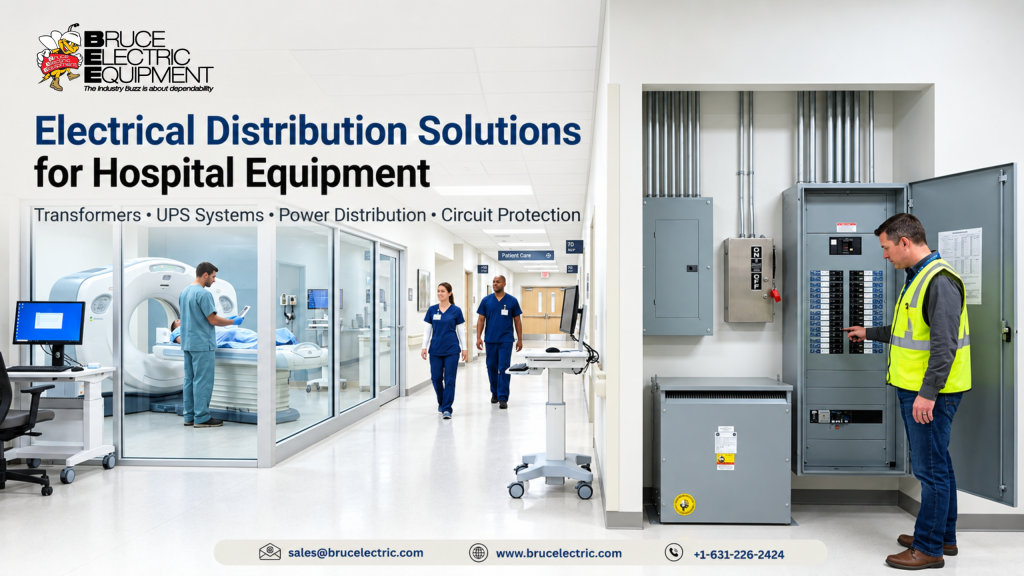
Healthcare Power Challenges
Healthcare facilities operate electrical systems that support patient care, diagnostic services, building operations, and critical infrastructure. Maintaining system reliability requires addressing several challenges associated with power quality, equipment availability, and operational continuity.
• Continuous Operation of Critical Equipment: Ventilators, patient monitoring systems, infusion devices, imaging equipment, and laboratory instrumentation depend on a stable medical equipment power supply for accurate and uninterrupted operation. Power disturbances can affect equipment functionality, disrupt clinical processes, and reduce system availability.
• Power Quality Requirements: Sensitive medical equipment is susceptible to voltage fluctuations, harmonic distortion, electrical noise, transient surges, and utility interruptions. Maintaining acceptable power quality is necessary to support equipment performance, reduce operational risk, and extend equipment service life.
• Backup Power and Distribution Reliability: Healthcare facilities require electrical infrastructure capable of supporting critical loads during utility disturbances and outages. Transformers, UPS systems, and power distribution equipment are essential components of hospital electrical systems, providing voltage transformation, power conditioning, and continuity of service for critical applications.
• Compliance with Healthcare Electrical Standards: Healthcare environments are subject to specific medical power supply requirements intended to support patient safety, equipment protection, and operational reliability. Electrical equipment must be selected and installed in accordance with project specifications, applicable codes, and relevant industry standards.
• Increasing Electrical Demand: The continued adoption of advanced imaging systems, digital technologies, laboratory equipment, and information technology infrastructure has increased the demands placed on modern healthcare electrical systems. Power infrastructure must be capable of supporting current operational requirements while accommodating future expansion.
Hospital Equipment & Electrical Distribution Requirements
| Equipment | Key Electrical Considerations | Potential Solutions |
|---|---|---|
| MRI / CT | Voltage, phase, frequency, capacity, power quality | Transformer, distribution, UPS/power-quality equipment where specified |
| X-ray | Voltage/current, phase, load characteristics, protection | Transformer, panelboard, circuit protection |
| Ultrasound | Electronic load, voltage stability, continuity | Distribution equipment, UPS where required |
| Patient Monitoring | Continuity, branch-circuit capacity, electronic loads | UPS, panelboards, circuit protection |
| Ventilators / Infusion Pumps | Continuity, equipment voltage, branch-circuit requirements | Essential/UPS-backed distribution where specified |
| Surgical Equipment | Voltage, grounding, patient-care requirements | Distribution or isolated power equipment where applicable |
| Laboratory Equipment | Power quality, harmonics, capacity, continuity | Transformer, K-factor/harmonic-mitigating transformer, UPS where appropriate |
| Sterilization Equipment | Voltage, phase, kVA/current, high electrical loads | Transformer, panelboard, circuit protection |
| Hospital IT Systems | Continuity, power quality, capacity, backup | UPS, transformer, panelboard, power-quality equipment |
Note: The appropriate solution depends on the equipment manufacturer’s requirements and facility electrical design. Not every equipment type requires a transformer, UPS or isolation system.
Hospital Equipment Power Solutions We Offer
Healthcare facilities require electrical equipment capable of supporting critical loads, maintaining power quality, and providing reliable distribution across patient care, diagnostic, laboratory, and support areas. Bruce Electric supplies the following equipment for healthcare facility power applications:
Dry Type Transformers:
Dry type transformers provide voltage transformation for electrical distribution systems, stepping voltage up or down to meet the requirements of connected loads. Bruce Electric maintains an extensive inventory of standard and non-standard dry type transformers from leading manufacturers, including Rex Power Magnetics, Hammond Power Solutions, MGM, Federal Pacific, G.E., Acme, Hevi-Duty, Sola HD, ABB, and others.
Isolation Transformers and Isolated Power Systems:
Isolation transformers provide electrical separation between primary and secondary circuits and can reduce electrical noise and leakage current. Bruce Electric supplies isolation transformers and isolated power system equipment specified for healthcare applications, including equipment designed to meet applicable NFPA 99 requirements and UL 1047 standards.
Uninterruptible Power Supply (UPS) Systems:
UPS systems provide temporary backup power during utility interruptions and power disturbances while also providing power conditioning for connected loads. Bruce Electric supplies UPS and battery-backup equipment designed to support the continuity and power quality requirements of critical medical equipment power supply systems.
Panelboards, Switchgear & Circuit Protection:
Panelboards, switchgear, and circuit breakers provide essential functions within hospital electrical systems, including power distribution, overcurrent protection, and circuit isolation. These components support the distribution of power to equipment and building loads throughout a healthcare facility. Bruce Electric supplies distribution and lighting panelboards, circuit breakers, and related equipment from leading manufacturers to meet specified voltage, current, and configuration requirements.
Powering Imported Medical Equipment in U.S. Facilities
Imported medical equipment may have electrical specifications that differ from the facility’s available power. Equipment may be rated for 380V, 400V, 480V, or 208V/240V, with either single- or three-phase configurations and 50 Hz or 60 Hz frequency.
Before selecting a transformer, verify:
•Equipment and facility voltage
•Primary and secondary voltage
•Single- or three-phase configuration
•Frequency
•kVA or input current
•Neutral and grounding requirements
•Manufacturer-approved operating requirements
For example, 400V, 50 Hz equipment connected to a 480V, 60 Hz facility supply cannot be evaluated by voltage alone. A transformer can address a voltage mismatch, but it does not convert frequency.
The appropriate configuration should therefore be determined from the equipment nameplate, manufacturer documentation, facility power system, and project requirements. Bruce Electric can help source dry-type transformer configurations based on these specifications.
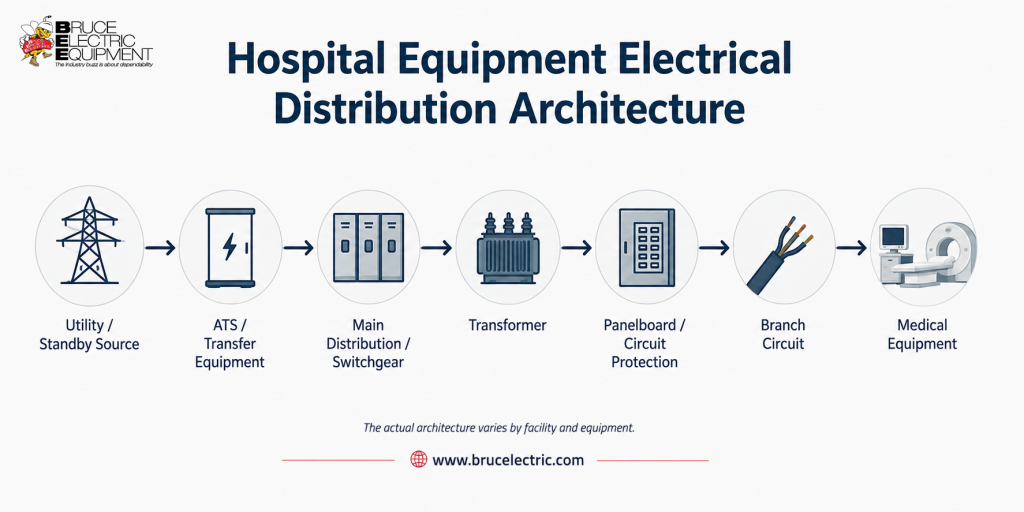
How Hospital Equipment Fits into an Electrical Distribution System
Hospital equipment is typically supplied through several levels of electrical distribution rather than directly from the utility source.
A simplified distribution path may look like:
Selection Checklist for Hospital Equipment Electrical Distribution Solutions
For a transformer or other distribution-equipment RFQ, provide:
•Equipment manufacturer and model
•Nameplate photo
•Required voltage
•Facility voltage
•Phase
•Frequency
•kVA/current
•Quantity
•Existing transformer information, if applicable
•Inrush/startup requirements, if available
•Enclosure/installation requirements
•Required delivery date
•Project specifications
For replacement equipment, the existing nameplate and equipment photos are particularly valuable.
Why Source Hospital Electrical Equipment from Bruce Electric?
Healthcare power projects often require equipment that meets defined technical specifications while remaining available within demanding project schedules. Our inventory, manufacturer relationships, equipment testing, warranty coverage, and rapid shipping capabilities support contractors, facility engineers, and procurement teams in sourcing electrical equipment for healthcare facilities.
• Extensive Inventory: We are one of the largest electrical equipment suppliers and master stocking distributors of dry type transformers, with standard and non-standard configurations maintained in inventory. This extensive stock helps reduce dependence on special-order manufacturing and associated lead times
• Wide Manufacturer Selection: We stock new electrical equipment from major manufacturers. We also offer reconditioned, used, and surplus equipment to accommodate different project specifications, availability requirements, and budgets.
• BEE Warranty Protection: Reconditioned transformers and circuit breakers are inspected and tested before shipment and are covered by our BEE warranty. Our stated warranty coverage extends to two years for transformers and one year for circuit breakers.
• Fast Equipment Availability: Most orders ship within 24 to 48 hours, with expedited shipping available when required. Our in-stock inventory is intended to support time-sensitive replacement, maintenance, and project requirements without relying solely on extended manufacturing lead times.
FAQS
Q1. When is an isolation transformer used in healthcare?
An isolation transformer is used when electrical separation is required by the equipment or system design. In a healthcare isolated power system, it is one component of a larger system that may include isolated circuits and line isolation monitoring.
Q2. What is the difference between an isolation transformer and an isolated power system?
An isolation transformer is a component; an isolated power system is a complete system. The latter can include the transformer, isolated circuits, line isolation monitor and associated grounding/bonding provisions.
Q3. What are the key medical power supply requirements for healthcare facilities?
Healthcare facilities require electrical systems designed to support critical loads, patient care spaces, essential building systems, and medical equipment. Requirements vary by facility and application and may include appropriate power distribution, grounding, backup power, power quality, redundancy, and compliance with applicable codes and standards, including NFPA 99 where applicable.
Q4. What transformer is used for medical equipment?
There is no single transformer type for all medical equipment. Depending on the application, dry-type, isolation, K-factor or harmonic-mitigating transformers may be appropriate.