Electrical Power & Distribution Solutions for Pharmaceutical Packaging
Pharmaceutical packaging operations rely on automated machinery for filling, labeling, sealing, cartoning, inspection, and other production processes. These machines use motors, drives, control systems, sensors, and electronic components that have specific electrical requirements. The power infrastructure must therefore provide the appropriate voltage, phase, capacity, and power quality required by the connected equipment. As packaging lines become more automated and production demands increase, meeting these electrical requirements becomes increasingly important, making dependable transformers and power distribution equipment important components of maintaining equipment performance and operational continuity.
At Bruce Electric Equipment Corp., we provide new electrical equipment available for purchase online, along with used, surplus, and professionally reconditioned equipment from leading manufacturers based on specific equipment and project requirements. Our product offerings include dry-type transformers, control transformers, drive isolation and harmonic-mitigating transformers, panelboards, circuit breakers, safety switches, UPS systems, power conditioning equipment, and industrial power supplies. Our inventory and sourcing capabilities help contractors, facility engineers, maintenance teams, and procurement professionals identify electrical equipment that meets specified pharmaceutical packaging machinery and facility power requirements.
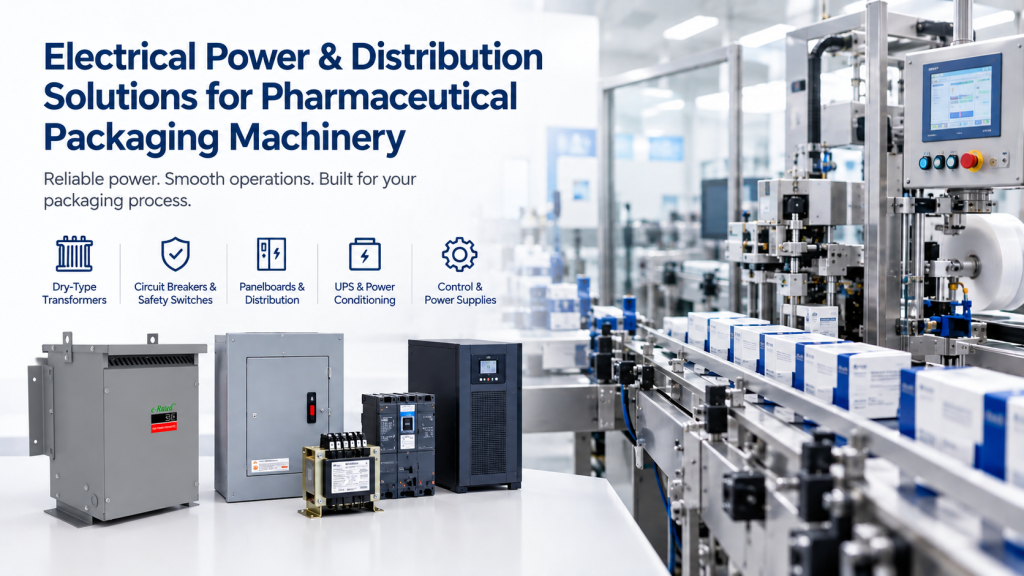
Electrical Power Challenges in Pharmaceutical Packaging Operations
Pharmaceutical packaging lines often combine multiple machines with different electrical characteristics and operating demands. When these requirements do not align with the facility’s existing electrical infrastructure, additional power transformation, distribution, or protection equipment may be required.
• Voltage Mismatch Between Equipment and Facility Supply: Packaging machinery may require a voltage, phase, or frequency configuration different from the available facility supply. This is particularly important when integrating machinery manufactured for different electrical standards. An appropriately specified transformer can help provide the required operating voltage when the facility supply and equipment requirements differ.
• High Motor Starting and Inrush Current: Conveyors, pumps, filling machines, compressors, and other motor-driven packaging equipment can draw elevated current during startup. These temporary current demands must be considered when sizing transformers and associated distribution equipment, particularly when multiple motors may start within a short period.
• Combined Demand from Multiple Packaging Machines: Filling, sealing, labeling, inspection, serialization, cartoning, and conveying equipment may operate simultaneously as part of an integrated packaging line. The combined connected and operating loads must be considered when determining transformer capacity and electrical distribution requirements.
• Power Requirements When Integrating New Equipment: Adding, replacing, or relocating pharmaceutical packaging machinery can introduce new voltage, phase, frequency, capacity, and protection requirements. Existing electrical infrastructure should be evaluated against the new machine’s nameplate specifications and operating characteristics before equipment is selected.
• Power Demands of Automation and Control Systems: Modern pharmaceutical packaging lines rely extensively on PLCs, HMIs, sensors, servo systems, vision inspection equipment, communication devices, and other electronic controls. These loads may require specific control voltages, regulated power, backup power, surge protection, or power conditioning in addition to the main machine supply.
Electrical Equipment We Supply for Pharmaceutical Packaging Operations
Bruce Electric supplies electrical equipment for new installations, packaging-line expansions, equipment replacements, and other projects where machinery and facility electrical requirements must be properly matched.
Dry-Type Transformers
Dry-type transformers can provide the voltage transformation required when packaging machinery operates at a different voltage from the facility supply. we supply transformers in a range of kVA ratings, primary and secondary voltage configurations, phases, and enclosure types for industrial applications.
Available configurations can address requirements involving 380V, 400V, 480V, and other specified equipment voltages, depending on the transformer rating, facility supply, machine requirements, and overall system design.
o Drive Isolation & Harmonic-Mitigation Transformers: Pharmaceutical packaging machinery incorporating VFDs and other nonlinear loads can introduce additional power-quality considerations. Bruce Electric supplies drive isolation and harmonic-mitigating transformers for applications where electrical isolation, drive-related requirements, or harmonic mitigation are specified as part of the electrical system design.
o Control Transformers: Packaging machinery often incorporates control circuits, contactors, relays, PLCs, and other components requiring control voltage different from the main equipment supply. Control transformers can provide the required secondary voltage for these circuits when properly specified for the connected load and application.
• Panelboards, Circuit Breakers & Safety Switches:
These components support power distribution, overcurrent protection, and provide a means of disconnect within packaging facility electrical systems. We supply panelboards, circuit breakers, and safety switches in configurations according to system voltage, current rating, interrupting capacity, and equipment specifications.
• UPS & Power Conditioning Equipment:
Automation, controls, instrumentation, computers, and other sensitive electronic systems may require backup power, surge protection, voltage regulation, or power conditioning. Bruce Electric supplies UPS systems, power line conditioners, and transient voltage surge suppression equipment for applications where these capabilities are specified.
• Power Supplies:
Power supplies convert and regulate electrical power for equipment and control systems requiring specific voltage and current levels. We supply industrial power supplies for applications involving automation equipment, electronic controls, instrumentation, and other devices that require stable and regulated power. Available solutions include AC-DC power supplies, DC-DC converters, linear power supplies, and switched-mode power supplies (SMPS).
Power Solutions for Imported 380V and 400V Packaging Machinery
Pharmaceutical manufacturers may install packaging machinery designed for electrical systems different from the power available at the facility. Equipment manufactured for international markets, for example, may be rated for 380V or 400V while the facility has a different available supply voltage. When a voltage mismatch exists, an appropriately specified transformer may be required between the facility supply and packaging machinery.
Transformer selection should be based on the actual machine and facility specifications, including:
– Available facility voltage
– Required machine voltage
– Single-phase or three-phase operation
– Equipment frequency requirements
– Connected load and required kVA
– Motor and inrush characteristics
– VFD and nonlinear loads
– Transformer connection requirements
– Enclosure and installation conditions
The equipment nameplate and manufacturer documentation should be reviewed before selecting a transformer or associated distribution equipment. Frequency compatibility and other machine-specific requirements should also be confirmed rather than assuming voltage transformation alone will make equipment compatible.
Our Team can help identify available transformer and electrical distribution equipment based on the specifications provided for the machinery and facility electrical system.
Application Areas of Power Distribution in Pharmaceutical Packaging
Electrical requirements vary according to the type of packaging machinery, its connected loads, controls, and operating configuration.
• Filling and Dosing Equipment: Automated filling and dosing systems can incorporate pumps, motors, drives, sensors, actuators, and control systems for dispensing and container handling. Transformers, control transformers, power supplies, and distribution equipment can support the required machine supply and control voltages when properly specified.
• Blister and Strip Packaging Machinery: Blister and strip packaging machines combine forming, heating, sealing, conveying, and automated control functions. Their electrical systems can therefore include resistive heating loads, motors, drives, controls, and auxiliary equipment requiring appropriate power transformation and distribution.
• Bottle Capping and Sealing Equipment: Capping and sealing systems use motors, drives, sensors, actuators, heating components, and controls for container handling and closure operations. The facility electrical supply and associated distribution equipment must accommodate the machine’s specified voltage, phase, load, and control-power requirements.
• Labeling, Coding, and Serialization Systems: Labeling and serialization equipment can incorporate printers, scanners, cameras, sensors, controllers, communication equipment, and machine-vision components. Power supplies, transformers, UPS systems, and other distribution equipment may be required according to the system design and individual equipment specifications.
• Cartoning and Case Packing Equipment: Automated cartoning and case packing systems may include conveyors, motors, servo drives, sensors, actuators, and machine controls operating as an integrated system. Transformer and distribution capacity should account for the applicable connected and operating loads.
• Inspection and Vision Systems: Automated inspection systems use cameras, lighting, sensors, processors, and controllers to verify labels, codes, closures, product presence, and other packaging attributes. These electronic systems may have specific voltage, regulated-power, backup-power, or power-quality requirements that should be considered as part of the overall packaging-line electrical design.
Equipment Selection Considerations for Pharmaceutical Packaging Machinery
Selecting a transformer or electrical distribution component should begin with the actual machine nameplate, manufacturer specifications, and facility electrical characteristics.
1. Verify Facility and Machine Voltage: Compare the facility’s available supply voltage with the packaging machine’s required input voltage. If they differ, determine the appropriate transformer primary and secondary voltage configuration.
2. Confirm Phase and Frequency: Determine whether the machinery requires single-phase or three-phase power and verify its operating frequency. Voltage transformation does not by itself correct a frequency incompatibility.
3. Determine Transformer Capacity and Configuration: Evaluate the connected load, operating load, motor loads, inrush current, primary and secondary voltages, phase, frequency, and other applicable load characteristics when determining transformer kVA and configuration.
4. Evaluate Motor, Drive, and Nonlinear Loads: Packaging equipment incorporating motors, VFDs, servo drives, rectifiers, or other nonlinear loads may introduce additional transformer and power-quality considerations. These characteristics should be identified before equipment is specified.
5. Specify Distribution and Protection Equipment: Determine the appropriate ratings for panelboards, circuit breakers, safety switches, and other distribution equipment based on system voltage, current, available fault current, interrupting capacity, conductor requirements, and connected equipment specifications.
6. Verify Circuit Protection Requirements: Overcurrent protection and interrupting ratings should be coordinated with the electrical system, available fault current, conductors, equipment ratings, and applicable design requirements.
7. Consider Installation and Enclosure Requirements: Transformer enclosure, dimensions, ventilation, environmental conditions, mounting requirements, and available installation space should be considered when selecting equipment.
8. Verify Compatibility Before Replacing Existing Equipment: When replacing a transformer or electrical distribution component, compare the existing equipment’s kVA, primary and secondary voltage, phase, frequency, enclosure, dimensions, connections, and other relevant nameplate characteristics with the proposed replacement.
Why Choose Bruce Electric for Pharmaceutical Packaging Power Equipment
Bruce Electric Equipment Corporation helps industrial customers source transformers and electrical distribution equipment for machinery installations, replacements, upgrades, and facility power requirements. The following are key reasons to choose Bruce Electric for pharmaceutical packaging power equipment:
• Large In-Stock Inventory: Our 15,000-square-foot facility houses an extensive inventory of transformers, panels, switches, circuit breakers, UPS systems, power conditioning equipment, and other electrical distribution products.
• Wide Manufacturer Selection: We stock new electrical equipment from major manufacturers, including Rex Power Magnetics, Federal Pacific, HPS, G.E., Acme, Hevi-Duty, Sola HD, ABB, and others. Used and professionally reconditioned equipment is also available through our equipment inquiry process for projects where suitable replacement or legacy equipment is required.
• Equipment Sourcing Support: If a required component is not available in our inventory, our team can assist in locating specified equipment through our sourcing capabilities. This can be particularly relevant when replacement or less-common configurations are required for existing packaging equipment.
• BEE Warranty Protection: Reconditioned transformers and circuit breakers are inspected and tested before shipment and are covered by our BEE warranty. Our stated warranty coverage is two years for transformers and one year for circuit breakers.
• Rapid Shipping: Most orders ship within 24 to 48 hours, with expedited shipping options available for time-sensitive requirements.
Frequently Asked Questions
Q1. What transformer is needed for a pharmaceutical packaging machine?
The appropriate transformer depends on the facility supply voltage, required machine voltage, phase, frequency, connected load, required kVA, motor and inrush characteristics, and other machine-specific electrical requirements. The equipment nameplate and manufacturer documentation should be reviewed before selecting a transformer.
Q2. Can reconditioned transformers be used for packaging equipment?
Reconditioned transformers may be suitable when their ratings, configuration, condition, and performance are appropriate for the machinery and project requirements. Compatibility should be verified before installation.
Q3. What should be checked when replacing a transformer for packaging equipment?
Compare the existing transformer’s kVA, primary and secondary voltage, phase, frequency, connections, enclosure, dimensions, and other relevant nameplate characteristics with both the proposed replacement and the packaging machine’s electrical requirements.
Q4. What determines the kVA rating of a packaging equipment transformer?
The kVA rating is determined primarily by the connected electrical load and its operating characteristics, including motor loads, inrush current, duty cycle, and anticipated loading. The transformer should be sized according to the equipment requirements and overall system design.
Q5. Can one transformer supply multiple pharmaceutical packaging machines?
Yes, provided its capacity, voltage, phase, and configuration are suitable for the combined connected and operating loads. The electrical system should be evaluated before connecting multiple machines to a common transformer.