Transformer Impedance and Its Impact on Fault Current and Voltage Drop

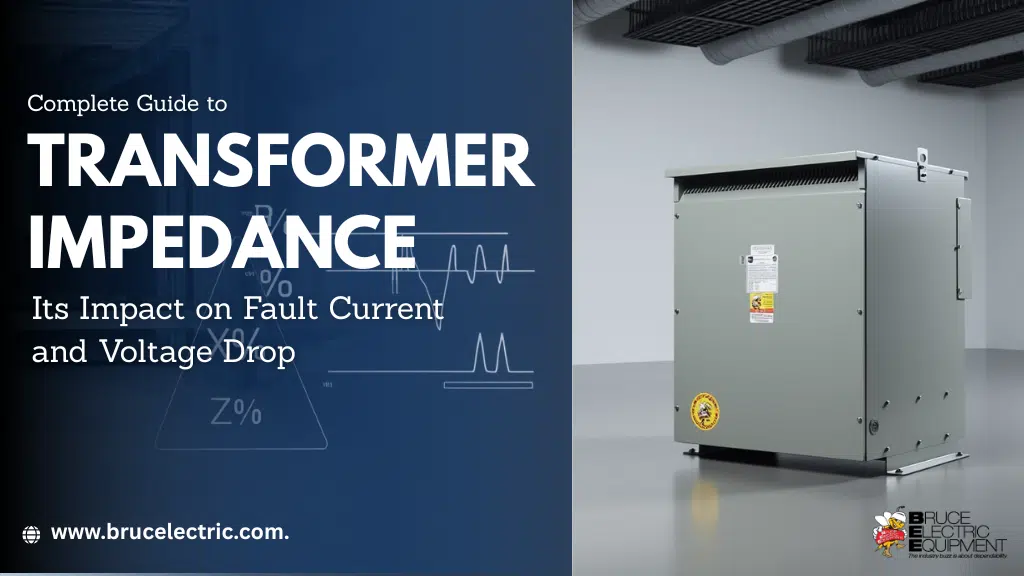
Transformer impedance (%Z) is the percentage of rated primary voltage required to circulate full-load current through a short-circuited secondary. It controls two system behaviors:
• Lower %Z = Higher fault current + better voltage regulation
• Higher %Z = Lower fault current + more voltage drops under load
Every NEC 450.3 protection calculation, arc flash study, and circuit breaker AIC selection starts with this one nameplate value.
Walk up to any dry-type transformer in a U.S. industrial facility and you’ll find a value stamped on the nameplate – 5.75%Z or 4%Z. For the engineer sizing circuit breakers, calculating fault current, or running an arc flash study, that single number drives every downstream protection decision. Getting it wrong means equipment damage, arc flash exposure, or NEC non-compliance.
Product Category
Sourcing a Dry Type Transformer for a U.S. Industrial System?
Bruce Electric stocks new, used, and reconditioned dry-type transformers, K-factor rated transformers, and drive isolation transformers — shipped across all 50 states from our 15,000 sq ft Lindenhurst, NY warehouse. Our engineers verify %Z compatibility and NEC 450.3 compliance before you commit to a unit.
What Is Impedance in a Transformer? The Physics Behind %Z
Transformer impedance is the internal opposition to current flow from winding resistance (R) and leakage reactance (X). Expressed as a percentage of rated voltage not ohms – %Z remains constant across all voltage classes, making it the universal comparison metric for any transformer size or rating.
The Impedance Triangle: R%, X%, and Z%
Total impedance is the vector sum: Z% = √(R%² + X%²)
| Component | What It Represents | Typical Range |
|---|---|---|
| R% (Resistance) | Real power losses – I²R winding heat | 0.5%–1.5% |
| X% (Leakage Reactance) | Magnetic leakage flux; dominates Z% | 4.0%–6.0% |
| Z% (Total Impedance) | Nameplate value – vector sum of R% + X% | 4.0%–7.5% |
Above 500 kVA, leakage reactance (X%) makes up 90–95% of total impedance. A 0.8 PF industrial load can produce 4× more voltage drop than a unity PF load on the same transformer.
| Transformer Type | Typical %Z Range | Standard |
|---|---|---|
| Single-phase distribution (25–167 kVA) | 2.0%–4.0% | ANSI C57.12.20 |
| Three-phase dry-type (15–500 kVA) | 4.0%–5.75% | ANSI C57.12.01 |
| Three-phase dry-type (500–2,500 kVA) | 5.75%–7.5% | ANSI C57.12.01 |
| Medium-voltage dry-type (>2,500 kVA) | 6.0%–10.0% | ANSI C57.12.01 |
| Unit substation transformers | 5.5%–7.5% | IEEE C57.12.00 |
UL-listed transformers 25 kVA and above carry a ±10% impedance tolerance; ANSI units carry ±7.5%. Always use the minimum nameplate %Z (worst case) when calculating maximum available fault current for protective device selection.
Transformer Impedance Formula: How to Calculate Fault Current (Step-by-Step, USA Industrial Standard)
The available symmetrical fault current at the transformer secondary is the full-load current divided by the per-unit impedance. This is the foundational calculation for every circuit breaker AIC selection in U.S. industrial power systems.
The Core Formula
Fault Current Formula
I_SC = I_FL ÷ Z_pu
I_FL (three-phase) = (kVA × 1,000) ÷ (√3 × V_LL)
Where: I_SC = Short-circuit current (A, symmetrical RMS) | Z_pu = %Z ÷ 100
Worked Example – 1,000 kVA, 480V Secondary, 5.75%Z
Step-by-Step Calculation
Step 1 – Full-load current:
I_FL = 1,000,000 ÷ (1.732 × 480) = 1,203 A
Step 2 – Fault current:
I_SC = 1,203 ÷ 0.0575 = 20,922 A (symmetrical RMS)
Result: Every circuit breaker on this secondary bus must carry a minimum 22 kAIC interrupting rating.
Fault Current vs. Impedance – Inverse Relationship
Doubling %Z cuts fault current in half. But it also increases voltage drop – the core trade-off every engineer must navigate.
| %Z | Multiplier (× I_FL) | I_SC – 1,000 kVA @ 480V | Implication |
|---|---|---|---|
| 3.0% | 33.3× | ~40,073 A | Very high fault exposure |
| 4.0% | 25.0× | ~30,054 A | Requires high-AIC breakers |
| 5.0% | 20.0× | ~24,044 A | Standard industrial range |
| 5.75% | 17.4× | ~20,922 A | Most common dry-type value |
| 7.5% | 13.3× | ~16,029 A | Better fault limiting |
| 10.0% | 10.0× | ~12,022 A | Max fault reduction; high ΔV |
When replacing a 7.5%Z unit with a 5.75%Z transformer common with surplus or reconditioned equipment available fault current increases ~30%. This can push existing downstream circuit breakers beyond their AIC rating and invalidate your current arc flash study. Always re-run fault calculations before installation.
Transformer Impedance and Voltage Drop: Why Power Factor Changes Everything
Voltage drop across a transformer increases with both impedance and load current, but the load’s power factor determines how severe that drop actually is. This surprises many engineers running facilities with mixed motor and electronic loads.
Voltage Drop Formula
Voltage Drop Formula
%ΔV = I_pu × (R% × cosφ + X% × sinφ)
Voltage Drop vs. Power Factor – (1,000 kVA, R%=1.1%, X%=5.64% (Z%=5.75%)
| Load PF | Voltage Drop | Practical Impact |
|---|---|---|
| Unity (1.0) | 1.1% | Negligible – VFDs and PLC panels unaffected |
| 0.9 lagging | 3.4% | Marginal – monitor sensitive loads |
| 0.8 lagging | 4.3% | Motor starting complications likely |
| 0.7 lagging | 5.1% | VFD under-voltage faults; UPS alarms probable |
Real-World Voltage Drop Consequences in U.S. Industrial Facilities
• Motor starting: A 200 HP across-the-line motor draws ~6× FLA for 3–8 sec. On a high-impedance transformer, bus voltage can dip 10–15%, stalling other motors on the same bus.
• VFDs (Variable Frequency Drives): Input voltage sags during acceleration can trigger under-voltage faults on units fed by transformers with >7% impedance. Consider drive isolation transformers for VFD-heavy panels.
• UPS and data centers: UPS input specs typically mandate ±3% voltage regulation. High-impedance transformers with non-unity PF loads routinely violate this threshold.
• PLC and control panels: Transient voltage sags from impedance-driven drops can corrupt PLC logic. A power line conditioner is often the fastest fix.
• K-Factor loads (harmonics): VFDs and rectifiers inject harmonic currents that increase eddy-current losses beyond standard %Z. Specify a K-factor rated transformer or harmonic mitigating transformer for these installations.
NEC 450.3 Overcurrent Protection: How Transformer %Z Drives Compliance
In the USA, transformer overcurrent protection is governed by NEC Article 450, Section 450.3. The maximum OCPD rating on both primary and secondary sides depends directly on transformer %Z. Non-compliant sizing is a code violation and a documented arc flash risk.
NEC 450.3(B) – Transformers 1,000 Volts or Less (Most Common in Industry)
• Primary-only protection: Maximum OCPD = 125% of rated primary current (next standard size per NEC 240.6 permitted)
• Primary + secondary protection: Primary max = 250% of rated primary current; Secondary max = 125% of rated secondary current
Worked NEC Compliance Example – 75 kVA, 480V Primary, 208/120V Secondary
NEC 450.3(B) Sizing Calculation
Primary current = 75,000 ÷ (480 × 1.732) = 90.2 A
Primary OCPD = 90.2 × 1.25 = 112.8 A → Use 125 A breaker (NEC 240.6)
Secondary current = 75,000 ÷ (208 × 1.732) = 208.2 A
Secondary OCPD = 208.2 × 1.25 = 260.2 A → Use 300 A breaker (NEC 240.6)
The “next higher standard size” rounding-up privilege applies only to transformer OCPDs not to secondary conductors under NEC Article 240. Confusing these two rules is one of the most common field violations in U.S. industrial transformer installations.
Selecting the right circuit breakers with adequate AIC ratings and safety switches or fused disconnects upstream of the transformer with verified interrupting ratings is just as critical as selecting the correct transformer %Z.
Selecting the Right %Z: Application-Based Framework for U.S. Industrial Systems
There is no universally “best” transformer impedance. The correct %Z depends on whether your priority is limiting fault current, maintaining tight voltage regulation, or enabling parallel operation.
| Application | Recommended %Z | Key Reason |
|---|---|---|
| Minimize fault current / lower AIC cost | 6%–8% | Reduces I_SC; enables lower-rated downstream breakers |
| Motor-heavy / tight voltage regulation | 3%–5% | Limits voltage sag on motor starts and VFD ramps |
| Parallel transformer operation | Match within ±7.5% | Prevents load imbalance and circulating currents |
| Data center / UPS installations | 4%–5.75% | Balances regulation with fault protection |
| Emergency replacement / retrofit | Match existing ±10% | Avoids invalidating arc flash study or breaker ratings |
4 Critical Selection Mistakes That Compromise System Safety
• Choosing the lowest %Z without checking downstream AIC ratings. A 3% transformer can push available fault current beyond 22 kAIC a code violation and arc flash hazard.
• Swapping 7.5%Z for 5.75%Z without recalculating fault current. Available fault current rises ~30%, potentially invalidating the existing arc flash study.
• Assuming reconditioned units carry the same %Z as new equivalents. Rewound windings can shift %Z. Always request a short-circuit test certificate.
• Ignoring power factor when diagnosing voltage drop complaints. Calculate %ΔV at actual site PF first PF correction often resolves the issue at a fraction of transformer replacement cost.
FAQs
Q1. What are the three types of impedance?
The three types of transformer impedance are resistance (R%), leakage reactance (X%), and total impedance (Z%). Resistance represents real power losses (heat), reactance represents magnetic flux leakage, and total impedance is the combined value shown on the transformer nameplate.
Q2. What factors affect impedance?
Transformer impedance is affected by winding design, leakage reactance, and conductor resistance. External factors like harmonic loads (VFDs, rectifiers) and manufacturing tolerances (±7.5% to ±10%) can also influence actual performance.
Q3. Can two transformers with different impedances be operated in parallel?
No, transformers with different impedance values should not be operated in parallel. Unequal impedance causes load imbalance, where the lower impedance unit carries more current, leading to overheating and potential failure. Impedance should match within ±7.5%.
Q4. Does a reconditioned transformer have the same impedance as a new unit?
A reconditioned transformer maintains the same impedance only if the original windings are unchanged. If rewound, the impedance may vary, so a short-circuit test report is required to verify the actual %Z before installation.
Q5. What is a typical transformer impedance value for a 480V industrial transformer in the USA?
For 480V industrial systems, typical transformer impedance ranges from 4% to 5.75% for units up to 500 kVA, and 5.75% to 7.5% for larger transformers (500–2,500 kVA). Always confirm the exact nameplate value for accurate fault current calculations.
Conclusion
Transformer impedance (%Z) is a critical factor that directly influences fault current, voltage drop, and overall system protection in industrial and commercial power systems. Selecting the right %Z requires balancing fault current limitation with voltage regulation to ensure safe operation, NEC compliance, and equipment reliability. Whether installing a new transformer or replacing an existing unit, always verify impedance, recalculate fault levels, and confirm downstream equipment ratings to avoid costly risks and performance issues.