Fuse vs Circuit Breaker: Key Differences, Applications, and How to Choose

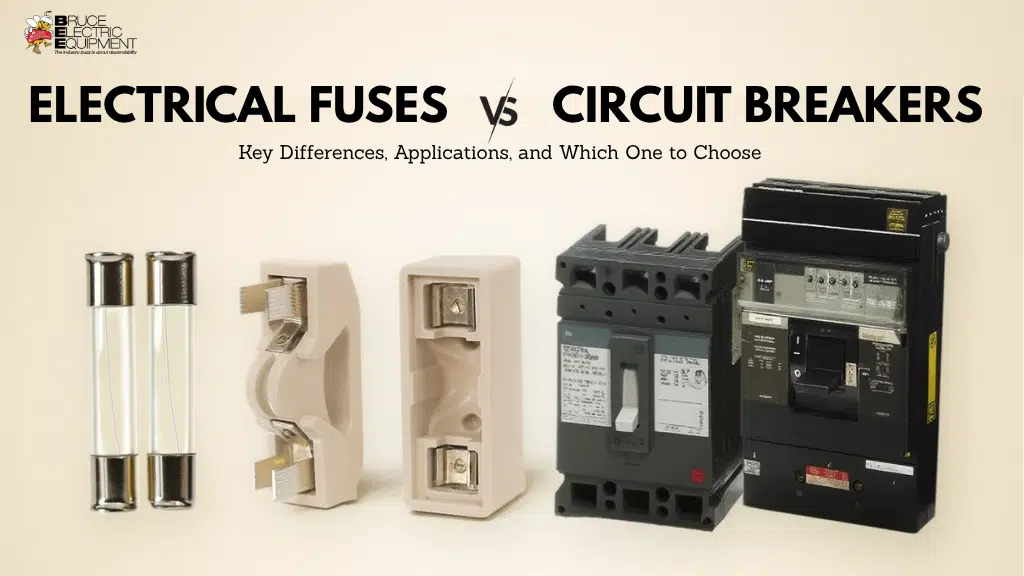
Every plant engineer, electrical contractor, and procurement manager in the U.S. eventually faces this decision: fuse or circuit breaker? Both are overcurrent protective devices (OCPDs) under NEC Article 240. The wrong choice can mean NEC violations, arc flash hazards, equipment damage, or costly production downtime.
In industrial environments where the wrong call means a failed NEC inspection, a blown dry-type transformer, or a six-figure outage a quick comparison chart won’t cut it. This guide delivers the operating mechanics, fault current essentials, NEC 450 transformer requirements, and a practical selection framework used by working electrical engineers.
How a Fuse Works
A fuse is a single-use overcurrent protective device that melts its internal element to break a circuit it must be replaced after every operation. A fuse contains a metal alloy element calibrated to melt at a precise current level. When fault current exceeds the rating, thermal energy severs the element in milliseconds opening the circuit before downstream equipment is damaged.
Key fuse types you’ll encounter in U.S. industrial and commercial work:
| Fuse Type | Response | Best Application |
|---|---|---|
| Fast-blow (quick-acting) | Near-instant | Semiconductors, transformer primaries, control circuits |
| Time-delay (slow-blow) | Tolerates inrush | Motor circuits (handles 600–800% startup surge) |
| Current limiting (Class J, RK1, L, T) | < 8.3 ms | High-fault-current buses, VFDs, MCC feeds |
| Semiconductor fuse | Sub-cycle | VFD IGBT protection, rectifiers, power supplies |
An oversized fuse won’t clear an overload it lets damaging current flow until something downstream fails. Always size within 125% of full-load current for maximum protection. If a fuse nuisance-trips on motor startup, switch to a time-delay fuse never a larger fast-blow.
How a Circuit Breaker Works
A circuit breaker is a resettable electromechanical switch that trips on overload or short circuit and can be manually restored in seconds. A circuit breaker detects fault conditions and opens its contacts to stop current without destroying itself. It trips and resets.
Standard Molded Case Circuit Breakers (MCCBs) use a dual-trip mechanism:
• Thermal trip – A bimetallic strip bends under sustained heat from overcurrent, releasing a latch. Higher overload = faster trip.
• Magnetic trip – A solenoid coil reacts to the intense magnetic field of a short circuit, opening contacts in 1-3 cycles.
Electronic trip units on larger-frame breakers (400A+) allow field-adjustable settings for long-time delay, short-time delay, instantaneous, and ground-fault protection enabling precise coordination across complex distribution systems.
Breaker types relevant to industrial and commercial installations
• Miniature Circuit Breakers (MCBs) – Branch circuit protection up to ~125A. Standard in residential and light commercial panels.
• Molded Case Circuit Breakers (MCCBs) – 15A to 2,500A+. The backbone of industrial distribution panels, motor control centers, and transformer secondary protection.
• Insulated Case Circuit Breakers (ICCBs) – Higher interrupting ratings than MCCBs; used in high-fault-current environments.
• GFCI and AFCI Breakers – Ground-fault and arc-fault protection mandated by NEC in residential, healthcare, and certain commercial applications.
Pro Tip: Standard Curve B or C thermal-magnetic breakers often nuisance-trip on transformer or motor inrush. For motor feeders, specify per NEC Article 430 or coordinate with a time-delay fuse upstream.
Fuse vs Circuit Breaker: Full Comparison
| Factor | Fuse | Circuit Breaker |
|---|---|---|
| Operating mechanism | Melts conductive element | Opens mechanical contacts |
| Response time | < 8.3 ms (current limiting) | 1–3 cycles (short circuit); seconds (overload) |
| Reusability | Single-use replace after every operation | Resettable reuse until mechanical wear-out |
| Upfront cost | Low ($0.50–$50) | Higher ($25–$2,500+) |
| Long-term cost | Higher if faults are frequent | Lower for frequently faulting circuits |
| Current-limiting ability | Superior (Class J, RK1, L, T) | Only specially rated types |
| Arc flash energy | Up to 90% reduction vs. standard breakers (IEEE) | Higher incident energy in most configurations |
| Interrupting rating | Up to 200,000A | 10,000A–200,000A+ |
| Trip adjustability | Fixed at purchase | Adjustable on electronic-trip units |
| Downtime after fault | Longer – must source and replace correct fuse | Shorter – reset in seconds |
| Selective coordination | Easier to achieve (NEC 517.17, 700.32) | Possible but more complex |
| Best for | Transformer primaries, VFDs, legacy systems, high-fault-current environments | Distribution panels, motor feeders, new construction |
What Is Fault Current and Why It Drives Device Selection
Fault current is the abnormally high surge of current during a short circuit or ground fault reaching 10–50× normal operating current when circuit impedance collapses to near zero.
Under NEC 110.9, every OCPD must carry a Short-Circuit Current Rating (SCCR) at or above the available fault current at its installation point. Installing an undersized device means it fails explosively rather than clearing the fault.
Transformer secondary fault current formula:
I fault = kVA ÷ (Voltage × √3 × Impedance%)
Example: A 500 kVA, 480V transformer at 5% impedance delivers ~12,000A available fault current. Every device on that secondary bus must be rated for at least 12,000A SCCR.
Current-limiting fuses clear faults in under half a cycle before current reaches its available peak. This is why they remain the preferred OCPD at transformer primaries and high-fault-current secondary mains, not because they’re cheaper, but because their energy limitation is physically superior.
Overcurrent Protection of Transformers: NEC Article 450
This is where the fuse-vs-breaker decision has direct NEC compliance implications – and where most generic guides fall short. NEC 450.3 sets maximum OCPD ratings for transformers based on voltage class. Sizing from the connected load instead of the transformer’s full-load current (FLC) is a common and dangerous field error.
Low-Voltage Transformers (1,000V or less) – NEC Table 450.3(B)
Primary-only protection (no secondary OCPD):
• Fuse: maximum 125% of transformer full-load current (FLC)
• Circuit breaker: maximum 125% of transformer FLC
• Next larger standard size permitted if calculation doesn’t match a standard rating (NEC 240.6)
Primary + secondary protection:
• Primary fuse: up to 250% of primary FLC
• Primary breaker: up to 250% of primary FLC
• Secondary fuse or breaker: maximum 125% of secondary FLC
The higher primary OCPD rating permitted when secondary protection is also provided is specifically designed to prevent nuisance tripping from transformer inrush current, which can reach 10–12 times full-load current for the first several cycles during energization.
Medium-Voltage Transformers (Over 1,000V) – NEC Table 450.3(A)
Primary-only protection at supervised locations:
• Fuse: up to 250% of primary FLC
• Circuit breaker: up to 300% of primary FLC
Worked example – 75 kVA, 480V primary / 208Y/120V secondary:
• Primary FLC = 75,000 ÷ (480 × 1.732) = 90.2A
• Primary OCPD (with secondary, 250%): 90.2 × 2.5 = 225A fuse or breaker
• Secondary FLC = 75,000 ÷ (208 × 1.732) = 208A
• Secondary OCPD (125%): 208 × 1.25 = 260A → next standard size = 300A breaker
For help sizing protection on a dry-type or three-phase transformer, contact Bruce Electric’s technical team.
Industrial and Commercial Applications: Which Device Belongs Where
Use a Fuse When:
1. High available fault current demands maximum current limiting At transformer secondaries, switchgear buses, and main service entrances where fault current exceeds 22,000A, Class J or Class L current-limiting fuses provide energy limitation that standard MCCBs cannot match.
2. Protecting semiconductor-based equipment Variable frequency drives (VFDs), soft starters, rectifiers, and power supplies contain IGBTs and SCRs that can be destroyed in microseconds by fault current. Fast-acting Class J or semiconductor fuses offer sub-cycle protection that no thermal-magnetic breaker can equal.
3. Transformer primary protection in fused disconnects Many industrial installations use fused disconnects (fused safety switches) on transformer primaries particularly at medium voltage. This provides visible isolation plus overcurrent protection in a single, compact device.
4. Panel boards in legacy industrial facilities Facilities built before 1970 often use fuse panels designed around cartridge fuses. Rather than full panel replacement, qualified personnel can continue using properly rated fuses while planning systematic upgrades.
5. Applications requiring NEC selective coordination (healthcare, emergency systems) Under NEC 517.17 (healthcare) and 700.32 (emergency systems), selective coordination is mandatory meaning only the OCPD closest to a fault should trip. Current-limiting fuses achieve selective coordination more readily due to their time-current characteristics.
Use a Circuit Breaker When:
1. Motor distribution centers and VFD feeders MCCBs with electronic trip units allow precise long-time delay settings that accommodate motor starting inrush without nuisance tripping, while still protecting against sustained overloads.
2. Distribution panels serving multiple branch circuits For main distribution panels feeding lighting, HVAC, and general power circuits, circuit breakers offer operational convenience a tripped breaker is reset in seconds; a blown fuse means tracking down the correct replacement in the middle of a service call.
3. Facilities requiring frequent resets If a circuit trips repeatedly due to process-related transients or intermittent faults under investigation, a breaker allows repeated resets without accumulating replacement fuse costs.
4. New construction and major renovations NEC requirements and modern facility standards default to circuit breaker panels for new installations. GFCI and AFCI protection now required in an expanding range of locations by the NEC is only available in breaker form.
5. Remote monitoring and intelligent power management Smart MCCBs with IoT-connected trip units provide real-time current monitoring, pre-fault alerts, and remote trip/reset capability capabilities no fuse system can offer.
5 Sizing Mistakes That Create Safety and Compliance Risks
1. Oversizing a fuse to stop nuisance tripping: A larger fast-blow fuse won’t clear an overload; it allows fault current to damage conductors and equipment. Switch to a time-delay fuse instead.
2. Sizing transformer OCPDs from the load side: Primary protection must be calculated from the transformer’s primary FLC per NEC 450.3, not the connected load amperage.
3. Ignoring SCCR on downstream equipment: When upgrading a main breaker to a higher rating, verify that all downstream devices are rated for the increased available fault current. Violations of NEC 110.9 create hidden arc flash and explosion hazards.
4. Installing an oversized fuse “to stop nuisance tripping”: This is one of the most dangerous field errors in electrical work. An oversized fuse allows fault current to flow beyond the conductor’s withstand rating, causing insulation damage, fires, or explosive arc faults before clearing. If a fuse is nuisance-tripping on motor inrush, the correct solution is a time-delay fuse not a larger fast-blow fuse.
5. Using the wrong fuse class for the application: Not all fuses are interchangeable. A Class K fuse installed where a Class RK1 is required provides significantly less current-limiting performance and may not meet the equipment’s SCCR rating.
How to Choose Between a Fuse and a Circuit Breaker
Use this structured approach when specifying overcurrent protection for U.S. industrial and commercial installations:
Step 1 – Determine available fault current Calculate or measure the available short-circuit current at the point of installation. This sets the minimum SCCR required for any device.
Step 2 – Identify the load type Is the load resistive (heaters, lighting), inductive (motors, transformers), or electronic (drives, UPS, rectifiers)? Inductive loads require time-delay characteristics; electronic loads require fast-acting current-limiting protection.
Step 3 – Evaluate operational requirements How often is a fault expected? Who will respond to a fault event? If the facility is remotely monitored or has limited on-site maintenance staff, a resettable breaker significantly reduces recovery time.
Step 4 – Apply NEC requirements For transformer protection, apply NEC 450.3(B) or 450.3(A) based on voltage class. For motor circuits, apply NEC 430. For healthcare or emergency systems requiring selective coordination, fuses typically offer the most straightforward compliance path.
Step 5 – Evaluate arc flash requirements If the facility has an arc flash study (required for workplaces under NFPA 70E), current-limiting fuses at strategic points in the distribution system can reduce incident energy levels to below 1.2 cal/cm² (the threshold for Category 1 PPE), dramatically reducing worker exposure.
Step 6 – Consider lifecycle cost for circuits that rarely fault, a fuse’s lower upfront cost wins. For circuits that trip regularly process equipment, compressors, variable loads a circuit breaker’s resettability reduces total cost of ownership.
Frequently Asked Questions
Q: What is the main difference between a fuse and a circuit breaker?
A fuse melts its element to clear overcurrent and must be replaced after each operation. A circuit breaker trips mechanically and resets in seconds. Fuses react faster and limit fault energy better; breakers offer convenience, adjustability, and GFCI/AFCI capability.
Q: Which is safer a fuse or a circuit breaker?
Both are safe when correctly sized. Current-limiting fuses reduce arc flash incident energy by up to 90% (IEEE data), making them technically superior in high-fault environments. For residential use, circuit breakers are safer in practice improper fuse substitution with an oversized replacement is a well-documented fire hazard.
Q: Can I replace a fuse with a circuit breaker?
In most cases, yes and it is often a recommended upgrade. The breaker must match or exceed the fuse’s interrupting rating, the panel bus must accommodate it, and NEC compliance must be confirmed. For transformer protection, verify the breaker rating meets NEC 450.3(B) limits.
Q: Are fuses still used in modern U.S. industrial facilities?
Yes – widely. In high-fault-current environments, motor control centers, and transformer primary protection, current-limiting fuses remain the preferred OCPD. They are also required where NEC selective coordination is mandated: healthcare (NEC 517.17) and emergency systems (NEC 700.32).
Q: What overcurrent device should I use for a VFD?
Always use a fast-acting current-limiting fuse Class J or a dedicated semiconductor fuse per the drive manufacturer’s specification. Standard thermal-magnetic breakers cannot react fast enough to protect IGBT modules. Never substitute a standard breaker for the fuse class specified in VFD documentation.