Shop by Categories
Inquiry Form
If you are interested to know more about the product you can send your enquiry through the below form.
CLUTTER INTO PROFIT

Turn your used or unwanted transformers or circuit breakers into cash or credit
Equipment Purchase Program

3 kVA Transformers
A 3 kVA Dry Type transformer is a dry-type electrical transformer rated at 3,000 volt-amperes (VA), designed for voltage conversion, electrical isolation, and power distribution in low to moderate load industrial and commercial applications. It is commonly used to supply control panels, HVAC systems, lighting circuits, machine tools, OEM equipment, and automation systems requiring stable and safe voltage levels.
At Bruce Electric, we supply new, used, surplus, and reconditioned 3 kVA transformers in a wide range of 3 kVA three-phase and single-phase configurations. Our inventory includes products from leading manufacturers such as Acme Electric, Hammond Power Solutions, EGS/SolaHD, GE, ABB, Square D and other major industrial brands. Whether you need a 3 kVA 480 to 120 transformer, or a custom voltage configuration, we provide both stocked units and RFQ-based sourcing to meet specific project requirements. Options are available for step-down, step-up, isolation, and buck-boost applications depending on system needs.
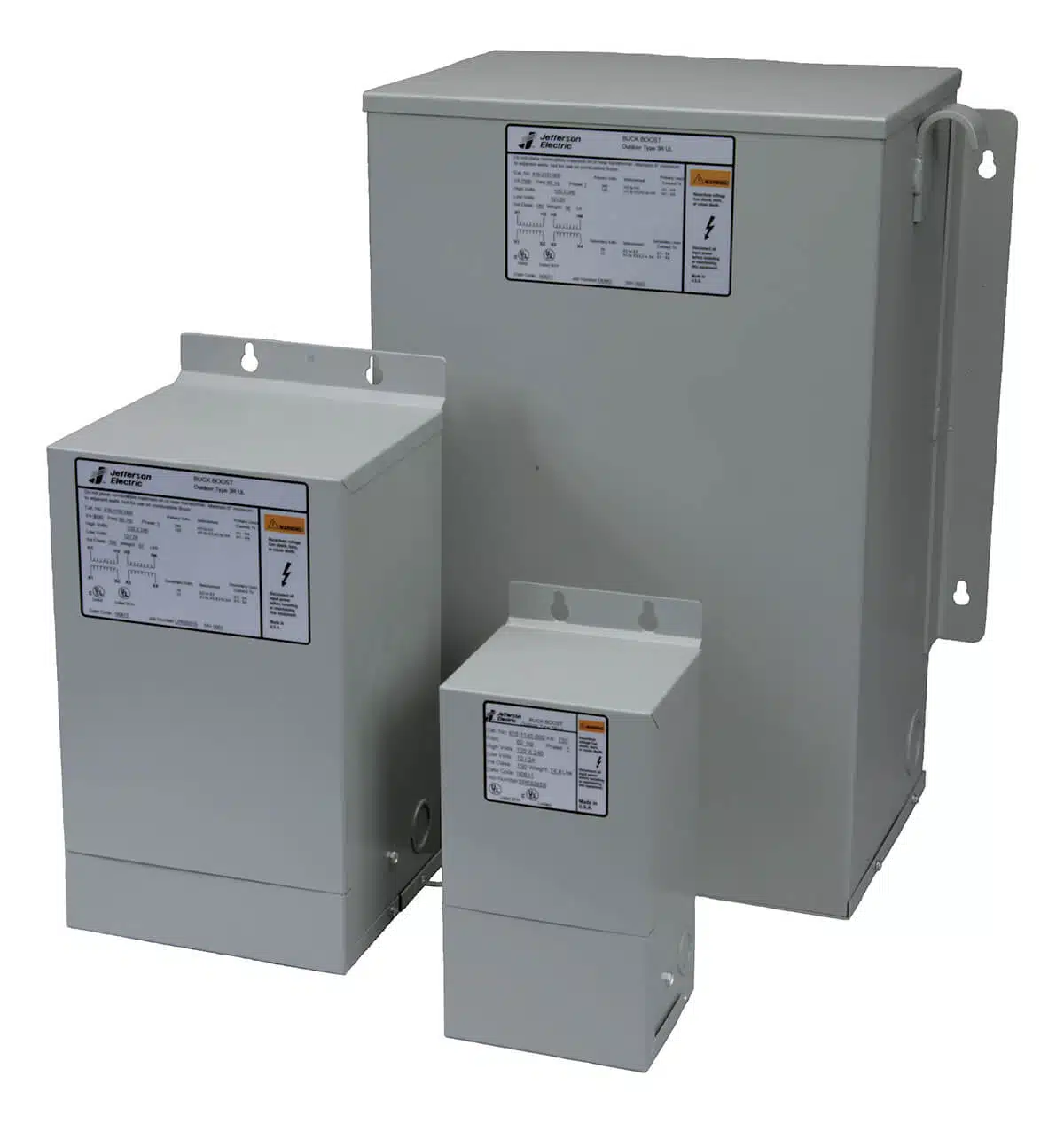
3 kVA Dry Type Transformers for Sale
Single and three-phase units from 7 lbs control transformers to 62 lbs industrial encapsulated models. Primary voltages from 120V up to 7200V medium voltage (HPS Millennium). Buck-boost, isolation, and autotransformer configurations available.
✔ NEMA 3R encapsulated for outdoor and damp locations ✔ 50/60 Hz dual-frequency models for export equipment ✔ Used and reconditioned units available via RFQ
3 kVA Transformer Specifications
The following specifications represent typical values for a 3 kVA transformer depending on design, manufacturer, and application requirements.
| Specification | Typical Range |
|---|---|
| Power Rating | 3 kVA (3000 VA) |
| Phase Options | Single-phase / 3 kVA three-phase transformer |
| Frequency | 50 Hz / 60 Hz |
| Primary Voltage | 120V – 7200V (model dependent) |
| Secondary Voltage | 12V – 480Y/277V (model dependent) |
| Temperature Rise | 55°C, 80°C, 115°C, 130°C, 135°C, or 150°C (standard dry-type); 180°C (Hammond commercial encapsulated C1F series) |
| Enclosure Types | Open Style (open core and coil), NEMA 1, NEMA 2, NEMA 2 Encapsulated, NEMA 3 Encapsulated, NEMA 3R, NEMA 3R Encapsulated, NEMA 3R Stainless Steel, NEMA 3R Heavy Duty |
| Mounting | Wall / Panel / Base Mount |
| Winding Material | Copper / Aluminum |
| Compliance | UL Listed (model dependent); 50/60 Hz dual-frequency on select models |
| Availability | New, surplus, reconditioned (RFQ-based) |
Available 3 kVA Transformer Types and Configurations
Bruce Electric offers 3 kVA single-phase transformers, three-phase transformers, buck-boost transformers, isolation transformers, and autotransformers for industrial control systems, OEM equipment, voltage conversion, and small distribution applications. Available configurations include single-phase 240 × 480V to 120/240V and 600V to 120/240V units, along with three-phase options such as 480V to 208Y/120V, 240V to 208Y/120V, 600V to 208Y/120V, and 480V to 240 Delta configurations. Buck-boost models are used for engineered voltage correction, while isolation transformers provide electrical separation between the source and load. Autotransformers are suitable for voltage conversion where electrical isolation is not required. Select the transformer based on the exact primary voltage, secondary voltage, phase, frequency, enclosure, load characteristics, and manufacturer wiring diagram.
3 kVA Transformer Configurations We Have In Stock
Single-Phase Configurations
| Primary Voltage | Secondary Voltage | Common Use Case |
|---|---|---|
| 120 × 240V | 120/240V | General purpose distribution, control power |
| 120 × 240V | 24V | Low-voltage lighting, HVAC control circuits |
| 120 × 240V | 16/32V | Buck-boost voltage correction |
| 208V | 120/240V | Step-down from 208V service for control or lighting |
| 240 × 480V | 120/240V | Industrial control, most common step-down configuration |
| 240 × 480V | 24/48V | Buck-boost voltage correction, HVAC controls |
| 277V | 120/240V | Step-down from 277V lighting service |
| 277/480V | 208/277V | Lighting transformer isolation and tap conversion |
| 480V | 120/240V | Control power from 480V service; machine tools |
| 600V | 120/240V | Canadian primary service, step-down to 120/240V |
| 120/208/240/277V | 120/240V | Multi-tap primary for flexible installation |
| 190–440V (multi-range) | 120/240V or 110/220V | Export and international equipment applications |
| 347/380V | 120/240V | Canadian and international service entry |
Three-Phase Configurations
| Primary Voltage | Secondary Voltage | Common Use Case |
|---|---|---|
| 480V | 208Y/120V | Commercial panel distribution, automation |
| 480V | 240D/120 tap | Industrial delta loads with neutral tap |
| 480V | 380Y/220V | International equipment, imported machinery |
| 240V | 208Y/120V | Step-down from 240V three-phase service |
| 208V | 208Y/120V | Isolation and re-grounding of 208V service |
| 208V | 480Y/277V | Step-up for 480V equipment from 208V service |
| 240V | 480Y/277V | Step-up for 480V or 277V lighting from 240V service |
| 600V | 208Y/120V | Canadian three-phase service step-down |
| 600V | 480Y/277V | Canadian service to 480V/277V equipment |
| 416V | 208Y/120V | Specialty primary voltage configurations |
| 380V | 208Y/120V or 220Y/127V | European primary, US or international secondary |
| 230V | 230Y/133V or 460Y/266V | Drive isolation, international equipment |
| 460V | 230Y/133V or 460Y/266V | Drive isolation, VFD applications |
| 575V | 230Y/133V or 460Y/266V | Drive isolation, 575V primary service |
| 2400–7200V | 120/240V | Medium voltage primary service (HPS Millennium series) |
Medium Voltage Note: Hammond Power Solutions stocks 3 kVA units with primary voltages from 2400V through 7200V (HPS Millennium series, NEMA 3R Heavy Duty enclosure) for facilities served directly by medium-voltage distribution, eliminating the need for a separate distribution transformer.
Not all configurations are in active stock at all times. Contact Bruce Electric or submit an RFQ for specific configuration availability.
How Many Amps Can a 3 kVA Transformer Handle?
A 3 kVA transformer’s full-load current depends on the rated voltage and whether the transformer is single phase or three phase.
Single-Phase Formula: Amps = (kVA × 1000) ÷ Voltage
Example: At 240V → Amps = 3000 ÷ 240 = 12.5 A
Three-Phase Formula: Amps = (kVA × 1000) ÷ (Voltage × 1.732)
Example: At 480V three-phase → Amps = 3000 ÷ (480 × 1.732) ≈ 3.6 A
Full-Load Current Reference Table
| Secondary Voltage | Single-Phase (A) | Three-Phase (A) |
|---|---|---|
| 120V | 25.0 A | 14.4 A |
| 208V | 14.4 A | 8.3 A |
| 240V | 12.5 A | 7.22 A |
| 277V | 10.8 A | 6.25A |
| 480V | 6.25 A | 3.61 A |
| 600V | 5.0 A | 2.9 A |
Per NEC Article 450.3(B), (transformers 1000V or less). The 125% sizing rule applies to primary-only overcurrent protection. Where both primary and secondary protection are provided, NEC 450.3(B) permits primary protection up to 250% and secondary protection up to 125%. Use BEE’s kVA Calculator to confirm your load before selecting a unit.
Applications of 3 kVA Transformers
A 3 kVA transformer is one of the most versatile small-capacity units in commercial and industrial electrical systems. Its compact size and wide availability in specialized types make it the standard choice wherever control power, low-voltage distribution, or precise voltage matching is needed.
1. Industrial Control Panels and Machine Tools: Used to supply control power for PLCs, relays, contactors, solenoids, and machine control circuits. Common applications include stepping 240V or 480V building power down to 120V or 120/240V control voltage.
2. HVAC and Building Automation: Suitable for thermostats, damper actuators, VAV systems, sensors, and building automation controls requiring low-voltage or corrected supply voltage.
3. VFDs and Motor Control Equipment. Select 3 kVA drive-isolation and control transformer models can support small drives, motor starters, and associated control circuits where isolation or voltage matching is required.
4. OEM Equipment and Imported Machinery. Multi-tap and export-model transformers support equipment designed around different primary voltages or 50/60 Hz requirements, making them suitable for machinery builders and replacement applications.
5. Lighting and Auxiliary Power. Used to provide 120V, 120/240V, or low-voltage auxiliary power for lighting controls, emergency systems, control devices, and small equipment loads.
6. Instrumentation and Test Equipment. Isolation and encapsulated transformer options can be used for control, monitoring, laboratory, and test applications where the correct voltage configuration and circuit separation are required.
How to Choose the Right 3 kVA Transformer
Selecting the right transformer starts with understanding the electrical requirements of the application.
1. Confirm phase requirement. A single-phase 3 kVA unit is for single-phase control or lighting loads. A three-phase 3 kVA unit is for three-phase panel feeds, automation systems, or drive applications. These are not interchangeable.
2. Identify primary and secondary voltage. Match to your available supply voltage and required output. The most common single-phase configuration in this rating is 240×480V primary → 120/240V secondary. The most common three-phase configuration is 480V → 208Y/120V. Confirm both voltages before ordering.
3. Select the correct transformer type. General purpose encapsulated units suit most distribution and control applications. Open-style (open core and coil) units are for panel-interior installations where an external enclosure is already provided. Buck-boost units are for voltage correction only, not full step-down. Drive isolation units are for VFD applications. Autotransformers are for voltage adjustment without isolation.
4. Determine enclosure. Open style or NEMA 1 for clean indoor panel installations. NEMA 3R or NEMA 3R encapsulated for outdoor or wet locations. NEMA 3R Stainless Steel (confirmed Acme Electric) for corrosive environments. NEMA 3R Heavy Duty for medium-voltage units.
5. Check frequency. Most units in this rating are 60 Hz. If the application requires 50 Hz or dual 50/60 Hz operation (export, imported equipment), select confirmed dual-frequency models from Acme Electric, EGS/SolaHD, or Jefferson Electric.
6. Review temperature rise rating. For continuous-duty applications, a 115°C rise is standard. For applications requiring lower operating surface temperatures or higher ambient environments, 80°C rise units are available from Hammond Power Solutions industrial encapsulated series. For applications inside machinery or control panels where Class H insulation is acceptable, 150°C or 180°C rise units reduce cost and size.
Installation Considerations for 3 kVA Transformers
Proper installation helps ensure safe operation, reliable performance, and maximum service life from a 3 kVA transformer. Consider the following factors during system design and installation.
1. Mounting Requirements. Most 3 kVA dry type transformers can be wall-mounted, panel-mounted, or floor-mounted depending on enclosure style, transformer design, and application requirements.
2. Ventilation and Cooling. Dry-type transformers generate heat during operation and require adequate airflow. Sufficient clearance should be provided around the transformer to support proper cooling and to prevent excessive operating temperatures.
3. Overcurrent Protection. Primary and secondary overcurrent protection should be properly coordinated with the transformer rating and connected load. Fuses or circuit breakers should be selected in accordance with applicable electrical codes to protect against overloads, short circuits, and equipment faults while minimizing nuisance trips.
4. Grounding Requirements. Grounding practices depend on system configuration and local code requirements. Installations should comply with NEC guidelines and project specifications to ensure safe and reliable operation.
5. Inrush Current Considerations. Loads such as contactors, relays, solenoids, and motor controls may produce high inrush currents during startup. Transformer sizing and protection devices should be selected accordingly to prevent nuisance tripping and voltage fluctuations.
6. Environmental Conditions. Consider installation factors such as indoor or outdoor location, ambient temperature, moisture exposure, dust levels, and corrosive environments when selecting the appropriate enclosure type.
Why Choose Bruce Electric for 3 kVA Transformers?
Bruce Electric has supplied industrial electrical equipment since 1973, helping contractors, OEMs, maintenance teams, and facility managers source the right transformer for voltage conversion, control power, and replacement needs. Our team can help match exact voltage, phase, enclosure, frequency, and manufacturer requirements using a part number or nameplate photo. With new listed inventory plus RFQ-based sourcing for used, surplus, and reconditioned equipment, Bruce Electric provides practical options for both standard and hard-to-find 3 kVA transformer applications.
Frequently Asked Questions
Q1. What is the difference between a 3 kVA transformer and a 3-kW transformer?
A 3 kVA transformer is rated based on apparent power (volt-amperes), while kW measures real power consumed by a load. The actual kW supported by a transformer depends on the load power factor.
Q2. Can a 3 kVA transformer be used outdoors?
Yes, provided the transformer is installed in an enclosure suitable for the environment. Outdoor installations typically require weather-resistant enclosures such as NEMA 3R, while harsh or corrosive environments may require NEMA 4X protection.
Q3. Can a 3 kVA transformer be reverse fed?
In many applications, a transformer can be reverse fed provided the voltage ratings, wiring configuration, and applicable codes are properly evaluated. Manufacturer recommendations should always be reviewed before reverse-feeding a transformer.
Q4. Can a 3 kVA transformer be used for control panel applications?
Yes. A 3 kVA transformer is commonly used to provide power for control panels, PLC systems, relays, contactors, and other industrial control equipment.
Browse Related Transformer Categories
75 kVA Transformers
Technical Reading
Dry Type Transformer Testing & Troubleshooting Guide