Transformer Losses Explained: Core Loss, Copper Loss, and Efficiency in Industrial Power Systems

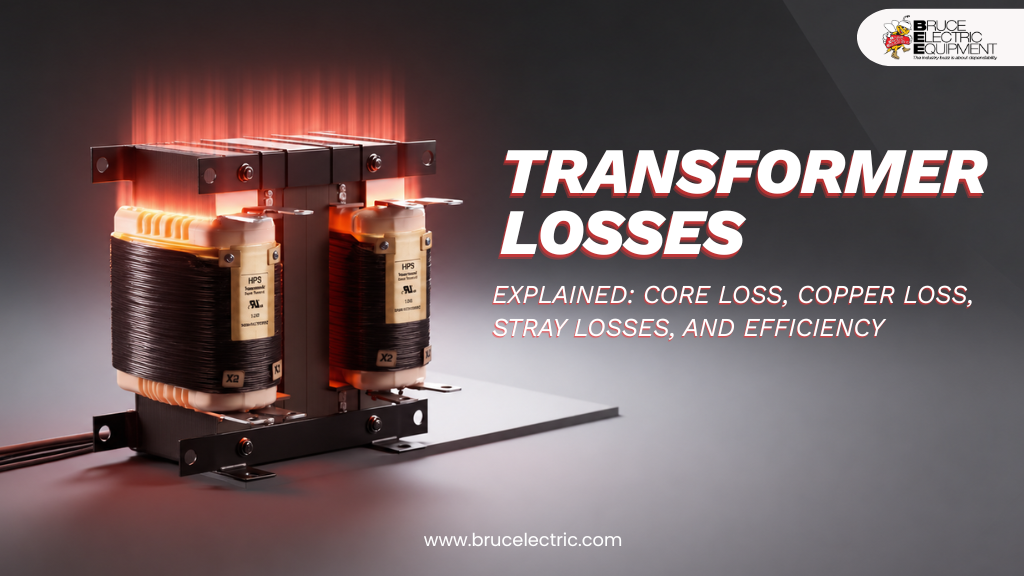
What Are Transformer Losses?
Transformer losses represent the electrical energy converted to heat during the power transformation process. No transformer can achieve 100% efficiency because energy dissipation occurs in two primary ways: through the magnetic core and through the windings.
Think of a transformer as a highly efficient energy converter, but not a perfect one. When primary-side current creates a magnetic field in the core, some energy escapes as heat. When that magnetic field induces current in the secondary windings, the resistance of the copper conductors generates additional heat. These losses are inherent to transformer operation, not design flaws.
Understanding why losses occur and quantifying them is essential for calculating total cost of ownership and optimizing industrial power distribution systems.
Core Loss in Transformer
Core loss, also called iron loss or no-load loss, occurs in the transformer’s magnetic core regardless of load conditions. Even when a transformer sits energized but supplying no load, core losses persist.
What Causes Core Loss?
Core loss comprises two distinct mechanisms:
– Hysteresis Loss
Hysteresis loss occurs because magnetic materials don’t respond instantaneously to changing magnetic fields. As AC current reverses direction (50 or 60 times per second), the core material’s magnetic domains lag slightly behind the applied field. This molecular friction converts energy into heat. Hysteresis loss is relatively constant and independent of load—it depends primarily on voltage magnitude and frequency.
– Eddy Current Loss
Eddy current loss results from electrical currents induced within the core material itself. These circular currents, called eddy currents, flow through the core’s conducting material and dissipate energy as I²R losses. Eddy current loss increases with frequency and voltage squared, making it particularly significant in modern industrial systems with harmonic distortion.
Why Core Loss Occurs at No Load
The transformer core is magnetized continuously whenever primary voltage is applied. This magnetization requires energy, and that energy escapes as heat—regardless of secondary-side load. This explains why transformers consume power even when supplying zero load. For large transformers or facilities with always-on systems, no-load losses accumulate into significant annual energy consumption.
Core Materials and Efficiency
Modern transformers use Cold-Rolled Grain-Oriented (CRGO) steel for cores because its directional magnetic properties reduce hysteresis and eddy current losses compared to conventional steel. Higher-grade CRGO materials and thinner core laminations further minimize losses, though they increase manufacturing cost—a trade-off reflected in transformer pricing and lifecycle cost analysis.
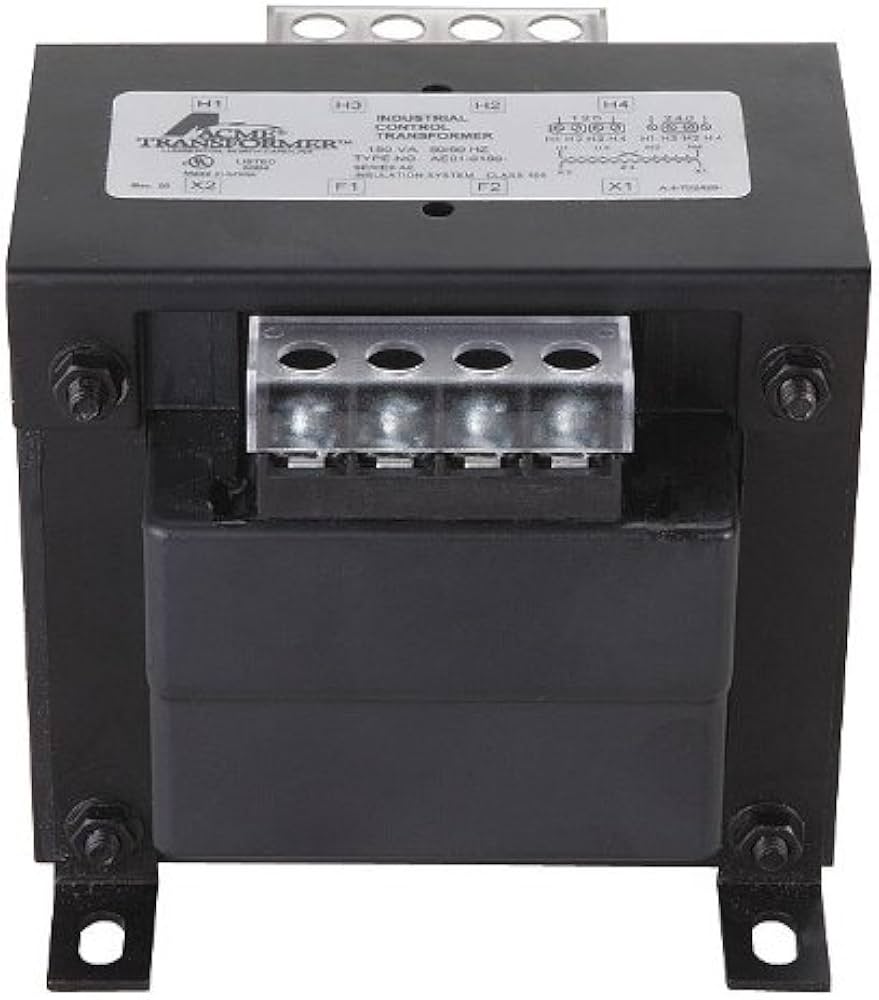
Product Category
Reduce Core Loss with High-Efficiency Dry Type Transformers
Core losses run 24/7 — even at zero load. Bruce Electric stocks DOE 2016-compliant dry type transformers built with CRGO steel cores that minimize hysteresis and eddy current losses, helping reduce your facility’s no-load energy consumption year-round.
Copper Loss in Transformer
Copper loss, also called winding loss or load loss, occurs in the transformer’s copper windings and increases proportionally with load current. When current flows through the resistance of copper conductors, electrical energy converts to heat according to the I²R relationship.
Understanding I²R Losses
Copper loss follows a fundamental electrical principle:
Power Dissipated (P) = I² × R (current squared times resistance).
This quadratic relationship means copper losses escalate dramatically under heavy loads. Doubling the current quadruples the copper loss. A transformer operating at 50% rated load experiences only 25% of maximum copper loss; at 100% load, it experiences full copper loss.
Load-Dependent Behavior
Unlike core loss, copper loss varies directly with load. A lightly loaded transformer dissipates minimal winding losses; a heavily loaded transformer can generate significant heat. This is why transformer efficiency varies across the load spectrum peak efficiency typically occurs at 30-50% rated load, not at full capacity.
Temperature Impact and Conductor Resistance
Copper’s electrical resistance increases with temperature. As a transformer heats up under load, winding resistance increases, which increases copper loss further. This creates a feedback loop: higher loads generate heat, increased temperature increases resistance, and increased resistance generates more heat. Temperature monitoring and proper ventilation are critical for preventing runaway thermal conditions.
Stray Losses in Transformer
Stray losses, the smallest loss category but often overlooked, result from leakage magnetic flux that doesn’t contribute to useful energy transfer. This flux induces eddy currents in structural components, tank walls, and core clamps.
In modern industrial systems with significant harmonic content, stray losses become more pronounced. Harmonic currents generate harmonic magnetic fields that intensify stray losses. For facilities with non-linear loads (variable frequency drives, switching power supplies, LED lighting), stray losses can exceed theoretical calculations based on fundamental frequency alone.
Transformer Efficiency Explained
Transformer efficiency quantifies the percentage of input power delivered as useful output power.
Transformer Efficiency Formula
Efficiency (%)=(Input Power/Output Power)×100
A 1000 kVA transformer with 98% efficiency delivers 980 kW of output when supplied 1000 kW of input power. The missing 20 kW becomes heat loss.
Why Transformer Efficiency Matters Industrially
A 1% efficiency difference across a fleet of transformers compounds dramatically over years of operation. Consider a facility with ten 500 kVA transformers operating continuously at average 75% load:
• Ten transformers at 98% average efficiency: ~18 kW average loss
• Ten transformers at 97% average efficiency: ~27 kW average loss
That 9 kW difference, sustained over a year, represents roughly 80 MWh of wasted energy annually. Over a transformer’s service life, this translates into substantial operating costs.
Partial Load Efficiency
Most transformers operate below rated capacity. Transformer efficiency varies across the load range because core losses remain relatively constant while copper losses increase quadratically with load. The efficiency curve shows a peak at moderate loading, not full load. Understanding your facility’s actual load profile is critical for selecting transformers that operate efficiently at typical conditions.
How Transformer Losses Affect Industrial Operations
Transformer losses create cascading operational consequences.
Energy Costs: Losses directly increase utility costs because wasted electrical energy converts into heat rather than usable output power.
Thermal Stress: Heat generation accelerates insulation degradation. A transformer’s insulation lifespan can reduce significantly for every 10°C rise above rated operating temperature.
Cooling System Demands: Wasted energy increases HVAC and ventilation requirements. Dry type transformers especially require proper airflow for effective heat dissipation.
Reduced Reliability: Transformers operating near thermal limits are more susceptible to insulation breakdown, overheating, and premature failure.
Power Quality Impact: Stray losses and harmonics can affect voltage regulation, impedance, and overall system stability in industrial power systems.
Dry Type Transformer Losses
Dry type transformers, commonly used in commercial buildings, hospitals, data centers, and industrial facilities, rely entirely on air cooling. Unlike oil-filled transformers, they lack liquid coolant for heat dissipation, making ventilation essential for maintaining efficiency.
– Thermal Behavior of Dry Type Transformers
Dry type transformers typically operate at higher temperatures and depend heavily on ambient airflow. Poor ventilation increases winding temperature, raises conductor resistance, and drives up copper losses.
– Ventilation and Efficiency
Manufacturers design dry type transformers for operation within specific ambient temperature and airflow conditions. Restricted airflow or elevated room temperatures reduce operating efficiency and shorten equipment lifespan.
– Industrial Applications
Because of their safety, low maintenance requirements, and indoor installation capability, dry type transformers are widely used in industrial and commercial environments where fire safety and environmental considerations are priorities.
How to Reduce Transformer Losses
- Right-Sizing and Load Optimization
Select transformers appropriately sized for actual facility loads. Oversized transformers operate at low efficiency because core losses remain constant while copper losses decrease disproportionately. However, undersizing increases loading percentage and copper losses. The optimal transformer operates at 50–75% of rated capacity during normal conditions.
- High-Efficiency Transformer Selection
Specify transformers meeting DOE 2016 efficiency standards. Modern high-efficiency transformers, though more expensive initially, recover their cost premium within 5–10 years through energy savings. This is particularly important for large transformers and those with high utilization.
- Load Balancing Across Phases
Three-phase transformers operating with unbalanced loads experience elevated losses. Load balancing across phases, accomplished through proper feeder distribution, reduces average current and copper losses.
- Preventive Maintenance
Maintain cooling systems: clean air filters, ensure radiator fins are free of debris, verify fan operation, and test temperature sensors. Check for oil oxidation in oil-cooled units. Regular thermography identifies hot spots and indicates incipient failures before catastrophic loss.
- Harmonic Mitigation
Facilities with non-linear loads should consider harmonic filtering and K-rated transformers to reduce additional heating caused by harmonics.
- Proper Ventilation
Ensure dry type transformers receive unrestricted airflow per manufacturer specifications. Position intake vents away from heat sources and exhaust locations. Never cover ventilation openings.
Frequently Asked Questions
Q1. What are the main losses in a transformer?
The three primary transformer losses are core loss, copper loss, and stray loss. Core loss occurs in the magnetic core, copper loss occurs in the windings due to resistance, and stray loss results from leakage magnetic flux.
Q2. What causes copper loss in a transformer?
Copper loss occurs because electrical current flowing through the transformer windings encounters resistance, generating heat according to the I²R principle.
Q3. What is core loss in transformer?
Core loss is the constant energy loss occurring in the transformer core due to hysteresis and eddy current effects whenever the transformer is energized.
Q4. What is the transformer efficiency formula?
Transformer efficiency is calculated as: Efficiency (%)=(Input Power/Output Power)×100
Q5. How can transformer losses be reduced?
Transformer losses can be reduced through proper sizing, high-efficiency core materials, load balancing, preventive maintenance, harmonic mitigation, and proper ventilation.
Conclusion
Transformer losses are unavoidable, but understanding and managing core, copper, and stray losses is essential for improving energy efficiency, reducing operating costs, and extending equipment lifespan. Proper transformer sizing, ventilation, load management, and high-efficiency designs can significantly improve long-term system performance. For industrial facilities, selecting the right transformer is not just about power distribution – it is a critical decision that impacts reliability, thermal performance, and overall operational efficiency.
Dry Type Transformers
Looking for a More Efficient Transformer? Bruce Electric Has It In Stock.
Every percentage point of efficiency lost in your transformer compounds into thousands of dollars of wasted energy over its service life. Bruce Electric supplies new, used and professionally reconditioned dry type transformers inspected, tested, and ready to ship from our Lindenhurst, NY warehouse to facilities across all 50 states.
✔ 50+ years of experience ✔ Ships in 24–48 hours nationwide ✔ Expert transformer sizing support