Dry Type Transformer Cooling Explained: Natural Air vs. Forced Air

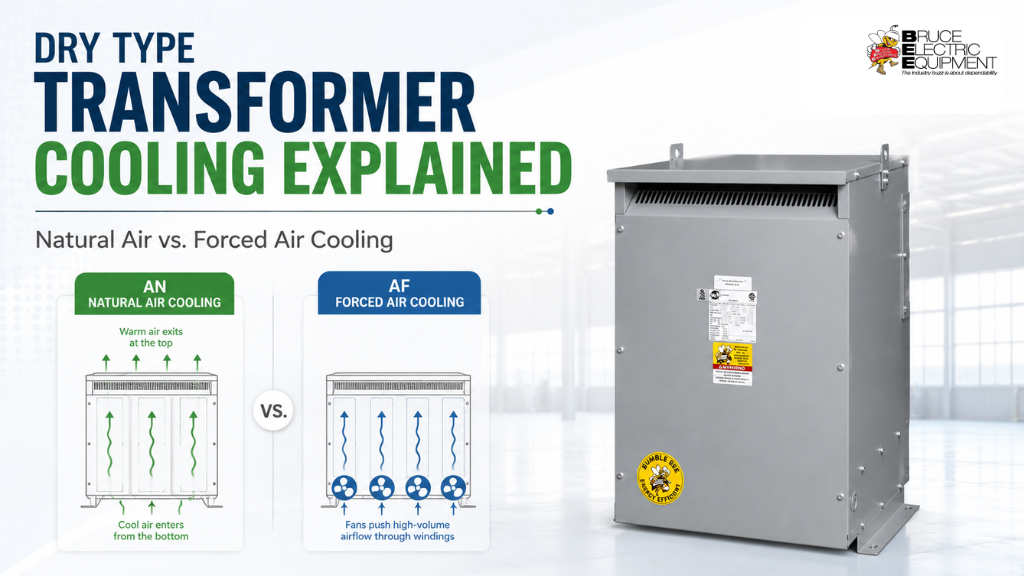
When engineers and facility managers spec out a dry type transformer, most of the conversation centers on kVA ratings, voltage class, and insulation system. Cooling often gets treated as an afterthought until there’s an overtemperature trip, a premature winding failure, or a commissioning problem because the equipment room wasn’t properly ventilated.
Transformer cooling directly affects equipment lifespan, operational reliability, load capacity, and long-term maintenance costs. In industrial and commercial facilities, improper cooling can lead to overheating, unexpected downtime, reduced transformer efficiency, and costly equipment replacement.
Understanding how dry type transformers manage heat isn’t just textbook knowledge. It directly affects transformer lifespan, load capacity, installation requirements, and total cost of ownership. Here’s what you actually need to know.
How Heat Builds Up in a Dry Type Transformer
Transformers are highly efficient, but they’re not perfect. Every transformer loses a portion of input energy as heat primarily through core losses (from magnetic flux cycling in the iron core) and copper losses (from current flowing through the windings). In a dry type transformer, there’s no insulating oil to absorb and transfer that heat. The windings, core, and enclosure have to manage it directly through the surrounding air.
This is why cooling class matters. The method by which a dry type transformer dissipates heat determines its continuous load capacity, its temperature rise rating, and the physical environment it can operate in safely.
The two primary cooling methods for dry type transformers are:
• AN (Air Natural) – passive cooling through natural air convection
• AF (Air Forced) – active cooling using integrated cooling fans
AN Cooling: Natural Air Cooling
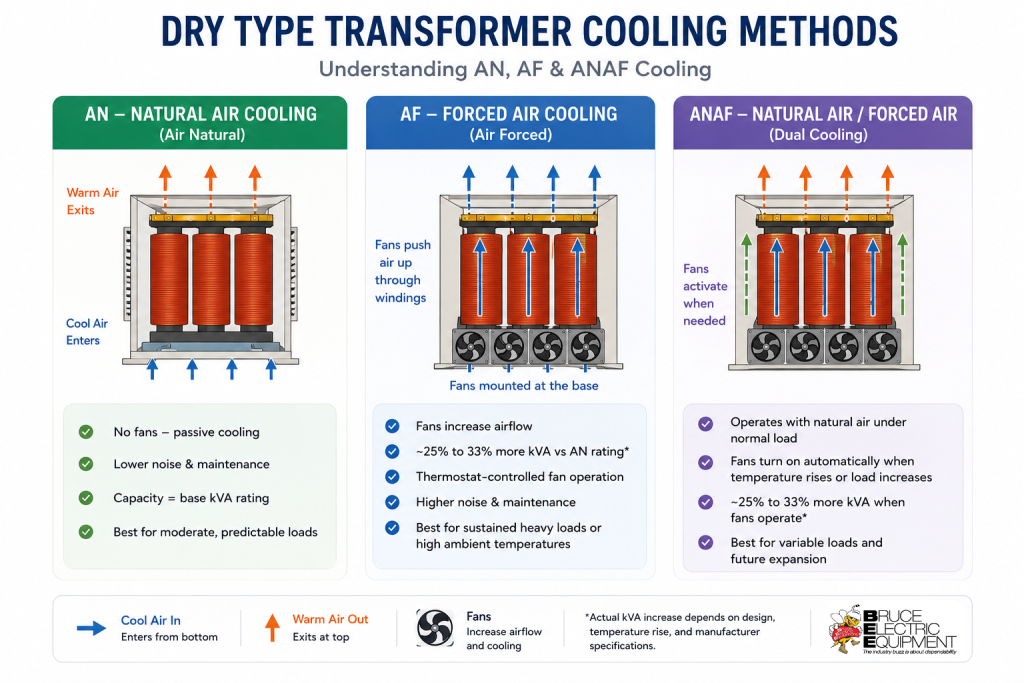
AN cooling sometimes written as ONAN in legacy standards relies entirely on natural air movement. As the transformer windings heat up during operation, the surrounding air warms, becomes less dense, and rises. Cooler air flows in from below to replace it. This thermosiphon effect, combined with radiation from the core and coil surfaces, removes heat continuously without any mechanical assistance.
What this looks like in practice:
AN-cooled dry type transformers have open ventilated enclosures or NEMA 1 / NEMA 2 housings with louvers designed to maximize airflow. Winding geometry is typically open-coil or ventilated-disc to expose maximum surface area to circulating air.
Where AN cooling works well:
• Indoor installations with adequate room ventilation
• Light-to-medium duty cycle loads
• Locations where fan noise or mechanical maintenance is undesirable
• Clean environments without heavy airborne particulate
Because there are no fans, AN-cooled transformers are mechanically simpler. There’s nothing to wear out, no fan motor to replace, and no added noise. In properly ventilated electrical rooms, this is often the preferred solution for commercial buildings, light manufacturing, and institutional facilities.
The limitation of AN cooling:
At high continuous loads, natural convection may not remove heat fast enough to keep winding temperatures within rating. The transformer’s kVA capacity is fixed at the AN rating there’s no headroom to push beyond it without risking thermal degradation of the winding insulation.
AF Cooling: Forced Air
AF cooling adds powered fans to the AN base design. Fans are mounted at the base of the transformer and direct airflow through the winding channels and across the core surfaces. This dramatically increases the volume of air moving through the unit per minute, pulling significantly more heat away from the windings.
What forced air cooling enables:
The addition of fans typically allows a dry type transformer to handle 33% more load than its AN-rated capacity. A transformer rated at 750 kVA (AN) might carry 1000 kVA (AF) when fans are running. This is why you’ll often see dual ratings on transformer nameplates: 750/1000 kVA AN/AF.
Forced air cooling is particularly valuable in:
• High duty cycle or continuous full-load industrial applications
• Manufacturing facilities with significant process loads
• Data centers and mission-critical environments
• Situations where a larger AN unit would exceed available footprint or budget
Fan controls: In many installations, fans are thermostatically controlled. They engage automatically when winding temperature sensors detect rising temperatures typically around 80–100% of rated load and shut off as temperatures normalize. This prevents unnecessary fan run time while ensuring cooling engages exactly when it’s needed.
Installation considerations for AF-cooled units:
Forced air cooling introduces a few practical requirements. Fan motors need periodic maintenance and eventual replacement. The units produce more audible noise than passive AN design relevant in office-adjacent installations. Enclosures must allow adequate air intake and exhaust; a transformer jammed into a closet with blocked airflow voids the cooling benefit entirely.
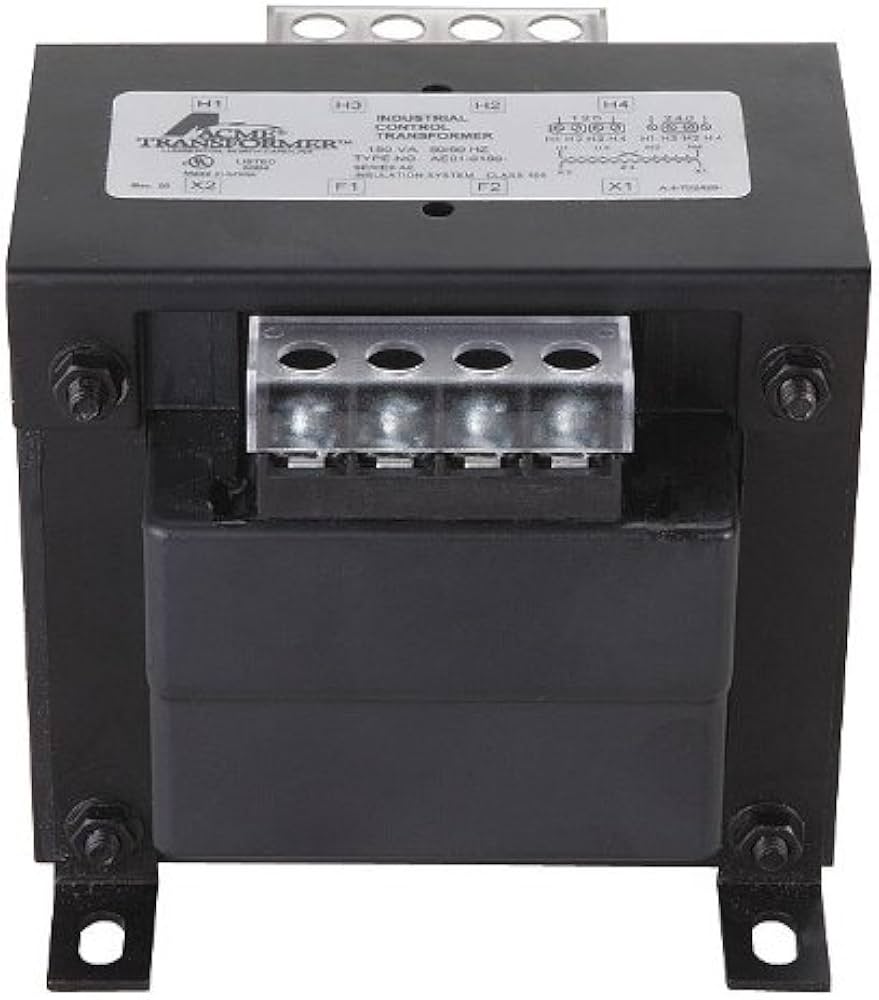
Dry Type Transformers
Not Sure Whether You Need AN, AF, or ANAF Cooling? We’ll Help You Spec It Right.
Wrong cooling class = overheating, derating, and premature failure.
Bruce Electric’s team helps engineers and facility managers select the right dry type transformer cooling configuration for their load profile, installation environment, and insulation class with new, reconditioned, and surplus inventory ready to ship.
✔ AN, AF & ANAF units in stock ✔ NEMA 1, 2, 3R enclosure options ✔ Expert sizing & cooling support
ANAF: The Dual-Mode Advantage
Many industrial dry type transformers are built as ANAF units capable of operating in both cooling modes. Under normal or partial loads, the transformer runs passively with AN cooling. When load increases, fans engage and unlock the full AF capacity.
This dual-mode design offers real operational flexibility. Facilities with variable load profiles like manufacturing plants with shift-based production or commercial buildings with peak demand periods can leverage both ratings without purchasing two separate units.
Transformer Cooling Classes and Insulation Temperature Rating
Cooling method is only half the picture. The other factor is insulation class, which defines how much temperature rise the transformer windings can sustain continuously without degradation.
Common insulation classes for dry type transformers:
| Insulation Class | Max Winding Temperature | Typical Application |
|---|---|---|
| Class B (130°C) | 130°C total | Older designs, less common today |
| Class F (155°C) | 155°C total | Standard commercial applications |
| Class H (180°C) | 180°C total | Heavy industrial, higher ambient temps |
| Class 220 (220°C) | 220°C total | High-performance, demanding environments |
Higher insulation class means the transformer tolerates more heat, but it also means the cooling system needs to ensure operating temperatures remain within that threshold. An improperly cooled Class H transformer will still fail prematurely if airflow is blocked.
A commonly used standard in North America is IEEE C57.12.01, which covers general requirements for dry type distribution and power transformers. NEMA ST-20 covers standard requirements including cooling class designations.
Choosing Between AN and AF Cooling: Buyer Considerations
There’s no universal right answer the correct cooling method depends on the specific installation. Here’s a practical framework:
Choose AN (natural air) if:
• The application runs at moderate, predictable load levels
• The installation location has adequate ventilation by design
• Fan noise or mechanical maintenance are concerns
• You’re working with commercial HVAC, lighting, or general power distribution loads
Choose AF (forced air) or ANAF if:
• The facility operates at sustained high load levels
• You need maximum kVA capacity in a limited physical footprint
• The application is industrial or process-intensive
• You want future load growth flexibility built into the unit
Choose ANAF specifically if:
• Load demand varies significantly over time
• You want a single unit that can handle both base load and peak demand
One often-overlooked factor: installation environment. A transformer in a sealed mechanical room without dedicated ventilation is an overheating risk regardless of its cooling class rating. Forced air units still need inlet and exhaust clearance typically 12–18 inches minimum around the enclosure, though always verify against the manufacturer’s installation instructions.
Common Mistakes in Transformer Cooling
Blocking ventilation paths.
The most common failure mode for naturally cooled transformers is an installation where airflow gets blocked by stored materials, adjacent equipment, or enclosures that weren’t designed for the unit’s ventilation requirements.
Ignoring ambient temperature.
Transformer kVA ratings assume a standard ambient temperature (typically 40°C per NEMA standards). In environments that regularly run hotter roof-mounted installations, poorly ventilated mechanical rooms in summer effective cooling capacity drops and the transformer must be derated accordingly.
Assuming fans eliminate all thermal risk.
Forced air cooling dramatically improves heat removal, but fan failure can still create problems. Specifying units with winding temperature monitors and alarms provides an important safety layer.
Undersizing for actual load.
Many transformers run at higher loads than originally planned. When evaluating cooling class, factor in the actual demand profile not just the nameplate connected load.
Dry Type Transformers
Overheating Transformer? Undersized Unit? Bruce Electric Has the Replacement In Stock.
Blocked ventilation, ambient derating, and undersized units are the top causes of dry type transformer failures. Don’t wait for a winding failure to shut your facility down. Bruce Electric stocks new, used, and reconditioned dry type transformers, including three-phase and K-factor rated units with fast turnaround from our Lindenhurst, NY warehouse.
✔ Ships in 24–48 hours nationwide ✔ Tested & inspected before shipping ✔ 50+ years of industry expertise
FAQs
Q1. What does AN mean in transformer cooling?
AN stands for Air Natural cooling. The transformer relies on natural airflow and convection to dissipate heat without cooling fans.
Q2. What does AF mean in transformer cooling?
AF stands for Air Forced cooling. Cooling fans increase airflow through the transformer to improve heat dissipation and increase load capacity.
Q3. What is the difference between AN and ANAF transformers?
AN transformers use only natural convection cooling. ANAF transformers combine natural air cooling with fan-assisted airflow during higher load conditions.
Q4. Can forced air cooling increase transformer capacity?
Yes. Forced air cooling commonly increases dry type transformer load capacity by approximately 25% to 33%.
Q5. Do dry type transformers require room ventilation?
Yes. Even forced air cooled transformers require adequate room ventilation and airflow clearance to operate safely and efficiently.