Shop by Categories
CLUTTER INTO PROFIT

Turn your used or unwanted transformers or circuit breakers into cash or credit
Equipment Purchase Program

5 kVA Transformers
A 5 kVA transformer is a compact dry-type transformer rated at 5,000 volt-amperes, used for voltage conversion, electrical isolation, and control power distribution in industrial and commercial systems. It is commonly applied in HVAC systems, control panels, lighting circuits, machine tools, and small industrial loads requiring stable and reliable power supply.
Bruce Electric supplies 5 kVA dry type transformers in new, surplus, and reconditioned conditions for a wide range of applications. Our inventory includes both 5 kVA single phase transformers and three-phase transformers, available in multiple voltage configurations and NEMA-rated enclosures for indoor and outdoor use. We stock transformers from leading manufacturers including GE, Hammond Power Solutions, Acme Electric, Federal Pacific, Jefferson Electric, and more. New units are available for direct purchase, while used and reconditioned units are offered through RFQ-based sourcing.
Showing 1–15 of 89 results
Hammond Power Solutions 5 kVA Three Phase Dry Type Transformer: 3300V - 120/240V (MVC5000QE)
SKU: MVC5000QEManufacturer: Hammond Power Solutions
KVA : 5
PHASE : THREE
PRIMARY VOLTAGE : 3300
SECONDARY VOLTAGE : 120/240
WINDING MATERIAL : ALUMINUM
HZ : 60
TEMP RISE : 150
ENCLOSURE : NEMA 3R HEAVY DUTY
TYPE : ENERGY EFFICIENT MEDIUM VOLTAGE DISTRIBUTION
TRADE NAME : HPS MILLENNIUM
KVA : 5
PHASE : THREE
PRIMARY VOLTAGE : 2400
SECONDARY VOLTAGE : 120/240
WINDING MATERIAL : COPPER
HZ : 60
TEMP RISE : 150
ENCLOSURE : NEMA 3R HEAVY DUTY
TYPE : ENERGY EFFICIENT MEDIUM VOLTAGE DISTRIBUTION
TRADE NAME : HPS MILLENNIUM
KVA : 5
PHASE : THREE
PRIMARY VOLTAGE : 4800
SECONDARY VOLTAGE : 120/240
WINDING MATERIAL : COPPER
HZ : 60
TEMP RISE : 150
ENCLOSURE : NEMA 3R HEAVY DUTY
TYPE : ENERGY EFFICIENT MEDIUM VOLTAGE DISTRIBUTION
TRADE NAME : HPS MILLENNIUM
Hammond Power Solutions 5 kVA Three Phase Dry Type Transformer: 6600V - 120/240V (MVC5000UE)
SKU: MVC5000UEManufacturer: Hammond Power Solutions
KVA : 5
PHASE : THREE
PRIMARY VOLTAGE : 6600
SECONDARY VOLTAGE : 120/240
WINDING MATERIAL : ALUMINUM
HZ : 60
TEMP RISE : 150
ENCLOSURE : NEMA 3R HEAVY DUTY
TYPE : ENERGY EFFICIENT MEDIUM VOLTAGE DISTRIBUTION
TRADE NAME : HPS MILLENNIUM
Hammond Power Solutions 5 kVA Three Phase Dry Type Transformer: 4160V - 120/240V (MVC5000SE)
SKU: MVC5000SEManufacturer: Hammond Power Solutions
KVA : 5
PHASE : THREE
PRIMARY VOLTAGE : 4160
SECONDARY VOLTAGE : 120/240
WINDING MATERIAL : ALUMINUM
HZ : 60
TEMP RISE : 150
ENCLOSURE : NEMA 3R HEAVY DUTY
TYPE : ENERGY EFFICIENT MEDIUM VOLTAGE DISTRIBUTION
TRADE NAME : HPS MILLENNIUM
Hammond Power Solutions 5 kVA Three Phase Dry Type Transformer: 7200V - 120/240V (MVC5000VE)
SKU: MVC5000VEManufacturer: Hammond Power Solutions
KVA : 5
PHASE : THREE
PRIMARY VOLTAGE : 7200
SECONDARY VOLTAGE : 120/240
WINDING MATERIAL : COPPER
HZ : 60
TEMP RISE : 150
ENCLOSURE : NEMA 3R HEAVY DUTY
TYPE : ENERGY EFFICIENT MEDIUM VOLTAGE DISTRIBUTION
TRADE NAME : HPS MILLENNIUM
KVA : 5
PHASE : THREE
PRIMARY VOLTAGE : 240
SECONDARY VOLTAGE : 208Y/120
WINDING MATERIAL : COPPER
HZ : 60
TEMP RISE : 115
KVA : 5
PHASE : THREE
PRIMARY VOLTAGE : 240
SECONDARY VOLTAGE : 400Y/230
WINDING MATERIAL : COPPER
HZ : 60
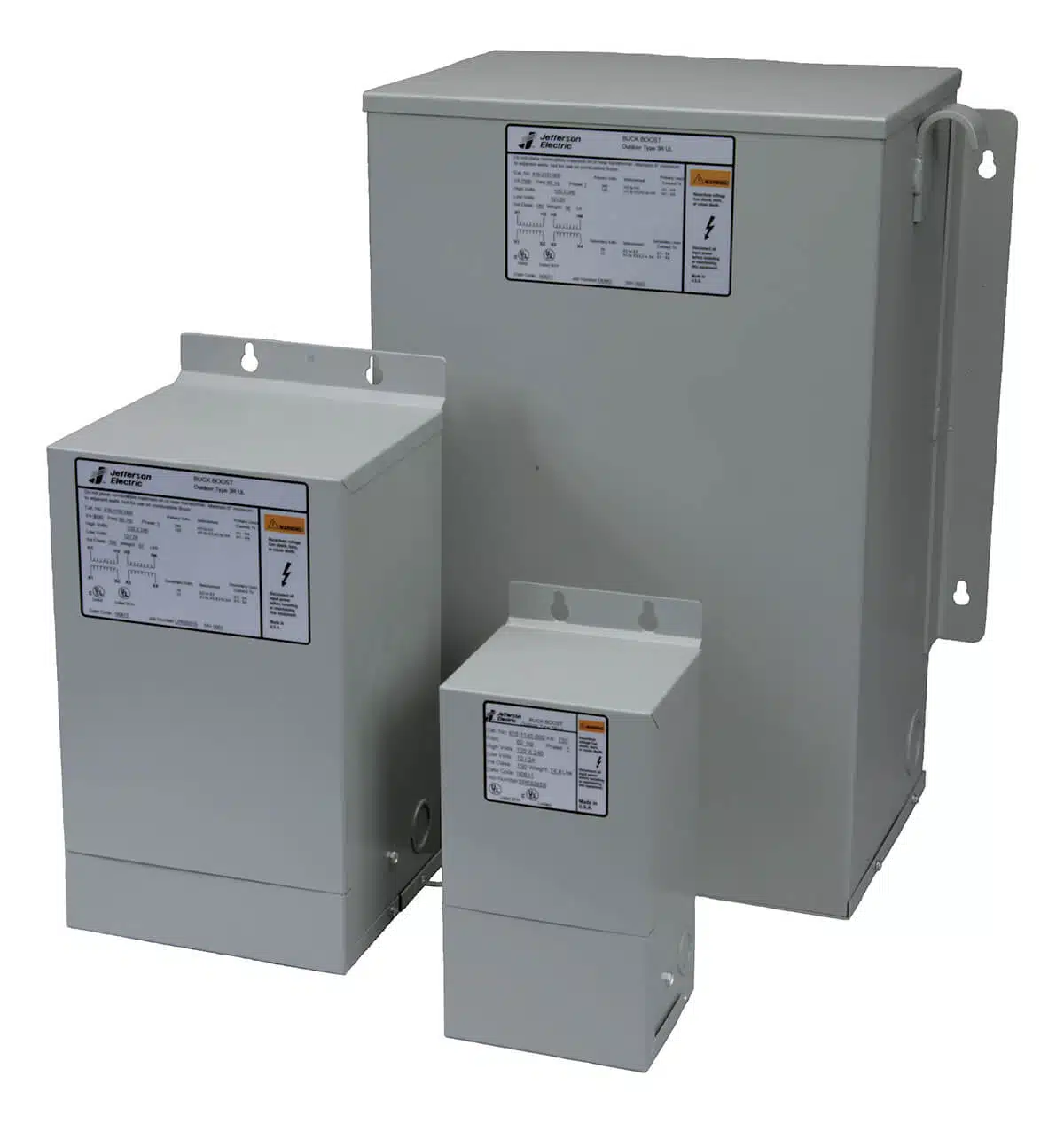
KVA : 5
PHASE : THREE
PRIMARY VOLTAGE : 240 X 480
SECONDARY VOLTAGE : 24/48
WINDING MATERIAL : ALUMINUM
HZ : 60
TEMP RISE : 120
ENCLOSURE : NEMA 3R
TYPE : BUCK BOOST
Jefferson Electric 5 kVA Three Phase Dry Type Transformer: 120 X 240V - 16/32V (416-1291-000)
SKU: 416-1291-000Manufacturer: Jefferson Electric
Weight: 90.5 lbs
KVA : 5
PHASE : THREE
PRIMARY VOLTAGE : 120 X 240
SECONDARY VOLTAGE : 16/32
WINDING MATERIAL : ALUMINUM
HZ : 60
TEMP RISE : 120
ENCLOSURE : NEMA 3R
TYPE : BUCK BOOST
EGS/SOLAHD 5 kVA Single Phase Dry Type Transformer: 240 X 480V - 120/240V (HSIF5AS)
SKU: HSIF5ASManufacturer: EGS/SOLAHD
Weight: 131 lbs
KVA : 5
PHASE : SINGLE
PRIMARY VOLTAGE : 240 X 480
SECONDARY VOLTAGE : 120/240
WINDING MATERIAL : ALUMINUM
HZ : 60
TEMP RISE : 115
ENCLOSURE : NEMA 3R ENCAPSULATED
TYPE : NON-VENTILATED AUTOMATION TRANSFORMER
TAPS : 2, 5% FCBN
EGS/SOLAHD 5 kVA Single Phase Dry Type Transformer: 240 X 480V - 24/48V (HS22F5A)
SKU: HS22F5AManufacturer: EGS/SOLAHD
Weight: 100 lbs
KVA : 5
PHASE : SINGLE
PRIMARY VOLTAGE : 240 X 480
SECONDARY VOLTAGE : 24/48
WINDING MATERIAL : ALUMINUM
HZ : 60
TEMP RISE : 115
ENCLOSURE : NEMA 3R ENCAPSULATED
TYPE : BUCK BOOST TRANSFORMER
KVA : 5
PHASE : SINGLE
PRIMARY VOLTAGE : 120 X 240
SECONDARY VOLTAGE : 16/32
WINDING MATERIAL : ALUMINUM
HZ : 60
TEMP RISE : 115
ENCLOSURE : NEMA 3R ENCAPSULATED
TYPE : BUCK BOOST TRANSFORMER
EGS/SOLAHD 5 kVA Single Phase Dry Type Transformer: 120 X 240V - 24-DecV (HS19F5A)
SKU: HS19F5AManufacturer: EGS/SOLAHD
Weight: 100 lbs
KVA : 5
PHASE : SINGLE
PRIMARY VOLTAGE : 120 X 240
SECONDARY VOLTAGE : 24-Dec
WINDING MATERIAL : ALUMINUM
HZ : 60
TEMP RISE : 115
ENCLOSURE : NEMA 3R ENCAPSULATED
TYPE : BUCK BOOST TRANSFORMER
EGS/SOLAHD 5 kVA Single Phase Dry Type Transformer: 190/200/208/220/380/400/415/440V - 110/220V (HS14F5BS)
SKU: HS14F5BSManufacturer: EGS/SOLAHD
Weight: 100 lbs
KVA : 5
PHASE : SINGLE
PRIMARY VOLTAGE : 190/200/208/220/380/400/415/440
SECONDARY VOLTAGE : 110/220
WINDING MATERIAL : COPPER
HZ : 50/60
TEMP RISE : 115
ENCLOSURE : NEMA 3R ENCAPSULATED
TYPE : NON-VENTILATED AUTOMATION TRANSFORMER
5 kVA Transformers | Control Power, Buck-Boost & Lighting.
Single and three-phase units for industrial control panels, HVAC automation, and low-voltage lighting. Encapsulated NEMA 3R options for outdoor use. Medium voltage models available from 2400V to 7200V primary (HPS Millennium series). 50/60 Hz dual-frequency on select models.
✔ Open style, NEMA 1, 2, 3R, and encapsulated enclosures ✔ Wall, panel, or base mount options ✔ Used and reconditioned units available via RFQ
5 kVA Transformer Specifications
| Parameter | Typical Range / Options |
|---|---|
| kVA Rating | 5 kVA (5,000 VA) |
| Frequency | 50 Hz, 60 Hz, or 50/60 Hz (model-dependent) |
| Phase | Single Phase / Three Phase |
| Primary Voltage | 120V – 7200V (model dependent) |
| Secondary Voltage | 12V – 400Y/230V (model dependent) |
| Mounting | Wall / Panel / Base Mount |
| Cooling Method | Dry Type (Air Cooled) |
| Temperature Rise | 55°C–180°C (Model-dependent) |
| Winding Material | Copper or Aluminum |
| Enclosure Types | Open style, NEMA 1, NEMA 2, NEMA 3, NEMA 3R, NEMA 3R encapsulated, or fully encapsulated |
| Mounting Style | Wall, Floor, or Panel Mounted |
| Efficiency | DOE-compliant designs available |
| Taps | Many models include primary taps (approximately 2.5% above/below rated primary voltage (FCAN/FCBN); tap configuration varies by model |
How Many Amps Can a 5 kVA Transformer Handle?
The current output of a 5 kVA transformer depends on secondary voltage and phase configuration. Full-load amperage varies with system conditions since kVA is apparent power, not fixed current.
Single-phase: Full-Load Amps = (kVA × 1,000) ÷ Volts
Example at 240V Single Phase: Amps = 5,000 ÷ 240 = 20.83 A
Three-phase: Full-Load Amps = (kVA × 1,000) ÷ (Volts × 1.732)
Example at 480V Three Phase: Amps = 5,000 ÷ (480 × 1.732) = 6.01 A
5 kVA Transformer Full-Load Amps Reference Table
| Voltage | Single-Phase Current | Three-Phase Current |
|---|---|---|
| 120V | 41.67 A | – |
| 208V | 24.04 A | 13.88 A |
| 240V | 20.83 A | 12.03 A |
| 277V | 18.05 A | – |
| 400V | 12.50 A | 7.22 A |
| 480V | 10.42 A | 6.02 A |
| 600V | 8.33 A | – |
Note: On a 5 kVA transformer with a 120/240V center-tapped secondary, 41.67 A reflects the transformer’s total rated capacity it is not independently available on each 120V leg simultaneously. Confirm leg loading against the manufacturer’s wiring diagram.
Per NEC Article 450.3(B) (transformers 1000V or less), the 125% sizing rule generally applies to primary-only overcurrent protection. Where both primary and secondary protection are provided, NEC 450.3(B) permits primary protection up to 250% with secondary protection at 125%. Final application of these rules depends on the NEC edition adopted in your jurisdiction, use BEE’s kVA Calculator as a starting point and confirm with a qualified electrician before selecting protection devices.
5 kVA Transformer Configurations We Have In Stock
Single-Phase Configurations
| Primary Voltage | Secondary Voltage | Common Use Case |
|---|---|---|
| 120×240V | 120/240V | General purpose distribution, control power |
| 120×240V | 12/24V | Buck-boost voltage correction |
| 120×240V | 16/32V | Buck-boost voltage correction |
| 208V | 120/240V | Step-down from 208V service for control or lighting |
| 208V | 208V | Isolation/distribution at matched voltage |
| 240V | 120/240V | General purpose step-down |
| 240×480V | 120/240V | Industrial control, most common step-down configuration |
| 240×480V | 24/48V | Buck-boost voltage correction, HVAC controls |
| 277V | 120/240V | Step-down from 277V lighting service |
| 277/480V | 208/277V | Lighting transformer isolation and tap conversion |
| 480V | 120/240V | Control power from 480V service; machine tools |
| 600V | 120/240V | Canadian primary service, step-down to 120/240V |
| 120/208/240/277V | 120/240V | Multi-tap primary for flexible installation |
| 190–440V (multi-range) | 110/220V or 120/240V | Export and international equipment applications |
| 347/380V | 120/240V | Canadian and international service entry |
Three-Phase Configurations
| Primary Voltage | Secondary Voltage | Common Use Case |
|---|---|---|
| 120×240V | 16/32V | Three-phase buck-boost voltage correction |
| 120×240V | 12/24V | Three-phase buck-boost voltage correction |
| 240×480V | 24/48V | Three-phase buck-boost, HVAC/industrial correction |
| 240V | 208Y/120V | Three-phase distribution, commercial panel feed |
| 240V | 400Y/230V | International three-phase distribution |
| 2400–7200V | 120/240V | Medium voltage primary service (HPS Millennium series) |
Important Note: The 5 kVA category includes Hammond Power Solutions Millennium medium-voltage dry-type distribution models with primary voltages from 2400V through 7200V and 120/240V secondary voltage. These are specialized three-phase distribution products. Confirm the intended application, enclosure, grounding method, protection scheme, connection requirements, and manufacturer documentation before specification.
Available 5 kVA Transformer Types and Configurations
Bruce Electric offers 5 kVA transformers for control power, voltage conversion, lighting, OEM equipment, and small distribution needs. The category includes common single-phase 208V, 277V, 480V, 600V, and 240 × 480V to 120/240V configurations, along with 480V to 240/120V panel-power-center models, 277/480V to 208/277V distribution transformers, buck-boost units, multivoltage export models, and select three-phase options for 240V to 208Y/120V or 400Y/230V applications. Specialized medium-voltage models with 2400V through 7200V primaries are also represented. Whether you need a standard replacement, control transformer, buck-boost unit, isolation/distribution model, or international-voltage configuration, Bruce Electric can help match the right 5 kVA transformer using your voltage, phase, frequency, enclosure, part number, or nameplate details. Confirm the final selection with the manufacturer’s wiring diagram and product documentation.
Applications of 5 kVA Transformers
1. Industrial Control Panels and Machine Tools. Supplies control power for PLCs, relays, contactors, solenoids, and machine control circuits commonly stepping 240V or 480V building power down to 120V or 120/240V control voltage.
2. HVAC and Building Automation. Suitable for thermostats, damper actuators, sensors, and building automation controls requiring corrected or low-voltage supply.
3. Buck-Boost Voltage Correction. Corrects minor voltage deviations on an existing feeder without full step-down/step-up isolation.
4. OEM Equipment and Imported Machinery. Multi-tap and export-model transformers support equipment built around different primary voltages or 50/60 Hz requirements.
5. Lighting and Auxiliary Power. Provides 120V or 120/240V auxiliary power for lighting controls, small equipment loads, and control devices.
6. Instrumentation and Test Equipment. Isolation/distribution and encapsulated options support control, monitoring, and test applications requiring circuit separation.
How to Select the Right 5 kVA Transformer
Selecting a 5 kVA dry type transformer requires evaluating voltage requirements, load characteristics, and installation conditions to ensure safe operation and long-term reliability. At this rating, transformers are often used for multiple control and auxiliary loads, making proper selection important for stable performance.
1. Verify System Voltage Requirements. Confirm both supply and load voltage before selection. A 5 kVA transformer is commonly used in 480V, 240V, and 208V systems for control and auxiliary power conversion.
2. Identify Load Grouping Requirements. Determine whether the transformer will serve a single device or multiple loads such as control panels, HVAC systems, or auxiliary circuits operating together.
3. Determine Phase Configuration. Choose single-phase or three-phase based on facility supply and equipment needs. Three-phase is common in industrial applications, while single-phase is widely used in commercial and OEM systems.
4. Evaluate Load Type. Consider whether loads are resistive, inductive, or electronic. Inductive devices like motors and solenoids may generate higher inrush currents during startup.
5. Select Enclosure Type. Choose protection based on environment, such as NEMA 1 for indoor use, NEMA 3R for outdoor installations, or encapsulated designs for harsh conditions.
6. Confirm Voltage Compatibility. Ensure correct primary and secondary matching. Common configurations include step-down applications like the 5 kVA 480 to 120 transformer and other facility-specific requirements.
7. Maintain Proper Load Margin. For continuous-duty operation, avoid running the transformer at full capacity. Operating at a reduced load improves thermal performance and extends service life.
5 kVA Transformer Installation Considerations
Installation of a 5 kVA dry type transformer should follow established electrical safety practices and manufacturer guidelines to ensure safe operation, proper heat dissipation, and system reliability.
1. Mounting and Physical Support. Install the 5 kVA transformer on a stable, vibration-free surface with adequate structural support to ensure safe operation based on enclosure type and mounting configuration.
2. Ventilation and Heat Dissipation. Provide sufficient clearance around the transformer to maintain airflow and prevent heat buildup during continuous-duty operation, ensuring stable performance and extended service life.
3. Electrical Protection Devices. Use properly rated fuses, circuit breakers, or disconnect switches to protect the 5 kVA transformer from overloads and short-circuit conditions in both primary and secondary circuits.
4. Grounding and Bonding. Ensure correct grounding of the transformer enclosure and system neutral in accordance with electrical code requirements to maintain safety and system stability.
5. Environmental and Enclosure Compliance. Match installation conditions with enclosure ratings such as NEMA 1 or NEMA 3R to ensure protection against dust, moisture, and environmental exposure.
6. Code Compliance and Safety Standards. Follow NEC Article 450 and local electrical regulations during installation to ensure safe operation, proper system coordination, and compliance with industry standards.
DOE and Compliance Notes
Federal DOE dry-type distribution-transformer efficiency requirements generally apply to qualifying dry-type transformers rated from 15 kVA through 5,000 kVA. A 5 kVA transformer is below that threshold. Several specialty transformer types, including autotransformers, machine-tool control transformers, nonventilated transformers, drive-isolation transformers, sealed transformers, and certain wide-tap-range models, may also fall outside the federal dry-type distribution-transformer definition.
Confirm project-specific efficiency, compliance, listing, and specification requirements using the selected manufacturer’s current documentation.
Why Choose Bruce Electric for 5 kVA Transformers?
Bruce Electric has supplied industrial electrical equipment since 1973, helping contractors, OEMs, maintenance teams, and facility managers source the right transformer for voltage conversion, control power, and replacement needs. Our team can help match exact voltage, phase, enclosure, frequency, and manufacturer requirements using a part number or nameplate photo. With new listed inventory plus RFQ-based sourcing for used, surplus, and reconditioned equipment, Bruce Electric provides practical options for both standard and hard-to-find 5 kVA transformer applications.
FAQs
Q1. What size load can a 5 kVA transformer support?
A 5 kVA transformer supports up to 5,000 VA of connected load, but continuous operation is typically recommended at 80–90% of rated capacity depending on duty cycle and load type.
Q2. When should I choose a 5 kVA transformer instead of a smaller unit?
A 5 kVA transformer is selected when multiple control devices, auxiliary circuits, or combined loads exceed the capacity of smaller control transformers such as 1 kVA or 3 kVA units.
Q3. How do voltage configurations affect a 5 kVA transformer selection?
Voltage configuration determines compatibility with supply and equipment requirements, such as 480V to 120V control power applications or other facility-specific distribution levels.
Q4. Can a 5 kVA transformer handle motor or inductive loads?
Yes, but inductive loads require careful consideration due to inrush current. Proper sizing and protection coordination are important for motors, solenoids, and similar equipment.
Q5. What installation factors are critical for a 5 kVA transformer?
Key factors include enclosure rating, ventilation, grounding, overcurrent protection, and compliance with electrical codes to ensure safe and reliable operation.
Browse Related Transformer Categories
Technical Reading
Dry Type Transformer Testing & Troubleshooting Guide