Why Do Transformers Blow? Common Causes of Transformer Explosion and Failure

There’s a reason a transformer blowing up makes the news. The flash of blue light, the crack of sound, and the neighbourhood going dark are jarring but it’s not random. Behind every failed transformer is a sequence of identifiable, preventable events.
Transformers blow primarily due to insulation breakdown, overloading, lightning-induced voltage surges, internal short circuits, cooling system failure, or aging infrastructure. Each of these failures creates extreme heat and pressure buildup that the transformer cannot contain leading to anything from a quiet shutdown to a catastrophic electrical transformer explosion.
Whether you’re a facility manager, electrical engineer, or procurement professional, understanding why power transformers fail helps you make smarter decisions before a crisis forces your hand. This guide breaks down the six core causes of transformer failure, explains the critical difference between oil-filled and dry-type transformer risk, and gives you a clear path to prevention.
What Actually Happens When a Transformer Blows?
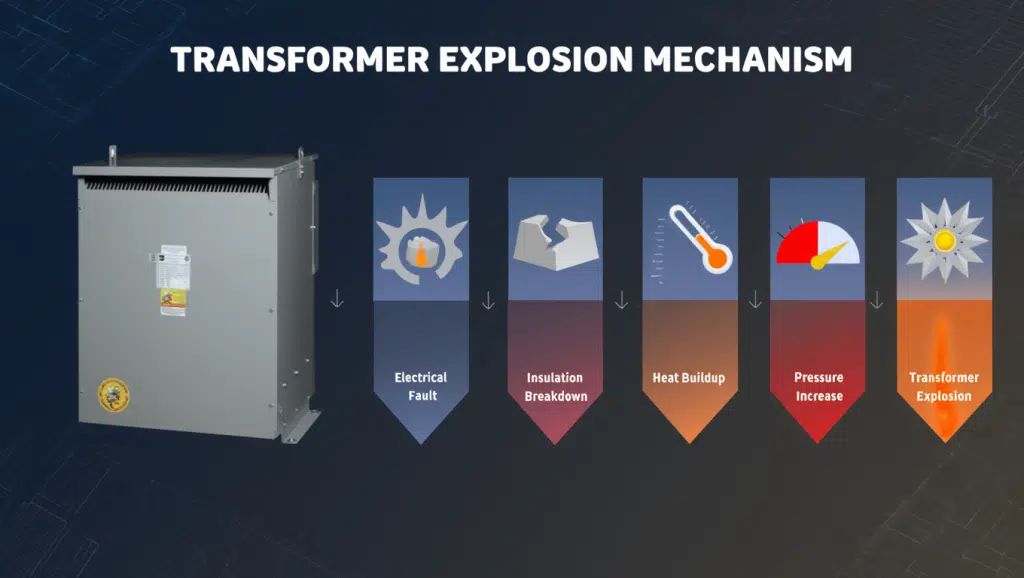
Transformer failure is rarely instantaneous; it’s a chain reaction. It typically begins with an electrical fault or thermal stress, which degrades the insulation protecting the windings. As insulation breaks down, current flows where it shouldn’t, generating rapid heat buildup. That heat accelerates further degradation, creating a runaway thermal cycle.
In oil-filled transformers, the mineral oil used for cooling vaporizes under extreme temperatures and can ignite, producing the explosive fireball most people associate with a transformer explosion. During fault conditions, internal temperatures can exceed 1,200°C in severe cases.
Dry-type transformers behave very differently. Because they use air or solid epoxy resin instead of oil, there is no flammable liquid to vaporize or ignite. This is precisely why building codes require dry-type units in hospitals, schools, data centers, and high-rise buildings environments where a fire or explosion is unacceptable.
⚠️ Warning Signs? Act Now.
See Burning Smell, Noise, or Bulging? Replace Your Transformer Before It Blows.
Transformer failures are preventable, but once you see warning signs, time is critical. Our dry-type units eliminate the risk of explosion and ship within 24–48 hours for emergency replacement.
✔ Dry-type = zero explosion risk vs oil-filled units ✔ K-Factor rated for harmonic-heavy loads (VFDs, servers) ✔ Emergency replacement units available nationwide
6 Common Causes of Transformer Explosions and Failures
1. Overloading Beyond Rated Capacity
Every transformer is rated in kilovolt-amperes (kVA) the maximum load it can safely handle. When connected equipment draws more current than that rating allows, the excess energy becomes heat in the windings. Sustained overloading degrades insulation rapidly and can lead to winding failure.
Modern facilities with variable frequency drives (VFDs), computers, LED lighting systems, and UPS equipment introduce non-linear loads that generate harmonics distorted waveforms that create additional heat even when the fundamental current stays within the rated limit. For these environments, K-Factor rated dry-type transformers are engineered to handle harmonic-heavy loads without premature failure.
2. Insulation Breakdown
Insulation is the transformer’s first and most critical line of defense. Winding insulation degrades over time due to heat cycling, moisture ingress, contamination, and simple aging. Once insulation fails, current can arc between conductors or from winding to core triggering a short circuit and rapid energy discharge.
Insulation thermal class determines how much heat a transformer can safely endure. Class F insulation is rated to 155°C; Class H insulation withstands up to 180°C. Choosing the right insulation class for the operating environment is essential and one of the factors that separates a well-specified dry-type transformer from an undersized one.
3. Lightning Strikes and Voltage Surges
A direct or nearby lightning strike can inject a massive transient voltage spike into the power line far exceeding what any transformer is designed to absorb. Switching surges from utility grid switching operations cause similar, though typically less severe, voltage transients.
If surge protective devices are aging, undersized, or absent entirely, the full force of those transient travels into the transformer’s windings. Pairing transformers with properly rated Transient Voltage Surge Suppressors (TVSS) is one of the most cost-effective protection strategies available.
4. Internal Short Circuits
An internal short circuit, whether from a winding fault, physical damage, or foreign material contamination creates an instantaneous, uncontrolled energy discharge through a path of near-zero resistance. This is one of the fastest routes to catastrophic transformer failure.
Differential relay protection and properly sized overcurrent devices are the primary safeguards. For critical installations, periodic insulation resistance (Megger) testing can identify developing winding faults before they escalate to a full internal short.
5. Cooling System Failure
Heat is a transformer’s constant enemy. For oil-filled units, low oil levels, contaminated oil, or blocked cooling fins interrupt the thermal management system and allow temperatures to climb unchecked. For dry-type transformers, blocked ventilation paths, dust accumulation on the windings, and failed cooling fans in forced-air models create the same problem.
Dry-type transformers must be installed in clean, dry, and adequately ventilated locations per manufacturer and NEMA installation guidelines. Enclosures that are too tight, or equipment rooms with poor airflow, are a common and preventable cause of premature transformer failure.
6. Age and Deferred Maintenance
A significant percentage of transformers in service across the U.S. are operating well past their intended design life. Aged units accumulate wear across insulation, gaskets, winding connections, and tap changers each of which increases the probability of failure with every passing year.
A properly maintained dry-type transformer, installed per manufacturer and IEEE C57.96 guidelines, can reliably serve more than 20 years. However, deferred maintenance skipped inspections, uncleaned ventilation, untested connections compresses that service life dramatically. Proactive replacement of aging units is almost always less expensive than emergency replacement after an unplanned failure.
Are Dry-Type Transformers Safer? What Most People Don’t Tell You
Most coverage of transformer explosions focuses on oil-filled distribution units the dramatic blue fireballs you see in viral videos. That coverage is accurate for oil-filled units. What it misses is the fundamental engineering difference between oil-filled and dry-type transformers.
Dry-type and resin-encapsulated transformers carry a dramatically lower explosion and fire propagation risk by design. Without flammable liquid, the mechanism for explosion is eliminated. Cast Resin (CRT), Vacuum Pressure Impregnated (VPI), and Encapsulated dry-type designs each provide inherent fire resistance, making them the required or preferred choice in any application where life safety and code compliance are paramount.
This isn’t simply a product preference. It’s why the NEC (National Electrical Code) and International Building Code (IBC) specify dry-type transformers for indoor and occupied building applications. In hospitals, data centers, schools, shopping centers, and high-rise facilities, dry-type transformers aren’t just the safer option they’re the code-compliant one.
Warning Signs Your Transformer May Be About to Fail
Transformer failures rarely occur without warning. Watch for these indicators:
• Unusual transformer humming, buzzing, or crackling sounds from the unit.
• Burning smell or visible discoloration, scorch marks, or carbon deposits on the housing.
• Frequent tripped breakers or erratic, unstable voltage supply to connected equipment.
• Oil leaks or staining around the base or seams of oil-filled units.
• The transformer housing feels abnormally hot to the touch during normal operation.
• Load demands that have grown to approach or exceed the unit’s original kVA rating.
If any of these signs appear, do not delay investigation. Transformer failures rarely reverse themselves and the cost of emergency replacement, production downtime, or facility damage consistently exceeds the cost of proactive action.
🔄 Proactive Replacement
Don’t Wait for Catastrophe – Upgrade to a K-Factor Rated Dry-Type Transformer
Modern facilities with VFDs, computers, and LED lighting require K-Factor-rated units engineered for harmonic-heavy loads. Standard transformers degrade 2× faster under non-linear loads. Upgrade before failure forces emergency downtime.
✔ K-4, K-13, K-20 ratings available for harmonic mitigation. ✔ Class F (155°C) and Class H (180°C) insulation options ✔ Sell your old transformer for cash or credit toward the upgrade
How to Prevent Transformer Explosions and Failures
Transformer failure is largely preventable. These five practices cover the most critical prevention points:
• Right-size from the start: Use a kVA calculator to match transformer capacity to actual connected load factoring in harmonic-generating equipment. An undersized transformer is a failure waiting to happen.
• Choose the correct transformer type for the environment: Dry type for any indoor, occupied, or sensitive location. K-Factor rated units for facilities with VFDs, servers, or non-linear loads. Drive isolation transformers where VFD-induced noise and harmonic stress require dedicated transformer protection.
• Schedule routine inspections: Annually verify insulation resistance, clean ventilation paths, test protective relays, and inspect winding connections and tap changer contacts.
• Install surge protection: Pair every transformer with correctly rated TVSS devices to guard against lightning and grid switching transients particularly for facilities in high-lightning zones or served by long overhead lines.
• Replace aging units proactively: If a transformer is approaching or past its expected service life, reconditioned or new in-stock units are a cost-efficient, fast-ship solution before a failure forces an emergency.
Frequently Asked Questions
1. What does it mean when a transformer blows?
A blown transformer means the unit has experienced an internal failure most commonly insulation breakdown, overloading, or a voltage surge that overwhelmed the unit. The result is loss of power to all connected equipment, and in oil-filled units, potential fire or explosion risk. Dry-type transformer failures are generally contained within the unit without fire propagation.
2. Is an electrical transformer explosion dangerous?
Oil-filled transformer explosions are serious hazards they release burning fluid, shrapnel, and high-voltage electrical hazards. Dry-type transformer failures are significantly less dangerous by design. Without flammable liquid, there is no explosion mechanism, and fire propagation is minimal to none. This is why dry-type transformers are the required choice for occupied buildings under the National Electrical Code.
3. Can a power transformer blowing up be prevented?
Yes, in many cases. Proper kVA sizing, routine inspection, surge protection, appropriate transformer type selection, and proactive replacement of aging units are the most effective prevention strategies. Most transformer failures that make the news are the result of deferred maintenance or undersized equipment, not unavoidable events.
Need a Replacement Transformer? Bruce Electric Has You Covered.
Since 1973, Bruce Electric Equipment Corp. has been one of North America’s largest master stocking distributors of dry-type transformers. Our inventory includes new, reconditioned and used dry-type transformers from GE, Acme, Hammond, ABB, and Hevi-Duty all available with warranty and fast-ship capability for emergency replacements.
Whether you need a direct replacement, an upgrade to a K-Factor rated unit, or a drive isolation transformer for a VFD-heavy facility we stock what you need.
→ Not sure what size you need? Use our free kVA Calculator
Standards referenced: NEMA ST-20, IEEE C57.96, NEC Article 450, IBC Chapter 6