Whole House Surge Suppression: How It Works and Why It’s Critical for Electrical Systems

Your building can experience up to 100 power surges every month, and most of them go completely unnoticed. These small, frequent voltage spikes don’t always cause immediate failure, but over time they quietly degrade electrical systems, shorten equipment lifespan, and increase the risk of costly downtime. Whole house surge suppression is designed to stop this damage before it starts. It works by installing a surge protection device (SPD) at your main electrical panel, where it intercepts excess voltage and safely diverts it to ground before it can reach any connected circuits. In this guide, you’ll learn how whole house surge suppression works, what causes power surges, and why it is a critical investment for protecting residential, commercial, and industrial electrical systems.
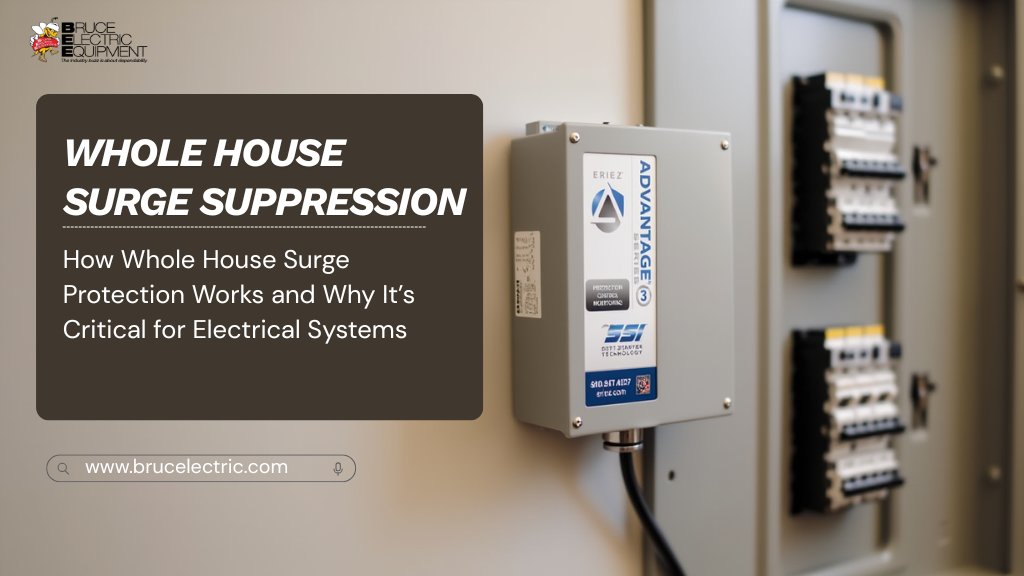
What Is a Whole House Surge Suppressor – And How Is It Different from a Power Strip?
A whole house surge suppressor is a surge protection device (SPD) installed at your main electrical panel, protecting all circuits at once and reacting in nanoseconds to unsafe voltage. A power strip, by comparison, only protects connected devices, handles far lower surge capacity, and wears out silently over time.
These devices were formerly called TVSS (Transient Voltage Surge Suppressors). Under UL 1449, they’re now classified as SPDs same core technology, updated terminology. Any unit you specify should meet UL 1449 as a minimum requirement. For a detailed breakdown of how the two terms differ in practice, see our guide on the difference between surge suppressors and surge protectors.
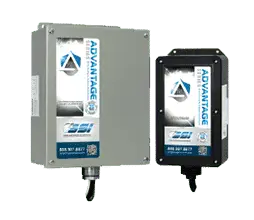
Surge Protective Devices / TVSS
Protect Your Electrical System Before Failure Happens.
Bruce Electric stocks UL 1449-compliant SPDs and TVSS units – new, reconditioned, and surplus, ready to ship for residential, commercial, and industrial installations.
What Causes Power Surges in Electrical Systems?
Power surges can be caused by both external and internal sources. Understanding these causes highlights why a layered surge protection strategy is essential.
External Surges (20% of Events – High Impact):
External power surges are less common but can be catastrophic when they occur. These surges typically happen due to:
• Lightning strikes: When lightning hits a power line or nearby area, it sends a huge voltage spike through the electrical grid.
• Utility grid switching: Power companies occasionally switch the flow of electricity to different grid sections, which can create sudden voltage changes.
• Neighboring facilities: Electrical activity from nearby industrial operations, factories, or large buildings may create voltage fluctuations that can affect your electrical system.
Even a single external surge can damage panels, transformers, and critical systems.
Internal Surges (80% of Events – High Frequency):
While external surges can be dramatic, the more frequent and insidious threats come from internal surges, which are often caused by devices within your own electrical system. These include:
• HVAC systems: Air conditioners, heating units, and ventilation systems use large motors that can cause voltage fluctuations.
• Refrigerators and freezers: The compressors in these appliances can create voltage spikes when they cycle on and off.
• Electric vehicle (EV) chargers: Charging an electric vehicle can produce brief power surges that impact the system.
• Motors and appliances: Other equipment, like pumps, elevators, and washing machines, can generate voltage spikes or transient surges during startup and operation.
These repeated micro-surges gradually wear down insulation and electronic components, leading to premature failure.
How Does Whole House Surge Suppression Work? (4-Step Process)
A properly installed SPD/TVSS operates automatically, invisibly, and in nanoseconds every single time a surge occurs:
• Monitor: The SPD continuously monitors incoming voltage at the main electrical panel for any deviation above the rated threshold.
• Detect: The moment voltage spikes beyond the safe operating range; the SPD activates typically within 1 nanosecond of detection.
• Divert: A Metal Oxide Varistor (MOV) becomes conductive, absorbing excess voltage and redirecting it safely to the grounding wire where it dissipates harmlessly.
• Resume: Normal voltage flow resumes immediately with zero interruption to connected devices or circuits.
The MOV (Metal Oxide Varistor) is the active core of most SPDs. Under normal operating conditions it is electrically inert. The instant voltage exceeds its clamping threshold, it transitions to a conductive state, absorbing the surge energy before any downstream equipment is affected. This is why MOV degradation over time matters: a worn MOV may no longer clamp effectively, making annual inspection and periodic replacement every 3 to 5 years under normal conditions essential to maintaining real protection.
It’s important to note that TVSS (Transient Voltage Surge Suppressors) was the older term for SPDs, but the industry has shifted to calling them SPDs as per the UL 1449 standard.
Whole House Surge Protection: Types, Placement, and Installation
Surge protection is only effective if you have the right device in the right location. The NEC and UL 1449 standard define three SPD types based on installation point. Here’s what you need to know about selecting and installing surge protection.
Surge Protection Device Types:
There are three primary types of surge protectors, each serving a specific purpose in protecting your electrical system.
Type 1 Surge Protector:
This type is installed at the service entrance, where the electrical supply enters the building. It protects against external surges like lightning strikes and utility grid switching.
Type 2 Surge Protector:
Installed at the electrical panel, this protector offers defense against internal surges that are created by appliances and equipment within the building.
Type 3 Surge Protector:
These are point-of-use surge protectors that can be plugged into outlets to protect individual devices, such as computers and televisions.
Layered Protection Strategy (Best Practice)
For maximum protection, combine all three types:
• Type 1 – Blocks external surges
• Type 2 – Protects internal circuits
• Type 3 – Safeguards sensitive devices
This multi-layered approach ensures complete system protection.
Installation Considerations
Proper installation is critical for performance.
• Type 1 and Type 2 SPDs must be installed by a licensed electrician
• Devices must be properly grounded and integrated into the system
• Incorrect installation can reduce effectiveness or cause failure
Why Whole House Surge Suppression Is Important
Whole house surge suppression offers several key benefits as follows:
• Protects Electrical Infrastructure: Your electrical panels, transformers, and other vital components are protected from surges, preventing costly damage.
• Prevents Equipment Damage and Failure: Sensitive devices like computers, television sets, HVAC units, and industrial machinery are safeguarded from voltage spikes, extending their useful lifespan.
• Reduces Downtime: For businesses, minimizing downtime is crucial. Surge protection helps ensure operations remain uninterrupted by protecting critical equipment from failure.
• Extends Equipment Lifespan: Repeated small surges can slowly degrade the internal components of appliances, leading to expensive repairs or replacements. Surge suppression reduces this risk.
• Financial Impact: Over time, micro-surges can cost a lot more than the initial investment in surge protection. Repairing or replacing damaged equipment due to surges is far more expensive than installing proper surge protection.
What to Consider When Choosing a Surge Protection Device
Selecting the right SPD ensures optimal protection and performance.
• Surge Current Rating (kA): Check how much surge current the device can safely handle. Choose an SPD with a sufficient kA rating to withstand the maximum surge levels expected in your environment. Residential applications typically require a minimum of 40 kA at the panel level. Commercial and industrial environments should be rated higher based on load profile, proximity to utility infrastructure, and lightning exposure.
• Voltage Protection Rating (VPR): Look at the VPR value to understand how much voltage the device allows to pass through during a surge. In general, a lower VPR indicates better protection for connected equipment, provided the SPD is properly rated for the application.
• System Voltage Compatibility: Verify that the SPD matches your electrical system’s voltage. An incompatible device will reduce protection efficiency and may fail to operate correctly.
• UL 1449 Compliance: Ensure the SPD meets the UL 1449 standard, which confirms that the device has been tested for safety, performance, and surge-handling capability. choose devices with indicator lights or audible alarms that signal when the MOV has been depleted
Cost vs Risk: Why Surge Protection Pays for Itself
The cost of installing surge protection varies by system, but the risk of not having it is consistent.
Unprotected electrical systems face both large surge events and frequent internal voltage fluctuations, which can cause equipment damage, downtime, and costly repairs.
For example, a brief voltage spike during a power disturbance can damage HVAC controls or drive systems leading to unexpected failures and operational disruption.
Over time, repeated micro-surges can also gradually degrade insulation and electronic components, reducing equipment reliability and lifespan. Surge protection is a preventive investment that helps avoid equipment damage, downtime, and long-term maintenance costs.
Why Choose Bruce Electric for Surge Protection Solutions
With over 50 years of experience in electrical distribution, Bruce Electric Equipment Corp. delivers more than just surge protection devices and it provides complete, engineered power protection solutions. From UL 1449 and IEEE-compliant products to expert installation and system integration, Bruce Electric supports residential, commercial, and industrial applications of all sizes. Their approach goes beyond standalone devices, combining surge protection with UPS systems, power line conditioners, and properly specified circuit breakers to safeguard entire electrical infrastructures. Whether you need fast access to a replacement SPD or guidance on a full facility protection strategy, Bruce Electric offers inventory, expertise, and responsiveness to protect your system with confidence.
Surge Protective Devices / TVSS
Protect Your Electrical System Before Failure Happens.
Don’t wait for a surge to expose the gaps in your protection. Bruce Electric delivers complete, engineered power protection – combining TVSS / SPD units, UPS systems, and power line conditioners to safeguard your entire facility.
✔ UL 1449 & IEEE-compliant units ✔ 50+ years of experience ✔ New, reconditioned & surplus in stock
FAQs
Q1. Can a whole house surge suppressor protect against lightning strikes?
A whole house surge suppressor can reduce damage from lightning-induced surges, but it cannot fully stop a direct lightning strike. Instead, it safely diverts excess voltage from nearby or indirect strikes to ground, helping protect your electrical system and connected equipment.
Q2. How do I know if my existing building already has surge protection installed?
You can check your main electrical panel for a labeled surge protection device (SPD), often mounted near the breaker panel. If you are unsure, a licensed electrician can inspect your system and confirm whether surge protection is already in place and functioning properly.
Q3. What happens when a surge protection device fails or reaches end of life?
When an SPD reaches its capacity or fails, it may stop protecting your system without obvious warning. Some modern devices include indicator lights that show operational status, but periodic inspection is recommended to ensure continued protection.
Q4. How long do surge protectors last?
Typically, 3 to 10 years, depending on surge exposure and device quality.