Indoor vs Outdoor Dry Type Transformer Installation: Which Is Better?

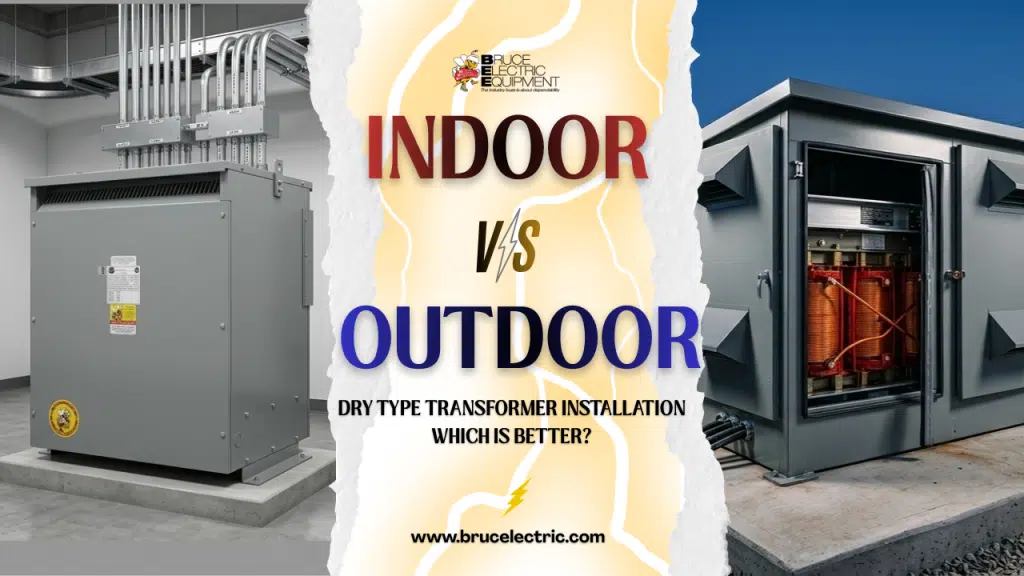
Specifying the right installation environment for a dry type transformer is a technical decision not just a space planning exercise. It determines your enclosure type, maintenance schedule, NEC compliance approach, and ultimately, your transformer’s service life. Get it wrong, and you face insulation failure, code violations, and unplanned downtime.
With over 50 years supplying electrical distribution equipment across North America, Bruce Electric Equipment Corp. helps engineers, contractors, and facility managers make this decision correctly. This guide gives you a clear, technical breakdown of indoor vs outdoor dry type transformer installation including enclosure ratings, NEC requirements, and an application-based selection framework.
What Dry Type Transformer Installation Actually Involves
Dry type transformers use ambient air for cooling and solid insulation systems either vacuum pressure impregnated (VPI) resin or cast epoxy resin instead of liquid dielectrics. This makes them the standard choice for indoor power distribution across commercial, institutional, and industrial facilities.
Most units are rated for a maximum ambient temperature of 40°C, with temperature rise calculations based on a 30°C average ambient. Ambient temperature ratings and performance characteristics for dry-type transformers are defined in IEEE C57.12 series standards, which establish thermal design limits and insulation life expectancy criteria.
One critical NEC requirement applies to all installations, Per NEC Article 450 under National Fire Protection Association NFPA 70, dry-type transformers over 112.5 kVA must be installed at least 12 inches from combustible materials unless the transformer is specifically listed for installation in contact with combustible materials.
The installation environment determines the correct NEMA enclosure, the appropriate product category, and the maintenance approach required to sustain performance across the transformer’s service life.
Product Category
Dry Type Transformers
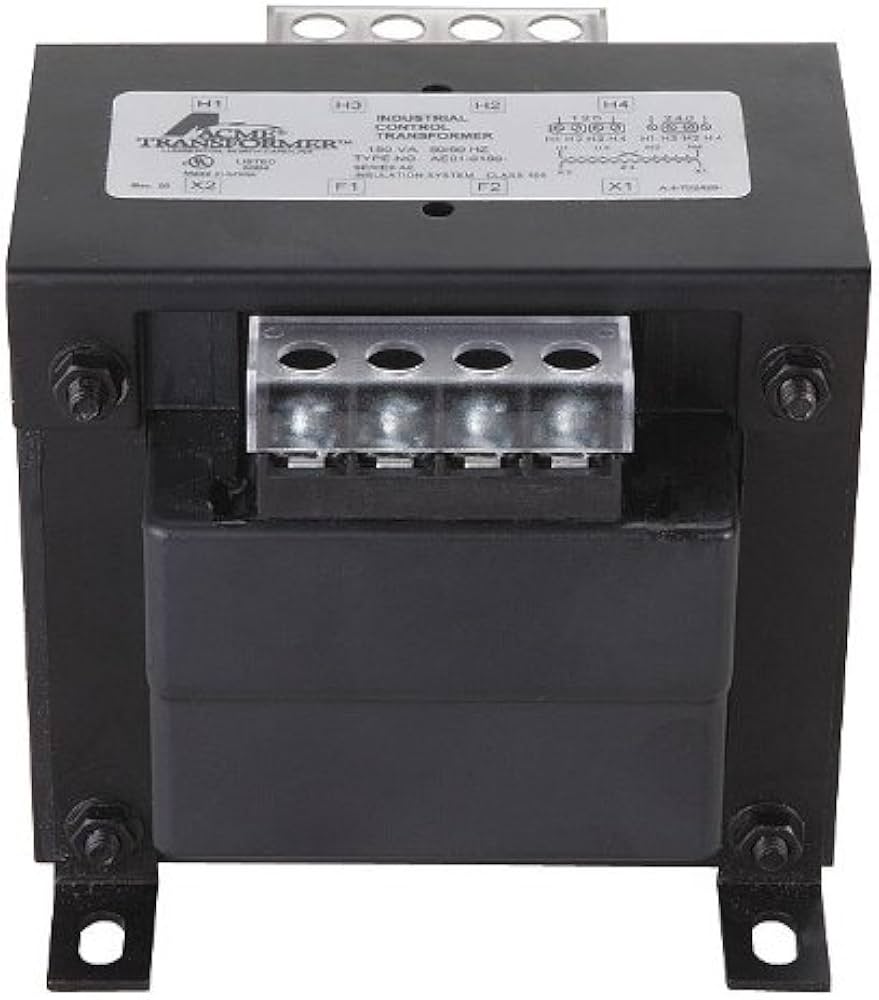
Explore our range of new, used, and reconditioned dry type transformers designed for reliability and efficiency.
Indoor Dry Type Transformer Installation
When Indoor Installation Is the Right Choice
Indoor installation is the default configuration for dry type transformers and covers most commercial and industrial applications. It is appropriate when a dedicated electrical room or mechanical space is available with sufficient ventilation, clearance, and NEC-compliant construction.
Technical Requirements for Indoor Installation
Four factors govern the technical adequacy of an indoor dry transformer installation:
• Ventilation is the most underestimated requirement. Transformer losses generate continuous heat that must be removed by airflow through and around the enclosure. In rooms with restricted airflow, ambient temperatures can rise well above the 40°C design maximum, progressively degrading insulation and reducing effective kVA capacity. Larger units or high-utilization environments may require forced ventilation or supplementary HVAC support.
• Clearance requirements are specified by the transformer manufacturer and must be maintained on all sides top, bottom, and all four faces to permit adequate convective airflow and safe maintenance access. These are not suggestions; violating them voids most manufacturer warranties and creates code compliance issues.
• Enclosure type for standard indoor environments is NEMA 1 a ventilated metal enclosure that provides protection against accidental contact with energized parts and against the ingress of falling solid objects such as dirt and debris. NEMA 1 is not rated for moisture, dripping water, or dust and is only appropriate in clean, dry interior spaces.
• NEC combustible material clearance must be confirmed during room design, particularly for transformers above 112.5 kVA, where a minimum 12-inch separation from combustible building materials is required unless a qualifying insulation class is specified.
Typical Indoor Applications at Bruce Electric
• Indoor installation suits a wide range of Bruce Electric’s product categories:
• General purpose dry type transformers – commercial buildings, retail, offices
• Dry-type control transformers – industrial machinery and automation panels
• Dry-type lighting transformers – institutional and retail facilities
• Medium voltage dry type transformers – typically installed in dedicated indoor electrical substation rooms within hospitals, campuses, and institutional distribution systems.
• K factor rated and harmonic mitigating transformers – datacenters, LED lighting, non-linear load environments
• Used and reconditioned dry type transformers – retrofit and budget-sensitive projects, backed by Bruce Electric’s BEE warranty of up to two years
Outdoor Dry Type Transformer Installation
Environmental Exposure and the Risk of Incorrect Enclosure Specification
Outdoor installation exposes a transformer to rain, humidity, UV radiation, ambient temperature extremes, wind-driven debris, and in coastal or industrial sites, corrosive atmospheric contaminants. None of these conditions are manageable with a standard indoor enclosure.
A NEMA 1 ventilated enclosure will fail in outdoor conditions. Moisture intrusion reduces insulation resistance, increases the likelihood of partial discharge activity, accelerates insulation aging, and can ultimately lead to premature winding failure. Correct enclosure specification is the non-negotiable foundation of any outdoor dry transformer installation. The enclosure rating must always be verified against actual site conditions before procurement.
Transformer Enclosure Types Explained
NEMA enclosure ratings are defined by the National Electrical Manufacturers Association. For outdoor dry type transformer installation, the relevant ratings are:
• NEMA 2 (Drip-proof): An indoor-only rating. Provides protection against dripping condensation beyond NEMA 1. Despite its name, NEMA 2 is not rated for outdoor use and must never be specified for exterior installations.
• NEMA 3R (Rainproof): The standard minimum for outdoor dry type transformer installations. Rated for rain, sleet, and external ice formation. Suitable for general commercial, industrial, and utility outdoor applications not exposed to water jets or corrosive conditions.
• NEMA 4 (Watertight): Rated for windblown dust, rain, splashing water, and hose-directed water from any direction. Appropriate for wash-down or direct-water-contact environments.
• NEMA 4X (Corrosion-resistant, Watertight): Adds corrosion resistance to NEMA 4. Required for coastal sites, chemical processing facilities, food and beverage plants, and any environment with corrosive atmospheric exposure.
Not all dry type transformers include outdoor-rated enclosures as standard. Units available with NEMA-rated enclosure options must be specified at the procurement stage, and the enclosure rating should always be verified based on project requirements.
When Outdoor Installation Is the Appropriate Choice
Outdoor installation is the right choice when no suitable interior space is available, when distributed site loads make a central indoor transformer room impractical, or when the project involves pad-mounted or substation-style distribution. Drive isolation transformers, buck boost transformers, and medium voltage dry type transformers are all available in configurations suited to outdoor deployment depending on site and load requirements.
Indoor vs Outdoor Installation: Technical Comparison
| Factor | Indoor Installation | Outdoor Installation |
|---|---|---|
| Standard Enclosure | NEMA 1 (ventilated) | NEMA 3R minimum |
| Environmental Exposure | Low controlled conditions | High weather, UV, moisture |
| Max Ambient Temp Rating | 40°C (30°C avg design basis) | 40°C thermal mgmt critical |
| NEC Clearance (>112½ kVA) | 12″ from combustibles required | Pad/structure placement applies |
| Ventilation Approach | Dedicated transformer room | Enclosure manages airflow |
| Maintenance Demands | Lower protected environment | Higher weathering effects |
| Enclosure Cost | Lower standard NEMA 1 | Higher NEMA 3R or above |
| Insulation Risk | Low in clean conditions | High without correct enclosure |
| Typical Applications | Commercial, institutional, industrial | Utility, substation, remote sites |
Application-Based Decision Guide
Specify indoor installation when:
• A code-compliant electrical room or mechanical space is available with verified ventilation and clearance
• The operating environment is consistently clean, dry, and temperature-controlled
• The transformer serves building-based loads HVAC, lighting, automation, or facility distribution
• The project involves general purpose, dry-type control, lighting, or K factor rated transformers in institutional or commercial settings
Specify outdoor installation when:
• No interior space is available or practical for a transformer room of the required size
• The transformer serves a distributed site load or utility-scale distribution point
• The unit will be pad-mounted as part of a substation, switchgear assembly, or site power distribution network
• The project involves remote, temporary, or construction-site power applications
In all cases, whether the unit is new, used, or reconditioned, confirm that the enclosure rating matches the actual site environment before installation is finalized.
Conclusion
Indoor and outdoor dry type transformer installation each serve distinct and legitimate roles. Neither is universally better the right choice depends on your site conditions, available space, enclosure specification, and load requirements. Always match the NEMA enclosure rating to actual environmental exposure, verify compliance with NEC Article 450 clearance requirements, and confirm that ambient operating temperatures remain within IEEE thermal design limits. Select the product category that fits the load.
FAQs
Q1. Can dry type transformers be installed outdoors?
Yes. Dry type transformers can be installed outdoors if they use a weather-rated enclosure such as NEMA 3R, 4, or 4X. Standard NEMA 1 enclosure are for indoor use only. The enclosure must match site exposure to rain, dust, and corrosive conditions.
Q2. What is the difference between indoor and outdoor transformers?
Indoor transformers use ventilated NEMA 1 enclosure and operate in controlled environments. Outdoor transformers require weatherproof enclosures like NEMA 3R or 4X to protect against rain, moisture, UV exposure, and temperature extremes.
Q3. What is the preferred type of transformer for most indoor installations?
Dry type transformers especially VPI and cast coil designs are preferred for indoor installations because they use air cooling, require less maintenance, and eliminate liquid dielectric risks.
Q4. How long do outdoor transformers last?
Outdoor dry type transformers generally last 20–30 years when properly installed with the correct NEMA enclosure and operated within rated ambient temperature limits.