Delta Vs Wye Transformer Connections and Selection Guide

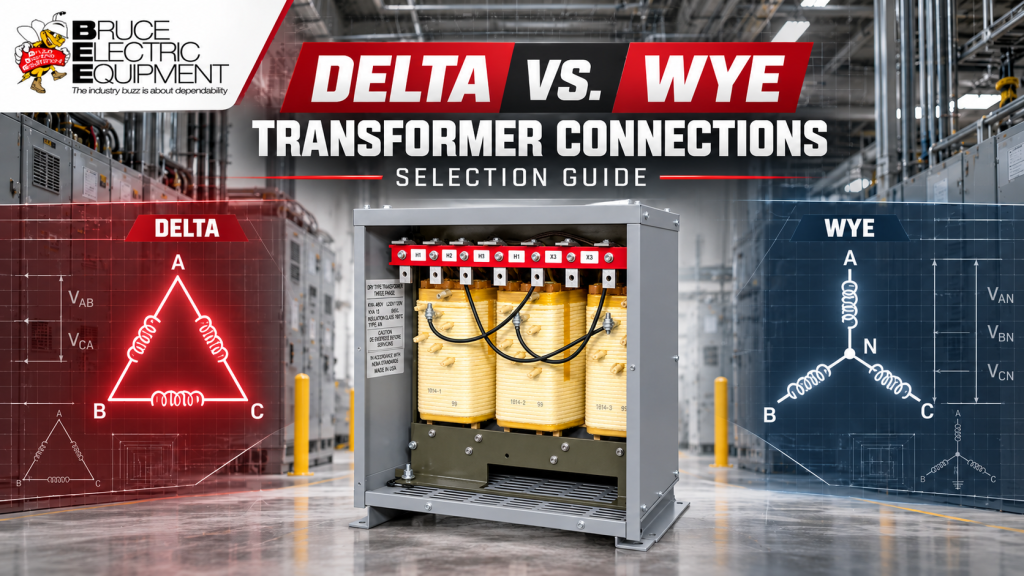
Transformer winding connections influence voltage availability, grounding, harmonic behavior, and fault performance in three-phase electrical distribution systems. Delta (Δ) and Wye (Y) are two of the most common transformer winding configurations used in commercial and industrial applications.
Choosing between delta and wye transformer connections involves more than matching primary and secondary voltages. Engineers and electrical contractors must also consider connected loads, neutral requirements, grounding arrangements, and compatibility with existing electrical equipment. This guide explains the key differences between delta and wye connections, examines the four common three-phase transformer configurations, and outlines practical considerations for selecting or replacing a transformer.
Delta vs Wye Transformer Connections: Core Electrical Differences
The main difference between delta and wye transformer connections is how the three-phase windings are arranged. In a delta connection, the three windings form a closed triangular circuit, with no inherent neutral point. In a wye connection, one end of each winding joins at a common point, creating a neutral that may be brought out for grounding or line-to-neutral loads. These arrangements affect voltage and current relationships, grounding options, and how the transformer responds to certain harmonic currents.
The table below summarizes the key differences.
| Feature | Delta (Δ) Connection | Wye (Y) Connection |
|---|---|---|
| Winding Arrangement | Three windings form a closed triangular circuit. | One end of each winding connects to a common neutral point. |
| Neutral Availability | No inherent neutral. Specially designed arrangements may provide a neutral or grounded reference. | A neutral point is available and may be brought out for line-to-neutral loads. |
| Line Voltage | Equal to phase voltage. | √3 times phase voltage in a balanced system. |
| Line Current | √3 times phase current in a balanced system. | Equal to phase current. |
| Grounding | May be ungrounded, corner-grounded, or used with an appropriate grounding arrangement. | The neutral may be grounded directly or through impedance, depending on system requirements. |
| Harmonic Behavior | A closed delta provides a circulating path for certain triplen harmonic currents, limiting their transfer through the transformer. | Triplen harmonic behavior depends on neutral connections, grounding, loads, and transformer design. |
| Typical Applications | Three-phase motor loads and equipment that does not require line-to-neutral power. | Commercial and industrial systems requiring three-phase and line-to-neutral power. |
For example, a 480 V delta winding has 480 V across each phase winding. In a balanced 480Y/277 V wye system, the line-to-line voltage is 480 V, while the line-to-neutral voltage is approximately 277 V.
Neither delta nor wye is universally better. The appropriate connection depends on the required output voltage, equipment loads, grounding design, and existing electrical infrastructure.
Types of Three-Phase Transformer Connections
Three-phase transformers can use delta or wye configurations on their primary and secondary windings. This creates four common connection combinations: delta-wye, wye-delta, delta-delta, and wye-wye.
Each configuration has distinct characteristics that influence voltage transformation, neutral availability, phase displacement, and electrical distribution requirements.
1. Delta-Wye (Δ–Y) Transformer Connection
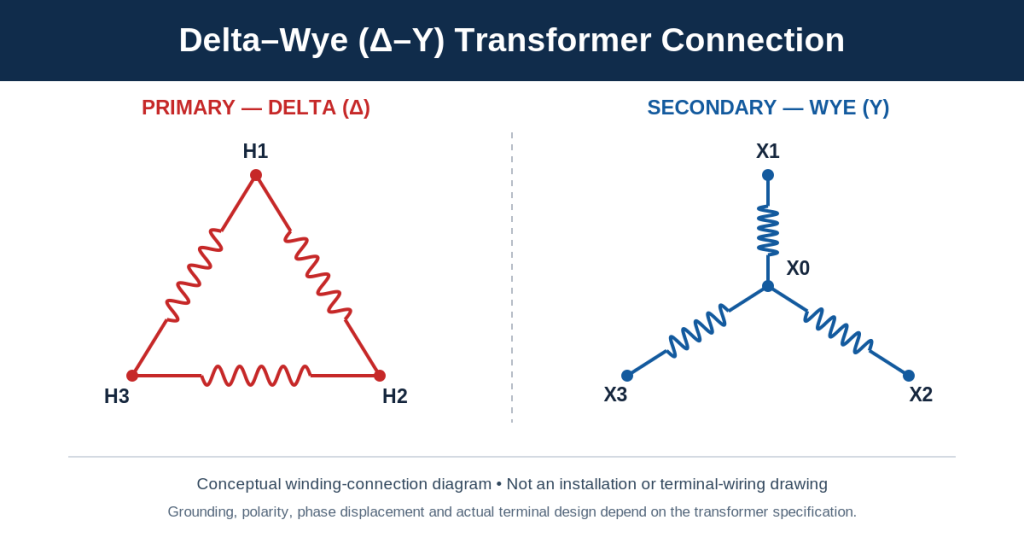
A delta-wye transformer has a delta-connected primary winding and a wye-connected secondary winding. This configuration is widely used in commercial and industrial electrical distribution systems that require both three-phase and single-phase power.
A common example is a transformer that steps down 480 V three-phase power to 208Y/120 V. The secondary provides 208 V between phases and 120 V between each phase and neutral, making it suitable for lighting, receptacles, and equipment requiring these voltages. The delta winding also provides a circulating path for certain triplen harmonic currents, helping limit their transfer to the upstream supply.
Delta-wye connections typically introduce a 30° phase displacement between primary and secondary line voltages. The direction depends on the winding arrangement and vector group. This phase displacement is particularly important when transformers operate in parallel or when a replacement must match an existing electrical system.
Typical applications: Commercial buildings, industrial facilities, electrical distribution panels, and installations requiring both three-phase and line-to-neutral power.
2. Wye-Delta (Y–Δ) Transformer Connection
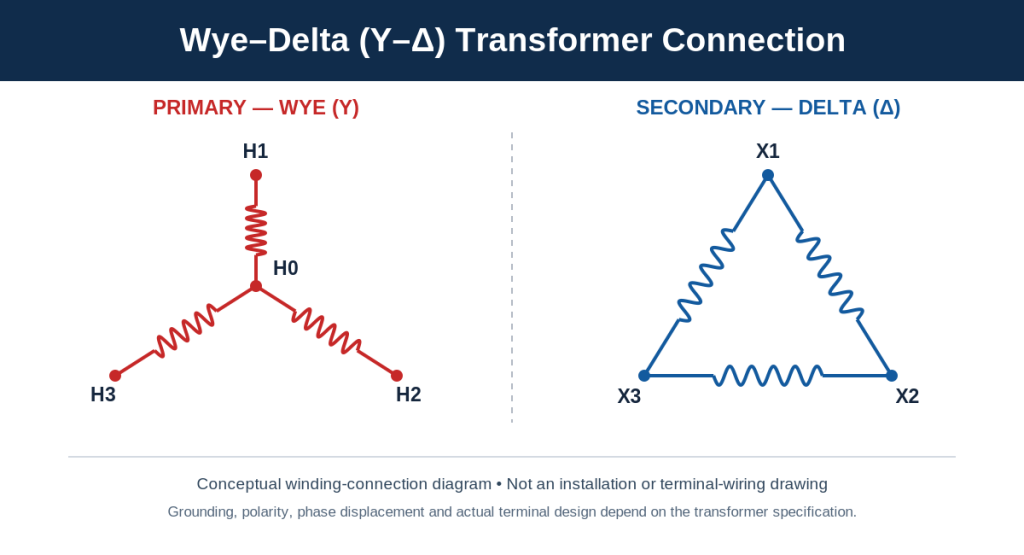
A wye-delta transformer uses a wye-connected primary winding and a delta-connected secondary winding. For example, an appropriately designed transformer may have a 4,160 V line-to-line grounded-wye primary and a 480 V delta secondary. The exact primary winding rating, neutral connection, and grounding arrangement must match the transformer nameplate and system design.
The delta secondary is suitable for three-phase, three-wire loads, including certain motors and industrial equipment. However, a standard three-wire delta secondary does not provide an inherent neutral for line-to-neutral circuits. If these circuits are required, the installation needs a suitably designed secondary configuration or another appropriate power source.
Wye-delta transformers also typically introduce a 30° phase displacement, with the direction determined by the winding connections and vector group.
Typical applications: Industrial motor systems, pumping equipment, and selected electrical distribution installations requiring three-phase, three-wire power.
3. Delta-Delta (Δ–Δ) Transformer Connection
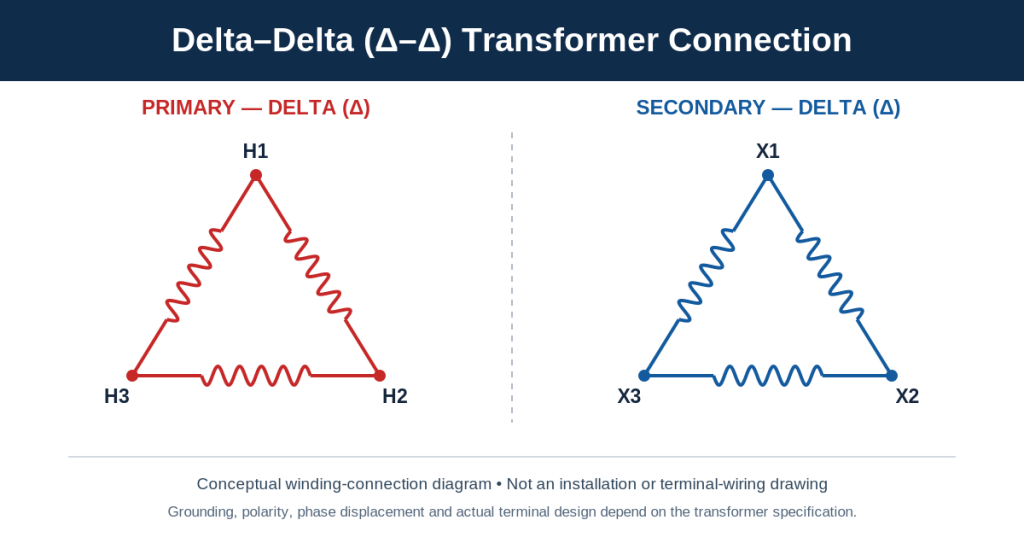
A delta-delta transformer has delta-connected windings on both its primary and secondary sides. With conventional corresponding winding connections, this arrangement introduces no phase displacement between primary and secondary line voltages. Delta-delta connections can accommodate unbalanced three-phase loads within the transformer’s rated operating limits. They are found in certain industrial facilities, including older electrical distribution systems where three-wire power is required.
One characteristic of a delta-delta transformer bank is the possibility of open-delta operation. In a bank of three equal-rated single-phase transformers, if one transformer is removed from service and the remaining units are appropriately reconfigured, the two transformers can continue supplying three-phase power at approximately 57.7% of the original bank’s total kVA capacity. This reduced-capacity operation applies to suitable transformer banks and should not be assumed for every integrated three-phase transformer.
A standard delta-delta connection has no inherent neutral. Applications requiring line-to-neutral loads therefore need another suitable arrangement. Grounding, protection, and fault detection must also be considered.
Typical applications: Industrial three-phase equipment, motor loads, and existing three-wire electrical distribution systems.
4. Wye-Wye (Y–Y) Transformer Connection
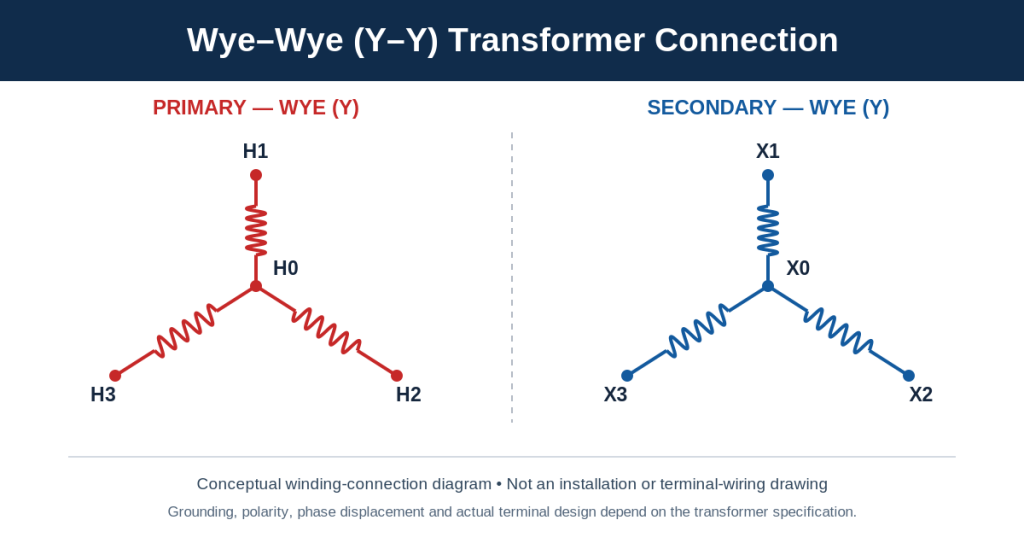
A wye-wye transformer uses wye-connected windings on both its primary and secondary sides. When the neutral points are brought out and the system is appropriately configured, this arrangement can support three-phase and line-to-neutral power on both sides. For example, a transformer may step down 480Y/277 V to 208Y/120 V, providing different voltage levels for commercial electrical loads. With corresponding winding polarity and connections, a conventional wye-wye configuration introduces no phase displacement between primary and secondary line voltages.
However, its performance depends on grounding, core construction, winding design, and load conditions. Neutral instability and third-harmonic voltage distortion can become concerns in certain arrangements, particularly where appropriate grounding or harmonic-current paths are absent. Some designs incorporate a delta tertiary winding or other provisions to address these conditions.
Typical applications: Selected commercial and utility distribution systems where neutral availability, grounding, and transformer design requirements support a wye-wye configuration.
Delta vs Wye Transformer Connections: Which Configuration Should You Choose?
The appropriate transformer connection depends on the available electrical supply, required output voltage, connected equipment, and grounding arrangement. Although several winding configurations can provide the same nominal voltage, they may differ in neutral availability, phase displacement, and system compatibility.
The following table highlights common selection considerations.
| Electrical Requirement | Connection to Consider | Key Consideration |
|---|---|---|
| 480 V to 208Y/120 V commercial distribution | Delta-Wye | Provides a secondary neutral for 120 V loads. |
| Three-phase, three-wire motor loads | Delta-Delta or another suitable configuration | Verify voltage, grounding, and equipment requirements. |
| Replacement in an existing delta-delta system | Delta-Delta | Check winding configuration, ratings, and compatibility. |
| Distribution requiring neutral points on both windings | Wye-Wye | Evaluate grounding, harmonics, and transformer design. |
| Installation with significant nonlinear loads | Application-specific design | Review harmonic performance, impedance, and thermal capacity. |
These examples are starting points, not interchangeable transformer specifications. The final connection must be verified against the electrical system design, equipment nameplates, and applicable installation requirements.
How to Select or Replace a Three-Phase Transformer
Choosing a three-phase transformer starts with understanding the electrical requirements of the installation. A connection suitable for one facility may not be appropriate for another, even when the nominal voltage and kVA ratings appear similar.
Before selecting a new dry-type transformer or replacing an existing unit, review the following factors.
1. Match Primary and Secondary Voltages
Confirm the available supply voltage, required output voltage, frequency, and winding configuration. If equipment requires line-to-neutral power, verify that the secondary provides a suitable neutral connection. For example, a 480 V three-wire delta output is not interchangeable with a 480Y/277 V four-wire output when 277 V line-to-neutral loads must be supplied.
2. Confirm Grounding and Bonding Requirements
Transformer grounding affects electrical safety, ground-fault performance, and system protection. Determine whether the installation creates a separately derived system and identify the appropriate neutral-to-ground bonding arrangement under the applicable electrical code.
A grounding transformer may establish a system grounding reference, but it should not automatically be treated as a source for ordinary line-to-neutral loads.
3. Calculate the Required kVA Rating
Evaluate connected equipment loads, operating demand, peak loading, motor starting requirements, and anticipated expansion.
A transformer must support the expected load without exceeding its rated capacity or thermal limits. Where significant starting currents or nonlinear loads are present, additional evaluation may be necessary.
4. Check Phase Displacement and Compatibility
When replacing an existing transformer or operating transformers in parallel, verify the winding configuration, vector group, phase sequence, polarity, and voltage ratio. Two transformers with matching nominal voltages are not necessarily compatible for parallel operation. Differences in phase displacement or other electrical characteristics can create serious operating problems.
5. Review Harmonics and Impedance
Nonlinear loads, including certain variable-frequency drives, UPS systems, and electronic equipment, can introduce harmonic currents into an electrical distribution system. Transformer impedance also affects voltage regulation and available short-circuit current. Review these characteristics alongside the facility’s protection and power-quality requirements.
6. Verify Physical and Thermal Requirements
For dry-type transformers, consider enclosure rating, ventilation, ambient temperature, insulation class, temperature rise, installation clearances, and maintenance access. When replacing an existing unit, compare its nameplate specifications and installation conditions with those of the proposed transformer. The final selection should follow the manufacturer’s documentation and applicable electrical codes.
Understanding Transformer Nameplate Connections and Voltage Ratings
When replacing a three-phase transformer, the nameplate provides essential information about its electrical characteristics. Primary and secondary voltage ratings, kVA capacity, frequency, and winding connections must be checked before selecting a replacement.
For example, a transformer rated 480 V primary and 208Y/120 V secondary provides a three-phase, four-wire secondary arrangement with 208 V line-to-line and 120 V line-to-neutral. By comparison, a transformer with a 480 V delta secondary ordinarily provides a three-phase, three-wire output without an inherent neutral. These configurations are not interchangeable when connected equipment requires line-to-neutral power.
Before requesting a replacement transformer, confirm the following specifications:
• Primary and secondary voltage ratings.
• Three-phase kVA capacity and frequency.
• Winding configuration and neutral availability.
• Impedance, grounding, and protection requirements.
• Enclosure type, dimensions, and installation conditions.
For existing installations, the manufacturer’s nameplate and connection diagram should be reviewed together. If the winding configuration or grounding requirements are uncertain, a qualified electrical professional should verify the specification before installation.
Select the Right Dry-Type Transformer with Bruce Electric
Selecting the correct transformer involves more than choosing a voltage rating or kVA capacity. Winding connections, grounding, load characteristics, and compatibility with existing equipment all influence the final specification.
At Bruce Electric Equipment Corp., we supply new dry-type transformers for commercial and industrial electrical distribution applications. With more than 50 years of industry experience, our team helps customers identify available equipment based on their voltage, capacity, and application requirements.
Whether you need a delta-wye transformer, a three-phase replacement unit, or another winding configuration, Bruce Electric can help you review available transformer options. Explore our dry-type transformers or call +1-631-226-2424 to discuss your equipment requirements and request a quote. Contact us for used, surplus, or reconditioned electrical equipment.
Frequently Asked Questions
1. What is the difference between delta and wye transformer connections?
A delta transformer connects three windings in a closed triangular circuit without an inherent neutral point. A wye transformer connects one end of each winding to a common neutral point. Delta connections commonly serve three-phase, three-wire loads, while wye connections can provide line-to-neutral power when appropriately configured.
2. How do voltage and current relationships differ between delta and wye connections?
In a balanced delta connection, line voltage equals phase voltage, and line current is √3 times phase current. In a balanced wye connection, line voltage is √3 times phase voltage, and line current equals phase current.
3. Does a delta transformer have a neutral connection?
A standard three-wire delta winding does not have an inherent neutral point. However, certain specially designed delta secondaries can provide a center-tapped neutral. Grounding transformers can also establish a grounding reference, but their suitability for supplying neutral load current must be evaluated separately.
4. Can a delta-wye transformer be connected to a wye electrical system?
Yes. A delta-primary transformer can be supplied from a wye electrical system when the source voltage and transformer ratings are compatible. The source neutral is generally not connected to a standard three-wire delta primary. Always follow the manufacturer’s wiring diagram and installation requirements.
5. Do delta-wye and wye-delta transformers introduce a phase shift?
Yes. Conventional delta-wye and wye-delta connections typically introduce a 30° phase displacement between corresponding primary and secondary line voltages. The direction depends on the winding arrangement and vector group. This is important when replacing or paralleling transformers.
6. Which is better for industrial applications: delta or wye transformers?
Neither connection is universally better. Delta connections are often suitable for three-phase, three-wire equipment, while wye connections are useful when line-to-neutral power is required. The correct choice depends on voltage, load, grounding, and electrical distribution requirements.
7. Can a delta-wye transformer be replaced with a wye-wye or delta-delta transformer?
A different winding configuration may be used only after verifying compatibility with the electrical system. Primary and secondary voltages, neutral availability, grounding, phase displacement, impedance, protection, and connected loads must all be evaluated. Matching kVA and voltage ratings alone is not sufficient.
8. Are delta-wye transformers suitable for data centers?
Delta-wye transformers can be suitable for data-center electrical distribution when their voltage ratings, grounding arrangements, capacity, and harmonic performance meet the facility’s requirements. UPS systems, nonlinear loads, redundancy, and power-quality considerations should be evaluated as part of the overall electrical design.