Why Does My Circuit Breaker Keep Tripping and How Can I Fix It?

A circuit breaker keeps tripping when it detects an electrical condition that requires power to be interrupted. The most common causes include circuit overloads, short circuits, ground faults, and problems with connected equipment. In industrial and commercial systems, high starting current, overheating, protective-device settings, or external control signals can also cause a breaker to open.
The correct fix depends on the underlying problem. A breaker that trips immediately when equipment starts may require a different investigation from one that trips after several minutes of operation. Repeatedly resetting the breaker without determining why it tripped can create serious electrical hazards.
For industrial facilities, recurring circuit breaker trips can interrupt motors, dry-type transformers, HVAC systems, manufacturing equipment, and electrical distribution networks. Understanding the tripping pattern and available protective-device information is the first step toward identifying a safe, effective solution.
What Should You Do When a Circuit Breaker Keeps Tripping?
If a circuit breaker trips repeatedly, stop attempting to reset it until the cause has been identified and the circuit has been determined safe to re-energize.
Follow these four steps to establish the appropriate next action.
Step 1. Check for Signs of Electrical Danger
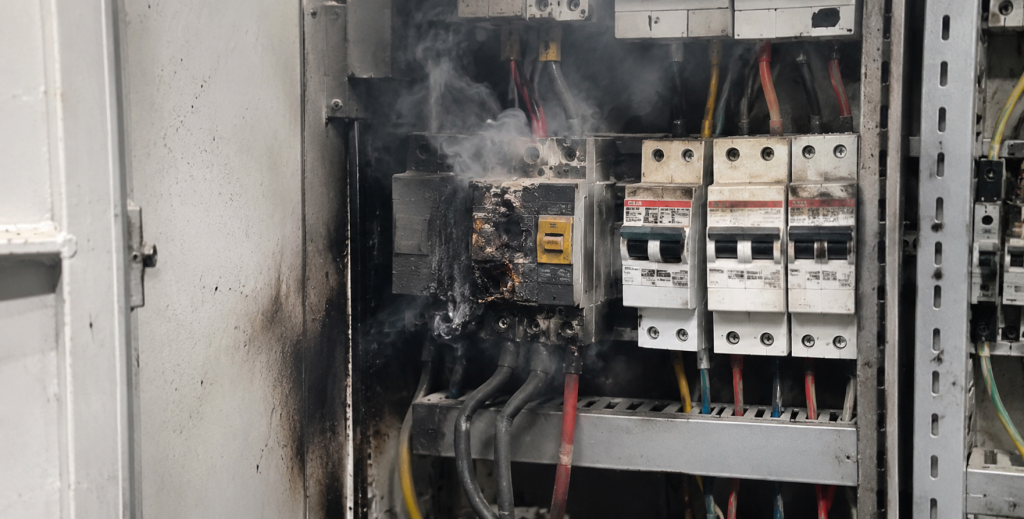
Look for warning signs that can be recognized without touching or opening electrical equipment:
• Burning odors or smoke.
• Unusual buzzing, arcing sounds, or visible sparks.
• Discolored equipment or damaged insulation.
• Evidence of water entering electrical components.
• Repeated interruption of essential electrical equipment.
If any of these conditions are present, stay clear of the affected equipment, prevent further use, and follow appropriate site emergency procedures.
Do not open electrical panels, touch damaged components, or attempt to restore power.
Step 2. Identify When and Where the Trip Occurred
Determine whether the breaker opened:
• Immediately after the circuit was energized.
• When a motor, compressor, or transformer started.
• After equipment had been operating for several minutes.
• When additional electrical loads were connected.
• Without an obvious change in equipment operation.
Also identify whether the affected device is a branch-circuit breaker, a feeder breaker, or the main breaker.
Record any fault indication visible on an accessible display. Some industrial breakers have electronic trip units that identify the protective function responsible for the operation.
Step 3. Determine Whether the Cause Is Known
If an overload can be positively established, the excessive load must be corrected before power is restored. Any reset must comply with the equipment instructions and applicable workplace procedures. If the cause is unknown, a fault is suspected, or the breaker trips again, do not continue resetting it.
OSHA 29 CFR 1910.334(b)(2) prohibits repetitive manual reclosing after a protective device operates in covered workplaces. It also requires the circuit to be determined safe before manual re-energization, with a specific examination exception when the operation can be established as an overload rather than a fault.
Step 4. Arrange Qualified Troubleshooting
When the problem cannot be safely identified through external observation and available records, qualified electrical personnel should investigate the circuit and its protective device. The objective is to determine whether the breaker operated correctly, whether connected equipment caused the trip, or whether the breaker itself needs attention.
What Causes a Circuit Breaker to Keep Tripping?
The following conditions account for many recurring circuit breaker interruptions. Each has different characteristics and requires a different corrective approach.
1. Overloaded Electrical Circuits
An overload occurs when connected equipment draws more current than the circuit or protective device is intended to carry under the applicable conditions. In industrial facilities, this may happen when several machines operate simultaneously, a motor experiences excessive mechanical loading, or additional equipment is connected without evaluating the available circuit capacity.
Many thermal-magnetic breakers respond to overloads using an inverse-time characteristic. A relatively small overload may take longer to cause a trip, while a greater overcurrent generally produces a faster response. For example, an industrial ventilation motor may operate normally when first started but draw excessive current as mechanical resistance increases.
Corrective action: Qualified personnel should evaluate operating current, equipment condition, conductor capacity, and breaker characteristics. The remedy may involve reducing excessive loads, repairing equipment, or properly modifying the electrical circuit.
2. Short Circuits
A short circuit occurs when current flows through an unintended low-impedance electrical path. Possible causes include damaged wire insulation, failed electrical components, incorrect wiring, or unintended contact between conductors.
Short circuits can produce high current, depending on the electrical system’s impedance and available fault current. A breaker equipped with instantaneous protection may operate rapidly when current reaches the applicable threshold. However, immediate tripping is not conclusive proof of a short circuit because some equipment also draws high current during startup.
Corrective action: The fault must be located and repaired. The breaker and associated components may also require inspection following a significant fault, according to manufacturer requirements.
3. Ground Faults and Electrical Leakage
A ground fault occurs when an energized conductor makes an unintended connection to ground or grounded equipment.
Damaged insulation, moisture intrusion, deteriorated cables, and component failures are possible contributing factors.
The protective response depends on the installed equipment.
A conventional overcurrent breaker may detect a sufficiently high-current ground fault. A GFCI, however, is designed to detect certain current imbalances associated with leakage and is not equivalent to ordinary overcurrent protection.
Some industrial electronic trip units also provide equipment ground-fault protection, which must not be confused with GFCI personnel protection.
Corrective action: Qualified personnel should identify the protection that operated and investigate the affected wiring, insulation, connections, and equipment.
4. High Motor Starting Current or Transformer Inrush Current
Electrical equipment can draw considerably more current when energized than during normal operation. This is common with industrial motors, compressors, pumps, and transformers. A motor may draw several times its normal operating current while accelerating. Likewise, a transformer can produce a brief magnetizing inrush current when energized, even with little or no secondary load.
If the starting-current profile interacts with the breaker’s time-current characteristics, an unwanted trip may occur.
However, a breaker that trips during startup should not automatically be assumed to be responding to harmless inrush current. A motor fault, wiring problem, or unsuitable protective-device application may produce similar symptoms.
Corrective action: Evaluate the equipment’s starting characteristics, the breaker’s time-current curve, and the applicable protection requirements. Corrective work may involve resolving equipment problems or reviewing protective-device selection and coordination.
For facilities using dry-type transformers, the transformer’s energization characteristics should be considered when investigating startup-related trips.
5. Overheating or Deteriorated Electrical Connections
High-resistance connections, damaged terminals, corrosion, and excessive operating temperatures can affect electrical distribution equipment. For example, a loose terminal may develop localized heating that damages conductors, insulation, or the breaker.
Depending on the condition and breaker design, elevated temperature may influence thermal protection. Importantly, a hazardous loose connection does not necessarily cause a conventional breaker to trip. Some connection problems can generate substantial heat without producing enough overcurrent to operate the protective device.
Corrective action: Qualified personnel should inspect connections and affected equipment according to applicable safety procedures and manufacturer instructions. Damaged components must be repaired or replaced.
6. Faulty Breakers, Incorrect Settings, or External Trip Signals
Not every trip result from an electrical fault in the connected load. A breaker may malfunction because of damaged contacts, deteriorated mechanisms, or defective protective components. Electronic-trip breakers may also be affected by unsuitable protection settings or trip-unit problems.
Additionally, some industrial breakers use accessories that open the device independently of normal overcurrent protection.
A shunt-trip accessory can open the breaker following an external control command. An undervoltage release can open it when the associated control voltage falls below the specified operating range. These functions may be used in equipment interlocks and emergency shutdown systems.
Corrective action: Before replacing the breaker, qualified personnel should review the load, wiring, protective settings, accessories, and available trip records to establish what caused the operation.
Circuit Breaker Trip Evidence Matrix
A useful diagnosis should consider three forms of evidence together: when the breaker tripped, what its protective device recorded, and what the connected equipment was doing at the time.
The following matrix is an original diagnostic reference developed for this article. It synthesizes the trip-timing and protection principles described in manufacturer documentation and OSHA safety guidance. It is not a manufacturer-approved test procedure or a substitute for qualified electrical evaluation.
| Observed condition | Possible protection or cause | Evidence to investigate | Common incorrect assumption |
|---|---|---|---|
| Trips immediately when equipment starts | Instantaneous protection, excessive inrush, or an electrical fault | Starting-current characteristics, trip indication, wiring condition, and manufacturer time-current curve | Every immediate trip proves a short circuit |
| Trips after equipment has operated for a period | Thermal or long-time protection, sustained overload, or abnormal heating | Operating current, equipment loading, temperature conditions, and available trip records | Delayed tripping always means the breaker is defective |
| Electronic trip unit shows an L or long-time indication | Long-time overcurrent protection | Load current, applicable settings, and equipment operating conditions | The breaker needs a higher ampere rating |
| Electronic trip unit shows an S or I indication | Short-time or instantaneous overcurrent protection | Fault conditions, startup current, protective settings, and coordination | Every high-current indication confirms a particular physical fault |
| A G indication or ground-fault protective device operates | Ground-fault protection or detected leakage, depending on device type | Wiring insulation, connected equipment, protective-device type, and ground-fault information | Equipment ground-fault protection and GFCI personnel protection are identical |
| Breaker opens without a recorded overcurrent trip | External trip command, undervoltage release, internal condition, or unavailable trip data | Control-circuit records, accessory status, trip-unit diagnostics, and manufacturer instructions | Every breaker opening is caused by excessive load current |
| Main breaker trips instead of a downstream breaker | Upstream protection operation or a coordination issue | System one-line diagram, available fault current, trip indications, and time-current curves | The main breaker must be faulty |
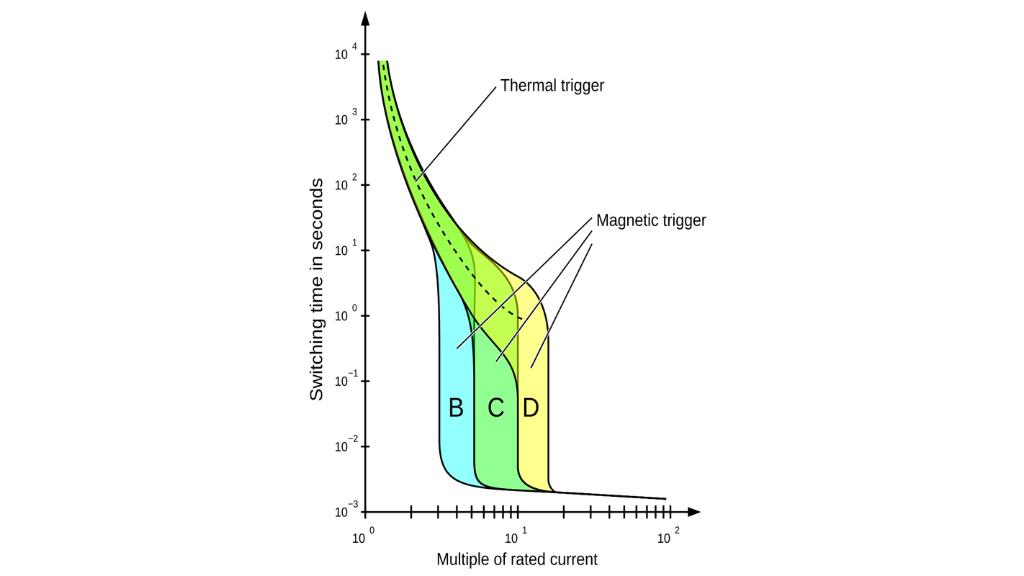
Source Wikipedia – Time till trip vs. current as multiple of nominal current
How to Use the Matrix Correctly
Begin with the recorded trip information, when available, rather than relying on timing alone. For example, if a breaker trips during motor startup and its electronic trip unit records an instantaneous operation, qualified personnel can investigate both motor starting characteristics and high-current fault possibilities.
If the same circuit instead records a long-time trip after sustained operation, the investigation shifts toward operating current, overload conditions, and the applicable protective settings. If no overcurrent indication is recorded, control accessories and other possible causes should also be evaluated. The value of this approach is that it helps narrow the investigation without assuming that one symptom has only one explanation.
Technical basis: Schneider Electric’s thermal-magnetic breaker troubleshooting guidance explains the relevance of startup versus delayed tripping, overloads, connections, and breaker condition. Its Micrologic trip-indicator documentation explains how specific electronic trip indications correspond to protective functions. The exact interpretation depends on the installed manufacturer and model. Not every breaker provides these indications.
How Do You Fix a Circuit Breaker That Keeps Tripping?
Once the likely cause has been identified, qualified personnel must confirm it before deciding on a repair. A systematic investigation generally follows four stages.
1. Confirm the Circuit and Protective Device
Identify the affected breaker, connected equipment, relevant electrical ratings, and recent operating conditions. For industrial installations, electrical drawings and maintenance records may help establish whether the trip involves a branch circuit, feeder, or upstream protective device.
2. Examine the Available Evidence
Review trip indications, event records, equipment nameplates, loading conditions, and the specific manufacturer’s documentation. Appropriate electrical inspection and testing may be required. Work involving exposed electrical parts must follow applicable safe work procedures.
OSHA 29 CFR 1910.333 addresses electrical safety-related work practices, including de-energization, lockout/tagout, and verification. Electrical testing must be performed by qualified persons using appropriate procedures and equipment.
3. Correct the Confirmed Problem
The required action depends on the findings.
| Confirmed cause | Appropriate solution |
|---|---|
| Circuit overload | Reduce excessive load, repair malfunctioning equipment, or properly evaluate circuit capacity |
| Short circuit or ground fault | Locate and correct damaged wiring, insulation, or equipment |
| Excessive starting current | Review equipment starting characteristics and protective-device application |
| Overheated connections | Repair or replace damaged components according to manufacturer procedures |
| Defective breaker | Replace it with a properly specified, approved device |
| Incorrect protective settings | Review and correct settings through authorized qualified personnel |
| External trip or undervoltage condition | Correct the relevant control-circuit or voltage problem |
4. Verify Safe Operation Before Restoring Service
After the problem has been corrected, qualified personnel should complete the inspections, tests, and checks required by the equipment manufacturer, electrical system design, and applicable procedures.
Re-energization should occur only after the circuit has been determined safe. A successful reset alone does not demonstrate that the original problem has been corrected.
When Should a Circuit Breaker Be Replaced?
Circuit breaker replacement may be necessary when inspection or appropriate testing identifies internal damage, malfunction, deterioration, or an unsuitable application. Physical damage following a significant fault, abnormal mechanical operation, or failure to meet applicable manufacturer requirements may justify replacement. However, a breaker that keeps tripping is not necessarily defective. If the underlying problem is an overload, short circuit, or equipment fault, installing another breaker may leave the original hazard unresolved.
Before sourcing a replacement, confirm the following specifications.
| Specification | What must be verified |
|---|---|
| Manufacturer and catalog number | Exact model or properly approved replacement |
| Ampere rating | Suitability for the circuit and connected equipment |
| Voltage rating | Compatibility with the electrical system |
| Number of poles | Correct circuit configuration |
| Interrupting rating | Suitability for the available fault current and applicable system design |
| Trip-unit type and characteristics | Required protective functions and settings |
| Equipment compatibility | Approval for the specific panelboard or switchgear assembly |
| Mounting and accessories | Correct connections and required control functions |
Two breakers with similar dimensions and the same ampere rating are not automatically interchangeable. The replacement must satisfy the applicable electrical ratings, equipment compatibility requirements, and manufacturer instructions.
Frequently Asked Questions About Circuit Breaker Tripping
Q1. Why does my circuit breaker keep tripping immediately?
An immediate trip may result from a short circuit, ground fault, excessive starting current, or protective-device characteristics that are unsuitable for the application. Available trip indications and professional testing are needed to determine the actual cause.
Q2. Why does my breaker keep tripping after a few minutes?
Delayed tripping may be associated with sustained overload, abnormal equipment heating, or temperature-related conditions. Operating current, equipment condition, and the breaker’s protective characteristics should be evaluated.
Q3. Why does my circuit breaker keep popping?
A circuit breaker that keeps popping generally means it is repeatedly tripping and disconnecting power. Overloads, electrical faults, and equipment problems are common possibilities. The underlying condition must be identified instead of repeatedly resetting the device.
Q5. Why does my circuit breaker trip with nothing plugged in?
A circuit may still supply hardwired lighting, HVAC equipment, controls, or other permanently connected loads. Fixed-wiring faults, electrical leakage, external trip commands, and breaker malfunctions are also possible.
Q6. Why does my main breaker keep tripping?
A main breaker may operate because of an overcurrent condition in the distribution system or because of the way upstream and downstream protective devices respond to a fault. A qualified professional may need to review the system’s protection settings and coordination.
Q7. Why does a three-phase circuit breaker keep tripping?
Potential causes include overloads, phase-to-phase faults, ground faults, motor starting conditions, and equipment problems. Phase loss or unbalance can also contribute to abnormal operation, depending on the equipment and protection installed.
Q8. Can a transformer cause circuit breaker tripping?
Yes. A transformer can draw a temporary magnetizing inrush current when energized. If that current interacts with the breaker’s protective characteristics, an unwanted trip may occur. Transformer faults or associated wiring problems must also be considered.
Q9. Can I replace a tripping breaker with a higher-ampere breaker?
Not simply to stop repeated trips. The replacement rating must be appropriate for the conductors, connected equipment, protection requirements, and electrical system. A rating change requires qualified evaluation.
Final Thoughts
A circuit breaker that keeps tripping is usually indicating an electrical or protection-related condition that needs investigation. The cause may be an overload, short circuit, ground fault, equipment starting current, overheating, or a problem with the protective device itself. The most reliable approach is to examine the trip pattern, review available protective-device information, identify the underlying cause, and implement the appropriate correction. For industrial and commercial facilities, this helps prevent unnecessary breaker replacements and repeated interruptions while supporting safe electrical system operation.
When a qualified evaluation confirms that a replacement breaker or related electrical distribution component is needed, Bruce Electric Equipment Corp. can assist with equipment sourcing. Serving industrial and commercial customers since 1973, Bruce Electric supplies circuit breakers, dry-type transformers, switchgear, panelboards, and other electrical equipment. The company also supports requirements for hard-to-find, used, surplus, and reconditioned equipment.
Explore our electrical equipment catalog or browse available three-pole circuit breakers. Request a quote with the required manufacturer, catalog number, ampere rating, voltage rating, number of poles, and other relevant specifications to confirm availability. Equipment sourcing does not replace qualified electrical troubleshooting, engineering evaluation, or safe installation practices.