How Do You Size an Electrical Transfer Switch for a Generator?

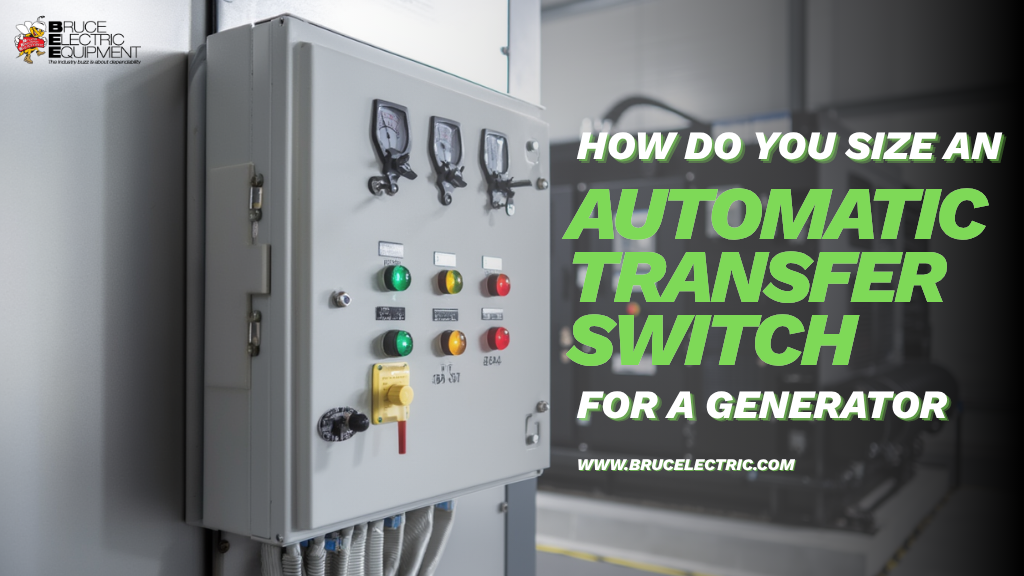
Modern facilities depend on uninterrupted power to maintain operations, protect critical equipment, and ensure safety during outages. Whether you’re protecting a hospital’s life-support systems, keeping a data center online, or maintaining production in a manufacturing plant, reliable backup power is essential. Every reliable backup power system relies on an automatic transfer switch (ATS), the critical control device that detects utility power failure, starts your generator, and seamlessly transfers your facility’s electrical load to emergency power. However, simply installing an ATS isn’t enough. The transfer switch must be correctly sized to match both your generator’s output capacity and your facility’s electrical load. This post will guide you through how to size an automatic transfer switch for a generator system, the key factors that determine ATS capacity, and common sizing mistakes to avoid.
Why Correct ATS Sizing Is Important for Generator Performances
Transfer switch sizing directly impacts generator performance, system reliability, and equipment longevity. Incorrect sizing creates operational problems and safety risks. Here’s why correct sizing of an automatic transfer switch is critical for ensuring optimal generator performance.
1. Undersized ATS Can Overload Generator Circuits: If the ATS amperage rating is lower than the connected load, contacts and conductors overheat during operation. This can trip protective devices, cause premature component failure, and create fire hazards. The generator may run at full capacity, but the undersized transfer switch becomes the system’s weak point.
2. Oversized ATS Increases Cost Unnecessarily: Specifying an ATS with excessive capacity adds unnecessary cost to the project without improving performance. While oversizing provides a safety margin, excessive oversizing wastes budget that could be allocated to other critical infrastructure.
3. Correct ATS Sizing Ensures Stable Load Transfer: Properly sized transfer switches handle the full load current without overheating, support motor starting inrush currents, and provide reliable switching under all operating conditions. This protects both the generator and connected loads while ensuring code compliance.
Product Category
Automatic Transfer Switches
Ensure uninterrupted power with automatic transfer switches designed for fast, reliable load switching.
Key Factors When Sizing an ATS for a Generator
Here are three primary factors to consider when determining the correct size of automatic transfer switch for your a generator system.
1. Generator Power Output:
Start with your generator’s rated output in kilowatts (kW) or kilovolt-amperes (kVA). The ATS must handle the full rated current the generator can supply. Calculate generator full-load current using:
• Single-Phase: I = (kVA × 1000) / Voltage
• Three-Phase: I = (kVA × 1000) / (Voltage × √3)
2. Generator Voltage and Phase Type:
Transfer switches are voltage- and configuration-specific. Common generator system voltages include:
• 120/240V single-phase (residential)
• 120/208V three-phase (commercial)
• 277/480V three-phase (industrial)
A 3-phase automatic transfer switch cannot be substituted for a single-phase application, and voltage ratings must match the generator output. Always verify phase configuration and voltage before selecting an ATS.
3. Electrical Load Connected to the Generator:
The connected load determines the minimum ATS rating. Calculate the total amperage of all circuits served by the generator:
• Add up all connected loads (lighting, HVAC, equipment, motors)
• Apply demand factors per NEC Article 220 if applicable
• Account for motor starting currents (typically 3-6 times running current)
• Add 20-25% safety margin for future expansion
4. Open vs Closed Transition Transfer Switch
An open transition transfer switch (break-before-make) briefly interrupts power during transfer and is suitable for most applications. A closed transition transfer switch (make-before-break) allows seamless transfer without interruption, making it ideal for critical systems such as hospitals and data centers.
Step-by-Step Guide to Sizing an Automatic Transfer Switch for a Generator
Follow this systematic approach to determine the correct automatic transfer switch sizing for your application:
Step 1: Determine Generator Output: Review the generator nameplate for rated kW or kVA output. Convert to amperes using the formulas provided earlier.
Step 2: Calculate Connected Load: List all critical loads that will transfer to generator power. Sum the amperage of all connected circuits. For motor loads, account for starting inrush current.
Step 3: Apply Safety Margin: Add 20-25% to the calculated load to accommodate voltage drop, power factor, and future load additions.
Step 4: Match Voltage and Phase Configuration: Ensure the ATS voltage and phase ratings match your generator output exactly. A 480V three-phase generator requires a 480V three-phase ATS.
Step 5: Verify ATS Features: Confirm the transfer switch includes necessary features: time delays, voltage/frequency sensing, engine control outputs, and bypass capabilities if required.
Step 6: Select Standard ATS Rating: Choose the next standard ATS size that meets or exceeds your calculated requirement. Common ratings include 30, 50, 100, 200, 400, 600, and 800 amp transfer switch capacities.
Step 7: Review NEC Compliance: Verify that the selected ATS complies with NEC requirements for transfer switch installations and generator connection.
Typical ATS Sizes for Different Generator Systems
Here are common automatic transfer switch sizing configurations matched to typical generator systems
1. 200 Amp Automatic Transfer Switch: Typically used for larger homes, small commercial buildings, or medium-sized office spaces that require more significant power to run HVAC systems, lighting, and appliances simultaneously.
2. 100 Amp Automatic Transfer Switch: Common for medium-sized homes or light commercial applications where the load is moderate, such as a small restaurant, or small retail shop.
3. 50 Amp Automatic Transfer Switch: Suitable for small homes, RVs, or cabins where load demands are minimal, such as a few lights, kitchen appliances, and basic heating or cooling systems.
4. 30 Amp Automatic Transfer Switch: Designed for small, low-power generators, typically used in smaller homes or backup systems for light-duty needs like lighting and a few essential appliances.
5. 800 Amp Transfer Switch: Typically used for large industrial or commercial generators that support high power loads, such as factories, large office buildings, or entire apartment complexes where there are significant electrical demands.
Common Generator Transfer Switch Sizing Mistakes
Avoid these frequent errors when sizing transfer switches for a generator systems:
• Sizing ATS to Breaker Rating Instead of Load: Using the main breaker size without calculating actual load leads to oversized equipment. A 200-amp main breaker doesn’t mean the facility draws 200 amps continuously.
• Ignoring Motor Starting Current: Failing to account for inrush current from motors, HVAC systems, and other inductive loads can result in nuisance tripping or contact welding during transfers.
• Mismatched Voltage or Phase Configuration: Installing a single-phase ATS on a three-phase generator, or mismatching voltage ratings, creates safety hazards and code violations.
• No Allowance for Future Expansion: Sizing the ATS exactly to current load eliminates the ability to add circuits without replacing the entire transfer switch.
• Selecting Wrong Transition Type: Using an open transition transfer switch for critical loads that require uninterrupted power compromises system reliability.
• Overlooking Wire Sizing: The transfer switch is correctly sized, but feeder conductors are undersized for the load, creating voltage drop and overheating.
Advanced ATS Sizing Considerations
For accurate sizing in complex systems, consider additional factors such as power factor (kW vs kVA differences), generator duty rating (standby vs prime), and short circuit withstand rating (WCR). Ensuring the ATS can handle available fault current is critical for safe and compliant operation.
Unsure If Your Transfer Switch Can Handle Your Generator Load?
Don’t let undersized equipment compromise your backup power system. Bruce Electric’s technical team has decades of experience sizing transfer switches for residential, commercial, and industrial generator applications. We’ll help you calculate your exact requirements, avoid costly sizing mistakes, and select the right ATS configuration, whether you need new, used or reconditioned equipment.
FAQs
Q1) How to select ATS for generator?
Select an automatic transfer switch (ATS) by matching its amperage rating to the generator’s full-load current, ensuring the voltage and phase configuration are identical, and adding a 20–25% safety margin. Also consider load type, motor starting current, and whether an open or closed transition transfer switch is required.
Q2) What size wire do I need for a generator to transfer switch?
The wire size between a generator and transfer switch is based on the generator’s full-load current and must typically be rated at 125% of the generator output current, as per NEC guidelines. Conductor size also depends on distance, voltage drop, and whether copper or aluminum wiring is used.
Q3) Which is better, ATS or STS?
An automatic transfer switch (ATS) is best for generator backup systems, while a static transfer switch (STS) is ideal for critical loads requiring near-instant power transfer between two utility sources. ATS handles generator switching, whereas STS is used in data centers and mission-critical applications.
Q4) Can I use a 50-amp transfer switch with a 30-amp generator?
Yes, a 50-amp transfer switch can be used with a 30-amp generator because the transfer switch rating can exceed the generator capacity. However, the connected load must not exceed the generator’s 30-amp output to prevent overload.
Q5) What happens if a transfer switch is undersized?
An undersized transfer switch can overheat, trip protective devices, and fail during operation, leading to power interruptions and potential safety hazards.
Q6) Can a transfer switch be larger than the generator?
Yes, a transfer switch can be rated higher than the generator capacity. However, it should still be properly matched to the load and system requirements for optimal performance.