Half Wave vs Full Wave Rectifier – Which One Is Best for Your Application?

Choosing between a half wave and a full wave rectifier can significantly impact the efficiency, cost, and reliability of your industrial power system. A half wave rectifier converts only one half of the AC cycle to DC achieving roughly 40.6% theoretical efficiency under ideal conditions, while a full wave rectifier utilizes the complete AC cycle, delivering up to 81.2% efficiency under ideal conditions, with far smoother DC output.
In industrial settings across the United States, from manufacturing plants and data centers to electroplating lines and motor drive systems the wrong rectifier choice can lead to power losses, equipment stress, overheating, and expensive downtime. Understanding the difference isn’t just academic; it’s a critical engineering and procurement decision.
This guide explains how each rectifier type works, breaks down their key technical differences using real data, and gives you a practical decision framework to choose the right rectifier for your specific application. We also cover common selection mistakes and share exactly what to look for when sourcing rectifiers in the US industrial market.
What Is a Half Wave Rectifier? Working Principle, Efficiency & Key Limitations
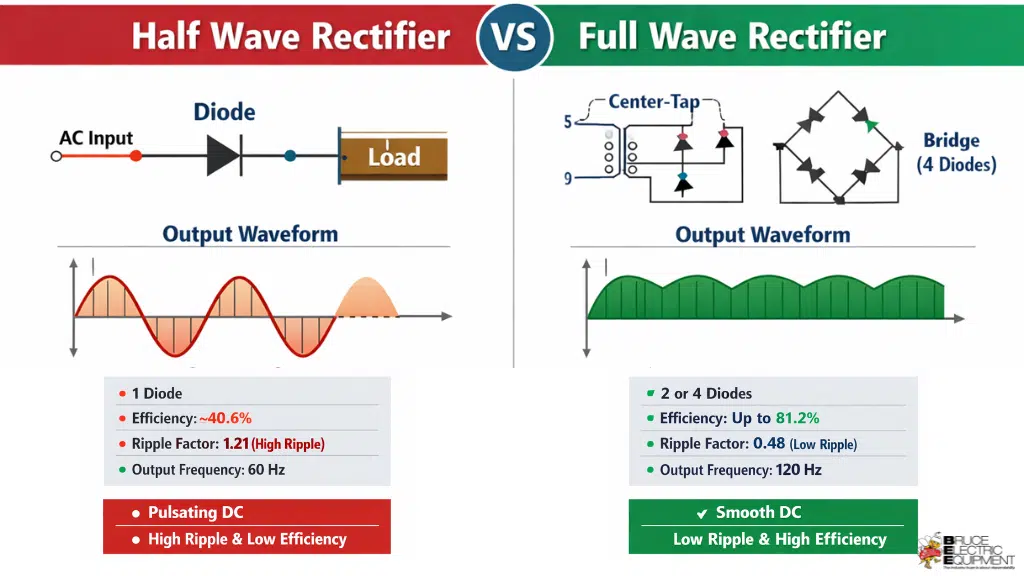
A half wave rectifier is the simplest AC-to-DC conversion circuit. It uses a single diode to allow current flow in only one direction, passing only one half-cycle of the alternating current waveform to the output.
How a Half Wave Rectifier Works – Step by Step
• During the positive half-cycle of the AC input, the diode becomes forward-biased and conducts current through to the load, producing an output voltage.
• During the negative half-cycle, the diode is reverse-biased (blocking mode) and no current flows. The output voltage drops to zero.
• The result is a pulsating, unidirectional DC output that only uses half of the available AC energy hence the name “half wave.”
• The output frequency equals the input AC frequency (60 Hz in the USA, 50 Hz in many other regions).
Key Technical Parameters – Half Wave Rectifier
| Parameter | Value / Description |
|---|---|
| Efficiency | ~40.6% (maximum theoretical) |
| Ripple Factor | 1.21 (high – output is far from smooth) |
| Number of Diodes | 1 |
| Output Frequency | Same as input (60 Hz in USA) |
| Peak Inverse Voltage (PIV) | Equal to peak AC input voltage (Vm) |
| Transformer Utilization Factor (TUF) | 0.287 (low – poor transformer usage) |
| DC Output Voltage | Vdc = Vm / π ≈ 0.318 × Vm |
| Suitable For | Low-power, non-critical, or budget-constrained applications |
Half Wave Rectifier – Practical Limitations
• Nearly 60% of input power is wasted – making it impractical for high-power industrial use.
• High ripple factor (1.21) means the output fluctuates heavily, which can damage or degrade sensitive electronic components.
• Half wave rectifiers introduce a DC component that can lead to transformer core saturation under certain operating conditions, potentially causing additional losses and heating.
• Not suitable for capacitive filtering at high power levels due to high peak-to-average current ratio.
What Is a Full Wave Rectifier? Types, Working Principle & Efficiency
A full wave rectifier converts both the positive and negative halves of the AC input waveform into usable DC output. By utilizing the entire AC cycle, it achieves nearly double the efficiency of a half wave rectifier and produces a smoother, more stable DC voltage.
There are two main configurations of full wave rectifiers used in industrial applications:
Type 1: Center-Tap Full Wave Rectifier
• Uses two diodes and a center-tapped transformer.
• During the positive half-cycle: Diode D1 conducts; D2 is reverse-biased. Current flows through the load in a fixed direction.
• During the negative half-cycle: D2 conducts; D1 is reverse-biased. Current still flows through the load in the same direction.
• PIV per diode = 2 × Vm (higher stress per diode than bridge configuration).
• Requires a center-tapped transformer increases size and cost but reduces diode count.
Type 2: Full Wave Bridge Rectifier
• Uses four diodes arranged in a bridge configuration no center-tapped transformer required.
• During the positive half-cycle: Diodes D1 and D3 conduct.
• During the negative half-cycle: Diodes D2 and D4 conduct.
• Current always flows through the load in the same direction regardless of input polarity.
• PIV per diode = Vm (lower stress, each diode only sees the peak voltage, not double).
• Most widely used configuration in modern US industrial power systems due to its efficiency, compactness, and reliability.
Key Technical Parameters – Full Wave Rectifier
| Parameter | Center-Tap Full Wave | Bridge Full Wave Rectifier |
|---|---|---|
| Efficiency | Up to 81.2% | Up to 81.2% |
| Ripple Factor | 0.48 | 0.48 |
| Number of Diodes | 2 | 4 |
| Output Frequency | 2× input (120 Hz in USA) | 2× input (120 Hz in USA) |
| Peak Inverse Voltage (PIV) | 2 × Vm per diode | Vm per diode |
| Transformer Utilization Factor (TUF) | 0.672 | 0.812 |
| DC Output Voltage | Vdc = 2Vm / π ≈ 0.636 × Vm | Vdc = 2Vm / π ≈ 0.636 × Vm |
| Transformer Required | Center-tapped required | Standard transformer (no center tap) |
The full wave bridge rectifier is the standard choice for most US industrial applications. Its higher TUF (0.812 vs. 0.287 for half wave), lower PIV stress per diode, and elimination of the center-tap requirement make it the most cost-effective full wave solution at scale.
In Stock Since 1973
Need an Industrial Rectifier? Bruce Electric Has It In Stock.
New, reconditioned, and surplus rectifiers from full-wave bridge rectifiers to complete industrial DC power supplies. Every unit is inspected, tested, and backed by our industry-leading warranty.
✔ In-stock & ships in 24-48 hours nationwide ✔ New, reconditioned & surplus options ✔ 1-year warranty on circuit breakers / 2-year on transformers
Half Wave vs. Full Wave Rectifier: Detailed Technical Comparison
The table below provides a side-by-side breakdown of every critical parameter. Use this as a quick-reference specification sheet when evaluating rectifiers for your application.
| Parameter | Half Wave Rectifier | Full Wave Rectifier |
|---|---|---|
| Number of Diodes | 1 | 2 (center-tap) or 4 (bridge) |
| Efficiency (Max) | 40.6% | 81.2% |
| Ripple Factor | 1.21 (very high) | 0.48 (much lower) |
| Output Frequency | Equal to input (60 Hz US) | 2× input (120 Hz US) |
| DC Output Voltage | 0.318 × Vm | 0.636 × Vm |
| PIV per Diode | Vm | 2Vm (CT) or Vm (bridge) |
| TUF | 0.287 | 0.672 (CT) or 0.812 (bridge) |
| Output DC Quality | Pulsating – high ripple | Smooth – low ripple |
| Transformer Requirement | No center tap needed | CT (2-diode) or standard (bridge) |
| Circuit Complexity | Simple – fewer components | More complex – more diodes |
| Heat Dissipation | Higher (inefficient conversion) | Lower (higher efficiency) |
| Power Output | Low | High |
| Initial Cost | Lower | Slightly higher |
| Long-Term Cost | Higher (inefficiency losses) | Lower (efficiency savings) |
| Scalability | Limited | Excellent for high-power systems |
| Best For | Low-power, non-critical use | Industrial, high-power, precision use |
Understanding Ripple Factor & Why It Matters for Industrial Systems
Ripple factor is one of the most important specifications when selecting a rectifier for industrial use. It measures how much AC variation remains in the DC output – a lower ripple factor means a cleaner, more stable power supply.
| Rectifier Type | Ripple Factor (γ) |
|---|---|
| Half Wave Rectifier | γ = 1.21 → Output is 121% as “noisy” as the DC level – essentially unusable for precision applications without heavy filtering |
| Full Wave Rectifier (CT or Bridge) | γ = 0.48 → Output noise is less than half the DC level – suitable for industrial systems, often with minimal additional filtering |
What This Means in Practice
A ripple factor of 1.21 indicates high AC variation relative to the DC output, resulting in unstable power without proper filtering. This can disrupt motor control systems, damage sensitive instrumentation, and reduce component life in US industrial facilities. Poor rectifier design may also contribute to harmonic distortion affecting IEEE 519-2022 compliance.
Smoothing the Output: Filter Capacitors
Both rectifier types use capacitors to reduce ripple, but performance differs:
• A full wave rectifier operates at 2× input frequency (120 Hz in the USA), allowing faster charge/discharge cycles and requiring smaller capacitors.
• A half wave rectifier operates at 60 Hz and typically requires larger capacitors (often ~2×), increasing cost, size, and weight.
• Rule of thumb: For ~1% ripple, a full wave rectifier needs about half the capacitance of a half wave design at the same load current.
Industrial Applications: When to Use Half Wave vs. Full Wave Rectifiers in the USA
Understanding which rectifier suits each application is critical for proper specification. Below are the primary use cases in US industrial environments:
Half Wave Rectifier – Appropriate Use Cases
• Low-power battery chargers: Small battery-powered devices and trickle chargers where output quality is not critical and cost minimization is the priority.
• Signal detection circuits: Rectifying high-frequency AC signals in communication equipment, where only the signal envelope, not power – needs to be extracted.
• AM radio demodulation: Legacy and niche applications where the half wave rectifier extracts audio signals from AM-modulated waves.
• Educational and laboratory use: Simple single-diode design widely used in US electrical engineering labs for teaching rectification fundamentals.
• Low-cost consumer electronics: Basic power supply rails in toys, LED drivers, and very low-current circuits.
Full Wave Rectifier – Industrial & Commercial Use Cases
• Industrial DC power supplies: Powers large machinery, CNC systems, and sensitive equipment in US manufacturing plants requiring stable DC voltage.
• Electroplating and metal finishing: Provides stable DC current for uniform metal deposition; half wave output can cause uneven plating and rejected products.
• Motor drives and variable speed drives (VSDs): Ensures smooth DC bus voltage for motor controllers in production lines, conveyors, and HVAC systems.
• Battery charging systems: Used in forklifts, UPS systems, and backup power to deliver efficient, controlled charging.
• Welding equipment: Full wave bridge rectifiers provide stable arc current for consistent weld quality.
• Renewable energy and solar inverters: Used in AC-DC conversion stages of grid-tied inverters and battery storage systems.
• Data center power distribution: Rectifier stages in UPS systems and PDUs ensure high-efficiency, reliable DC output.
• Healthcare and medical equipment: Powers MRI, CT, patient monitoring, and surgical systems; NEC Article 517 requires stable and clean power.
Which Rectifier Is Right for Your Application? A Practical Decision Guide for US Industrial Buyers
Choose the rectifier based on your application requirements:
Use a full wave rectifier for:
• Output power above 100W (higher efficiency, lower heat)
• Sensitive electronics or instrumentation (low ripple, stable DC)
• Motor drives, VFDs, and servo systems (reliable control)
• Electroplating, anodizing, galvanizing (uniform DC output)
• Industrial battery charging systems (efficient and controlled charging)
• Data centers, UPS systems, and PDUs (industry standard)
• Healthcare environments (NEC 517) (clean, compliant power)
• Applications requiring future scalability (supports higher loads)
Use a half wave rectifier only for:
• Low-power applications (<5W)
• Signal detection circuits
• Educational and lab use
• Basic battery trickle charging
• Cost-critical applications where performance is not a priority
If your application involves industrial machinery, power systems, precision electronics, or any load above 100W, choose a full wave rectifier. The higher initial cost is recovered quickly through reduced power losses and lower maintenance. Half wave rectifiers are appropriate only for low-power, non-critical, or space-constrained applications where output quality is secondary to cost.
How to Choose the Right Rectifier: 8 Common Selection Mistakes to Avoid
Incorrect rectifier selection leads to inefficiency, equipment failure, and costly downtime in US industrial facilities. Avoid these common mistakes:
1. Overlooking Efficiency Requirements
Using a half wave rectifier for high-power applications wastes energy. With ~40.6% efficiency, nearly 60% of input power is lost as heat increasing energy costs and thermal load. Always evaluate efficiency before selection.
2. Ignoring the Ripple Factor
High ripple (γ = 1.21) in half wave rectifiers causes voltage instability, damages sensitive systems, and may impact IEEE 519-2022 compliance. Always match ripple tolerance with your application.
3. Choosing Based Only on Price
Lower upfront cost of half wave rectifiers often leads to higher long-term costs due to energy loss, larger filters, and potential failures. Full wave rectifiers are more cost-effective over time.
4. Underestimating Load Requirements
Half wave rectifiers have low TUF (0.287), requiring oversized transformers. Full wave bridge rectifiers (TUF = 0.812) deliver better power utilization and efficiency.
5. Neglecting PIV Ratings
Incorrect diode PIV selection can cause failure. In center-tap designs, diodes must handle 2 × Vm. Always verify voltage ratings to avoid breakdown.
6. Ignoring Heat Dissipation
Half wave rectifiers generate more heat due to inefficiency. Poor thermal design in industrial panels can cause failure and safety risks. Full wave rectifiers are easier to manage thermally.
7. Overlooking Compliance Requirements
US installations must meet NEC and IEEE 519-2022 standards. Poor rectifier design can increase harmonic distortion and create compliance issues.
8. Ignoring Scalability
Half wave rectifiers limit future expansion. Full wave rectifiers especially bridge types scale efficiently with higher power demands.
FAQs
Q1: What is the difference between a half wave and full wave rectifier?
A: A half wave rectifier uses one diode to convert only one half of the AC cycle to DC, with ~40.6% efficiency and high ripple (1.21). A full wave rectifier converts both halves using two (center-tap) or four diodes (bridge), achieving up to 81.2% efficiency and lower ripple (0.48), resulting in smoother DC output.
Q2: Which rectifier is better for industrial applications?
A: A full wave rectifier is best for industrial applications due to higher efficiency, lower ripple, and stable DC output. It is widely used in motor drives, UPS systems, and industrial power supplies. A half wave rectifier is only suitable for low-power, non-critical applications.
Q3: What is ripple factor and why is it important in rectifiers?
A: Ripple factor (γ) measures AC variation in the DC output. A half wave rectifier has high ripple (1.21), causing unstable output, while a full wave rectifier has lower ripple (0.48), providing cleaner and more reliable DC power. Low ripple is critical for protecting sensitive equipment.
Q4: What is a full wave bridge rectifier and why is it preferred?
A: A full wave bridge rectifier uses four diodes and does not require a center-tapped transformer, making it compact and cost-effective. It handles both AC cycles efficiently and is the most commonly used rectifier in US industrial power systems.
Q5: How does load type affect rectifier performance?
A: Load type impacts rectifier behavior. Inductive loads (motors) help smooth current, while capacitive loads create high peak currents that can stress diodes. For most industrial loads, a full wave rectifier with proper filtering ensures stable and efficient performance.