AC-DC Rectifiers Key Applications in Industrial Power Systems

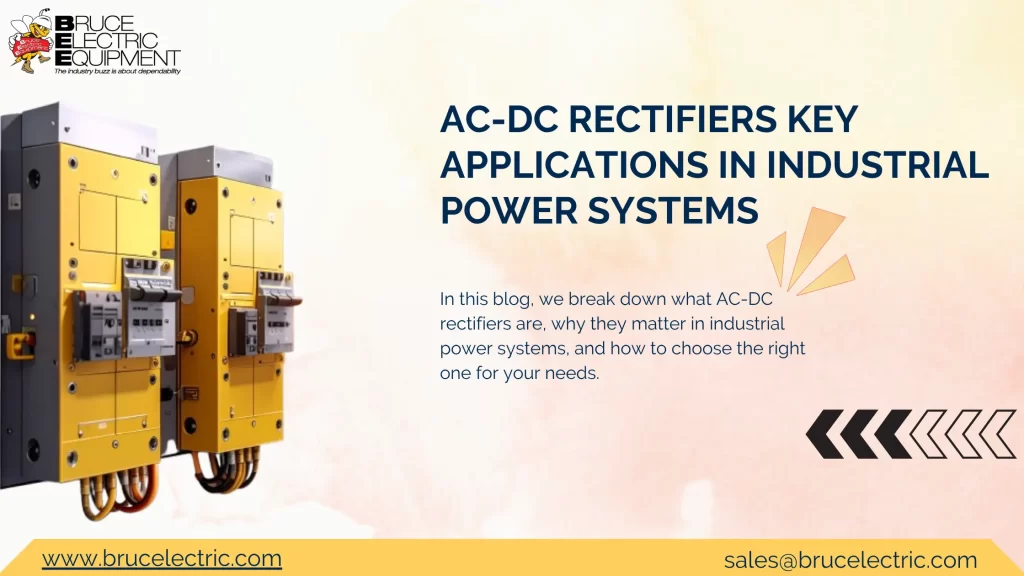
AC-DC rectifiers are critical components in industrial power systems, converting alternating current (AC) into stable direct current (DC) required for a wide range of applications. From battery charging systems and DC motor drives to electroplating and crane operations, rectifiers ensure reliable and efficient DC power supply.
At Bruce Electric Equipment Corp., we’ve provided industrial rectifiers and power solutions since 1973, helping facilities across the U.S. stay powered and productive. In this guide, we’ll explore how AC-DC rectifiers work, their key industrial applications, and important factors to consider when selecting the right rectifier for your system.
What Is an AC-DC Rectifier?
An AC-DC rectifier is an electronic device that converts alternating current (AC) which flows in both directions into direct current (DC), which flows in only one direction. This conversion is essential for any equipment that requires DC power to operate.
How Does an AC-DC Rectifier Work?
An AC-DC rectifier converts alternating current into direct current using semiconductor devices such as diodes or thyristors. During operation, the rectifier allows current to flow in only one direction, effectively transforming the AC waveform into a unidirectional DC output.
Depending on the configuration, rectifiers may produce pulsating DC, which is often filtered using capacitors or inductors to deliver a smoother and more stable DC supply for industrial equipment.
Where Are AC-DC Rectifiers Used in Industrial Power Systems?
Battery Charging Systems
Rectifiers are widely used in industrial battery charging systems to provide controlled and stable DC output. They help regulate voltage and current, ensuring safe charging, preventing overcharging, and extending battery life in backup power and UPS applications.
DC Motor Drives
In DC motor applications, rectifiers convert AC supply into DC power required for precise speed and torque control. These systems are commonly used in conveyors, rolling mills, and heavy machinery where consistent motor performance is critical.
Electroplating and Metal Processing
Rectifiers supply high-current, low-voltage DC power required for electroplating, anodizing, and metal finishing processes. Stable DC output is essential to achieve uniform coating thickness and high-quality surface finishes.
Crane and Hoist Operations
Industrial cranes and hoists rely on rectifiers to power DC drives that control lifting and movement operations. Reliable DC supply ensures smooth operation, load handling accuracy, and improved safety in heavy-duty environments.
Telecommunications and Data Centers
Rectifiers are used in telecom and data center power systems to convert AC to DC for powering critical communication equipment. They play a key role in maintaining uninterrupted operation and supporting battery backup systems.
Key Factors to Consider When Selecting an AC-DC Rectifier
Choosing the right rectifier depends on several technical and application-specific parameters:
- Output Voltage: Must match the required DC voltage of the load
- Current Rating (Amps): Should handle full-load and peak demand conditions
- Duty Cycle: Continuous vs intermittent operation impacts sizing
- Input Power Supply: Single-phase or three-phase compatibility
- Cooling Method: Air-cooled or oil-cooled depending on environment
- Application Type: Battery charging, motor drive, or process-specific use
Proper selection ensures efficiency, reliability, and long-term performance in industrial power systems.
Why Industrial Facilities Rely on AC-DC Rectifiers
– Ensures continuous operation of sensitive equipment.
– Supports fine-tuned motor and system control.
– Reduces energy loss during conversion.
– Available in various voltage and current ratings for large and small systems.
– Many rectifiers come with built-in surge protection, overload cutoff, and thermal safety.
Key Difference: AC-DC Rectifier vs. Inverter
While both rectifiers and inverters are used for power conversion, their direction of conversion is what sets them apart:
AC-DC Rectifier: Converts Alternating Current (AC) into Direct Current (DC).
➤ Used for DC-powered equipment, such as industrial motors, magnets, and battery charging systems.
DC-AC Inverter: Converts Direct Current (DC) into Alternating Current (AC).
➤ Commonly used in solar power systems or battery backups to feed AC-powered loads.
Why Choose Bruce Electric for AC-DC Rectifier Solutions?
Bruce Electric supplies high-quality electrical equipment for industrial and commercial applications, backed by decades of industry experience.
With 50+ years of experience and a vast 15,000 sq. ft. warehouse in Lindenhurst, NY, we offer:
- Wide inventory of new, used, and reconditioned equipment
- Tested and inspected for performance and reliability
- Warranty-backed equipment
- Fast availability for critical power applications
- – Buying used & surplus industrial equipment
Looking for reliable AC-DC rectifiers for your industrial application?
Bruce Electric offers tested and ready-to-ship electrical equipment, including solutions for battery systems, motor drives, and heavy-duty industrial operations.
Need help choosing a rectifier? Contact our team today or browse our inventory online.
Frequently Asked Questions (FAQs) for AC-DC Rectifiers
Q1) What’s the difference between a rectifier and an inverter?
A) A rectifier converts AC to DC, while an inverter converts DC to AC. Both are used in power conversion, but for opposite directions.
Q2) Are AC-DC rectifiers safe to use with sensitive equipment?
A) Modern rectifiers often include voltage regulators and surge protection to ensure stable power for sensitive loads like control systems or telecom equipment.
Q3) Can I use a used or reconditioned rectifier?
A) Absolutely if it’s properly tested and comes from a reliable source. At Bruce Electric, all reconditioned units are fully tested and covered by a warranty.
Q4) How do I know what size rectifier I need?
A) It depends on the voltage and current requirements of your equipment. Our team can help you calculate load requirements and recommend the right unit.
Q5) Do rectifiers need maintenance?
A) Regular inspection and cleaning can extend the lifespan. Some units may require periodic fuse or filter replacement depending on usage.