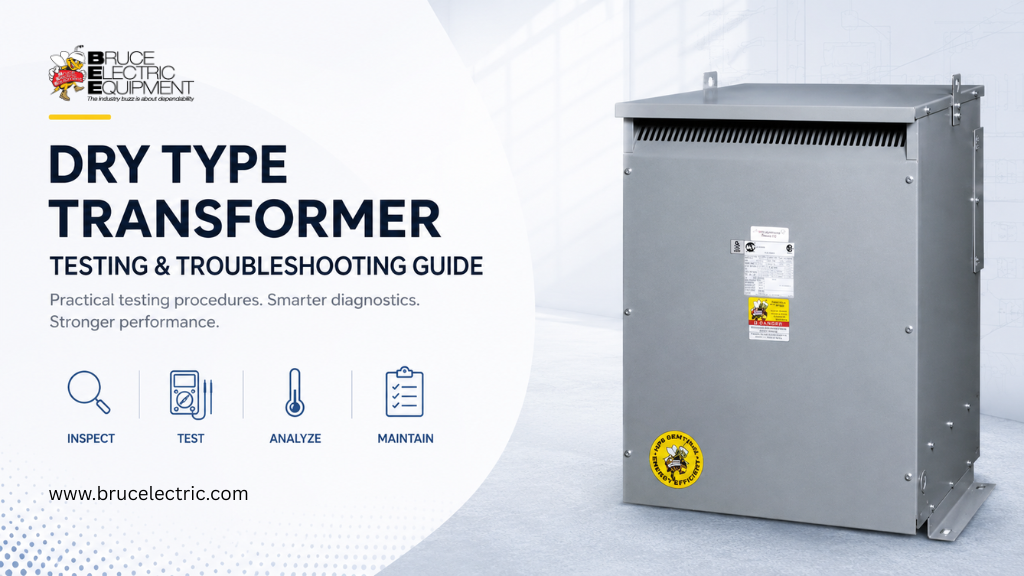
Dry Type Transformer Testing & Troubleshooting Guide

Dry type transformers are the workhorses of commercial and industrial power distribution, yet they rarely receive structured diagnostic attention until something fails. A manufacturing plant loses a production shift. A hospital runs on backup power. A data center experiences a voltage sag that corrupts a database. In nearly every case, early warning signs existed. They just weren’t identified in time.
Structured testing and troubleshooting protocols catch developing problems before they escalate into operational failures. This guide covers the tests that matter, how to interpret what they reveal, and how to work through the most common dry type transformer problems logically and efficiently.
Need a Dry Type Transformer? We Stock Up to 3,000 KVA.
Single phase, three phase, buck boost, and drive isolation transformers from GE, Acme, Hevi-Duty, Sola, and ABB. Standard and non-standard sizes ready for immediate shipment.
✔ Dry type specialists with complete in-house testing ✔ Step up, step down, and constant voltage models ✔ 2-year warranty on all transformer units
Common Signs of a Dry Type Transformer Problem
Recognizing early failure indicators is the foundation of any transformer diagnostics program. The following symptoms warrant immediate investigation:
• Persistent overheating – Operating temperatures consistently above nameplate ratings, especially under full load
• Unusual humming or buzzing – A shift from the normal 120 Hz hum, including rattling or sharpened tonal noise
• Burning odor – Indicates active insulation degradation or an internal hot spot
• Visible winding discoloration – Yellowing, browning, or charring of insulation materials
• Repeated upstream breaker trips – Protection responding to overcurrent or fault conditions
• Secondary voltage fluctuations – Unbalanced output suggesting winding or connection issues
• Thermal anomalies during infrared scanning – Localized temperature differentials inconsistent with load distribution
Any single symptom can escalate quickly. In facilities running continuous operations healthcare, semiconductor manufacturing, food processing even a brief unplanned outage carries significant cost. Don’t wait for a second symptom before acting on the first.
Essential Dry Type Transformer Tests
These four tests form the core of any credible transformer testing program. Each serves a distinct diagnostic purpose.
1. Visual Inspection
Purpose: Identify physical deterioration, environmental contamination, and installation deficiencies.
Inspect winding insulation for discoloration, cracking, or moisture exposure. Examine terminals and bus connections for corrosion and thermal stress. Check ventilation openings for dust and debris obstruction particularly critical in manufacturing environments with airborne particulates.
Insulation that has shifted from cream or tan to dark brown indicates thermal degradation. Blocked ventilation louvers are a direct path to overheating failure. Dust accumulation on dry type transformer windings restricts airflow and elevates operating temperatures, even when the blockage appears partial.
2. Insulation Resistance (Megger) Test
Purpose: Evaluate winding insulation condition by measuring resistance between windings and to ground.
Apply a calibrated DC test voltage typically 500V DC for low voltage units, 1000V DC or higher for medium voltage using a megohmmeter. Healthy transformers return readings in the hundreds of megohms. Values below 1 MΩ require immediate follow-up; below 100 kΩ indicates imminent failure risk.
Polarization Index (PI): Divide the 10-minute resistance reading by the 1-minute reading. A PI above 2.0 is generally acceptable. Below 1.0 signals deteriorated or moisture-contaminated insulation.
Declining trend readings across successive annual tests are more diagnostically significant than any single result. A unit reading 800 MΩ last year and 85 MΩ this year needs investigation regardless of where that number sits relative to the go/no-go threshold. IEEE and NETA MTS guidelines provide specific acceptance criteria by voltage class.
3. Winding Resistance Testing
Purpose: Detect open circuits, shorted turns, loose connections, and contact degradation.
Measure DC resistance across each winding phase using a calibrated winding resistance meter. Compare readings against manufacturer nameplate data and balance across phases. Phase-to-phase variance exceeding 1–2% warrants further investigation.
Elevated resistance on one phase relative to the others typically indicates a loose connection, corroded contact, or partial conductor failure. In three-phase transformer troubleshooting, winding resistance asymmetry is frequently the root cause of unexplained load imbalance and intermittent secondary voltage irregularities.
4. Infrared Thermography
Purpose: Identify thermal anomalies hot spots, overloaded phases, loose connections under operating load without de-energization.
Scan all accessible transformer surfaces with a calibrated thermal imaging camera under representative load conditions. Compare thermal patterns across phases and against prior baseline readings. Temperature differentials greater than 10–15°C between comparable components on different phases are abnormal. Localized hot spots at connection points indicate high-resistance contacts.
Facilities operating critical systems data centers, hospital distribution, continuous process manufacturing typically schedule annual thermal imaging inspections as a minimum. A single infrared scan can identify problems no amount of voltage or current monitoring would detect.
How to Troubleshoot a Dry Type Transformer
| Symptom | Likely Cause | Recommended Action |
|---|---|---|
| Overheating under normal load | Blocked ventilation, elevated ambient, harmonic loading | Clear ventilation paths; verify load vs. kVA rating; check for harmonic distortion |
| Overheating under high load | Transformer undersized for load growth | Audit actual load vs. nameplate; evaluate replacement if regularly above 80–90% capacity |
| Abnormal buzzing or rattling | Loose laminations, loose core bolts, vibration | Re-torque core bolts; inspect enclosure hardware; evaluate core integrity |
| High-pitched noise under load | Harmonic currents causing magnetostriction | Measure harmonic distortion; evaluate K-factor or harmonic mitigating transformer |
| Burning smell without visible damage | Early insulation degradation, developing hot spot | Immediate thermal scan; Megger test; do not defer |
| Breaker tripping on primary | Overload, inrush issue, or internal fault developing | Check load profile; verify protection settings; perform insulation resistance test |
| Phase voltage imbalance on secondary | Loose connection, failed tap, or winding damage | Winding resistance test across all phases; inspect tap changer and terminal lugs |
| Low insulation resistance reading | Moisture ingress, contamination, or aged insulation | Dry-out if moisture-related; track PI trend; evaluate replacement if thermally aged |
| Intermittent secondary voltage drops | Loose connection with thermal cycling | Torque all terminal connections; thermographic scan under load |
| Phase current imbalance | Unbalanced load, connection issue, or winding defect | Verify load balance; check winding resistance; inspect connection integrity |
Preventive Maintenance Best Practices
• Annual visual inspection – Covers insulation condition, terminal integrity, ventilation clearance, and physical damage
• Annual infrared thermography – Performed under representative load; establishes baseline and catches developing anomalies
• Insulation resistance testing every 1–3 years – Increase frequency with age and operational criticality
• Connection torque verification every 3–5 years – Thermal cycling loosens bolted connections; re-torquing prevents high-resistance hot spots
• Quarterly ventilation checks in dusty environments – Airborne particulates in manufacturing, woodworking, and cement facilities accumulate rapidly on winding surfaces
• Load monitoring – Track load growth over time; a transformer consistently running above 80% of nameplate kVA in a growing facility is a predictable future failure
In healthcare facilities and data centers, transformer maintenance is typically integrated into the broader electrical PM program and documented for compliance with NEC and facility standards.
When to Repair or Replace a Dry Type Transformer
Consider repair when:
• The transformer is under 15 years old with isolated damage to connections or tap changers
• Insulation resistance values remain above thresholds with stable or improving trends
• The unit can be removed from service without significant operational impact
Consider replacement when:
• Insulation resistance shows consistent multi-year decline
• The transformer has experienced repeated overheating each thermal excursion permanently degrades insulation life
• The unit is over 20–25 years old with limited or absent maintenance history
• The kVA rating no longer aligns with actual load requirements
• Repair costs approach 50% or more of replacement value
For older dry type transformers showing measurable insulation degradation, replacement is frequently more cost-effective than continued repair especially when factoring in the cost of an unplanned failure during critical operations. Reconditioned transformers from reputable suppliers can offer a practical intermediate option when new equipment lead times or budget constraints are a factor.
Bruce Electric maintains an extensive inventory of new and reconditioned dry type transformers from GE, ABB, Hammond Power Solutions, Acme, Jefferson Electric, and others available with warranty coverage and fast shipping across North America.
Frequently Asked Questions
Q1. How often should a dry type transformer be tested?
Annual visual inspection and thermal imaging represent the minimum. Insulation resistance testing should be performed every 1–3 years, with higher frequency for aging or operationally critical units.
Q2. What is a transformer Megger test?
A Megger test applies a DC voltage to a transformer’s windings to measure insulation resistance. It identifies moisture ingress, contamination, and insulation degradation before they progress to an in-service failure.
Q3. What causes dry type transformer overheating?
The most common causes are blocked ventilation, load above nameplate kVA rating, harmonic currents from non-linear loads, elevated ambient temperatures, and loose connections creating localized resistance heating. Identifying the root cause requires combining thermal imaging with load monitoring.
Q4. What does abnormal transformer noise indicate?
Changes from the normal operating hum rattling, buzzing, or high-pitched tones typically indicate loose laminations, loose core components, or harmonic-induced magnetostriction. High harmonic content from VFDs, UPS systems, or switching power supplies can significantly amplify noise and increase internal heating.
Q5. When should a transformer be replaced rather than repaired?
Replacement is the logical decision when insulation resistance shows a consistent declining trend, when the unit has experienced repeated overheating without corrected root cause, or when the transformer’s age and load profile make further repair investment economically unsound. In many facilities, measurable insulation deterioration in a unit over 20 years old is a stronger case for planned replacement than continued reactive maintenance.